Maximalist Home Decor: How to Master the More-Is-More Look
The first time you walk into a genuinely good maximalist room, the reaction is rarely “that’s a lot of stuff.” It’s usually closer to a held breath. Everywhere you look there is something to look at, and none of it feels random. A 1970s brass lamp sits beside a chipped Staffordshire dog. The walls are…
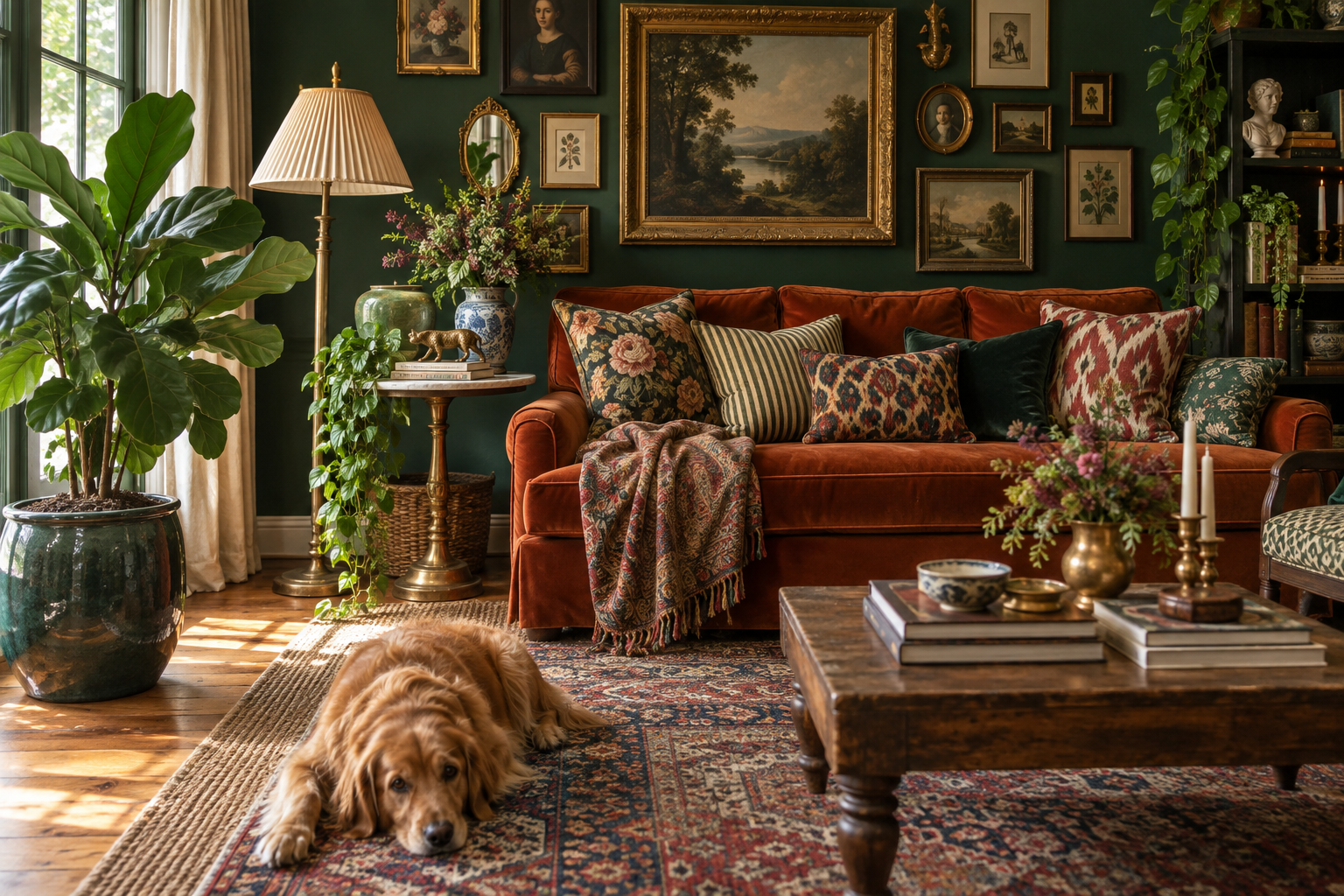
The first time you walk into a genuinely good maximalist room, the reaction is rarely “that’s a lot of stuff.” It’s usually closer to a held breath. Everywhere you look there is something to look at, and none of it feels random. A 1970s brass lamp sits beside a chipped Staffordshire dog. The walls are the colour of a pomegranate. Three different floral patterns share one sofa and somehow read as a family rather than a fight.
That effect is not accidental, and it is not the result of simply owning more things. Maximalism is a discipline with rules, they are just different rules from the ones most of us absorbed during the grey-and-beige decade. Rooms that go wrong go wrong for predictable reasons: no colour thread holding things together, patterns at identical scale, objects distributed evenly instead of in weighted groups, and no quiet zones for the eye to rest. Fix those four things and a crowded room turns into a rich one.
What follows is the working method. Not inspiration boards, but the actual sequence, measurements and judgement calls that make more-is-more look deliberate.
Maximalism Is Not Clutter, and It Is Not the Same as Eclectic Style
Maximalism is a decorating approach built on abundance with structure: saturated colour, layered pattern, dense displays and personal collections, all organised by a repeating colour palette and a deliberate visual hierarchy. Clutter is abundance without structure. The difference is not quantity. It is whether the eye is led or left to wander.
Think of it the way you’d think about a crowded room of people. A party has energy because there are groups, conversations, a rhythm to where people stand. A queue has the same number of bodies and none of the charm. Maximalist rooms are parties. Cluttered rooms are queues, or worse, a pile.
The style has deep roots. Victorian interiors were unapologetically dense, with pattern on pattern and every surface earning its keep. Dorothy Draper brought scale and high contrast to American interiors in the mid-century. Mario Buatta layered English chintz so thickly he earned a nickname for it. Tony Duquette built fantastical rooms from coral, abalone and salvage. More recently, designers like Kelly Wearstler and Luke Edward Hall have pulled the sensibility into a younger, stranger register. Iris Apfel made the case in her own wardrobe that restraint is not the only form of taste.
What’s the difference between eclectic and maximalist decor?
Eclectic describes the mix of sources: periods, styles and origins combined in one room. Maximalist describes the density and intensity: how much is present and how loud it is. A room can be eclectic and sparse, with three carefully chosen objects from three centuries against a white wall. A room can also be maximalist within a single style, like a fully committed Art Deco sitting room with nothing understated in it.
Most of the rooms people mean when they say maximalist are both at once, which is why the terms travel together. The practical upshot: eclecticism gives you permission to mix, maximalism gives you permission to fill. You need different tools for each. Mixing well is about finding relationships between unlike things. Filling well is about controlling density.
Start With a Colour Story Strong Enough to Carry the Weight
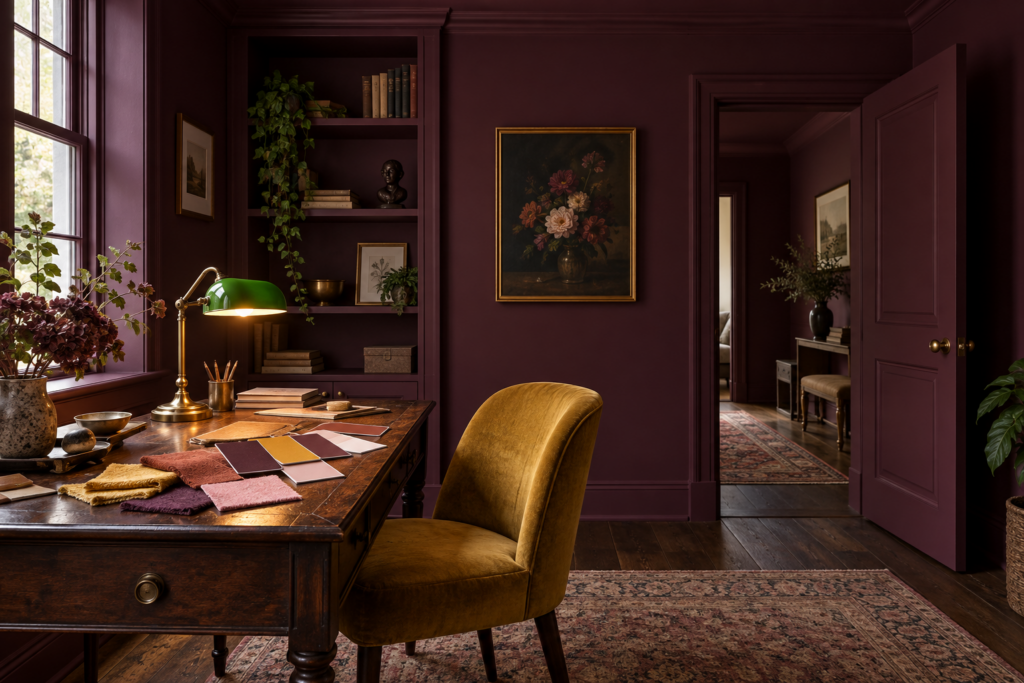
Colour does the structural work in a maximalist room. Before a single cushion is chosen, decide on a palette of roughly five to seven colours and commit to repeating each one at least three times around the space. That repetition is what makes a wildly varied room feel composed rather than accidental.
Three appearances is the working minimum. If a mustard yellow shows up once, in a single cushion, it reads as a mistake. If it shows up in a cushion, the spine of a book on the coffee table and a thin line inside a rug’s border, it reads as a choice. The eye connects the dots and interprets the whole room as planned.
The old 60-30-10 ratio (sixty percent dominant colour, thirty percent secondary, ten percent accent) is a decent starting scaffold, but maximalists tend to run something closer to 40-30-20-10, with two accent colours instead of one. The proportions matter less than the discipline of having proportions at all.
Colour drenching is the fastest route to a coherent maximalist shell. Paint walls, trim, skirting, door and sometimes the ceiling in the same shade, usually in a matte or eggshell finish for the walls and a slightly higher sheen for woodwork. Losing the contrast between wall and trim dissolves the room’s edges, which makes a small space feel larger and, more usefully here, gives you an unbroken backdrop against which a lot of busy objects can sit without the room feeling chopped into pieces.
Dark colours are not mandatory. Deep teal, oxblood, forest green and chocolate brown all work beautifully as maximalist envelopes, but so do hot coral, buttercup and a saturated sky blue. What matters is intensity, not darkness. Pale, chalky, low-chroma colours are the one genuine enemy of the look, because they cannot hold their own against layers of pattern and end up looking like a room that got interrupted halfway through.
Pay attention to undertone when combining. Warm reds fight cool pinks. A sage green with grey in it will make a clean emerald look dirty. Hold paint samples and fabric swatches against each other in daylight and again under lamplight at night, since artificial light shifts everything and maximalist rooms are usually most alive after dark.
Mixing Patterns So They Read as Deliberate
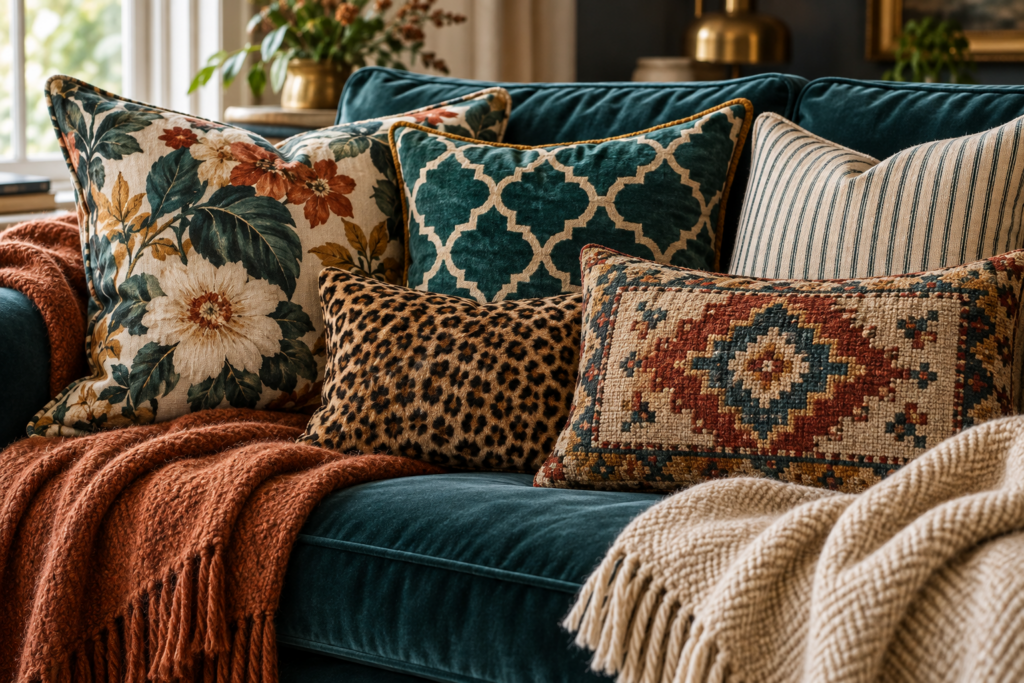
The single most reliable pattern-mixing formula is to vary scale while holding colour constant. Use one large-scale pattern, two medium ones and two or three small ones in the same palette. Different sizes stop the patterns competing for the same visual space, and shared colour tells the eye they belong to one another.
Scale is the part people get wrong. Three different florals at roughly the same size will vibrate unpleasantly, no matter how well their colours match. A large sprawling botanical, a medium geometric and a fine ticking stripe in the same three colours will sit together happily even though they have nothing else in common.
It helps to think in pattern families and then mix across them rather than within:
- Organic: florals, chintz, botanicals, William Morris style repeats, palm and leaf prints
- Geometric: stripes, checks, chevrons, trellis, Greek key
- Tribal and woven: ikat, suzani, kilim, block prints, tartan
- Abstract and painterly: watercolour washes, brushstroke prints, animal print treated as a neutral
A room with one from each family, tied by colour, almost always works. A room with four organics is a much harder trick.
Leopard print deserves a specific mention because it behaves like a neutral. Used in small doses, a leopard cushion, an ottoman, a lampshade or a stair runner, it will sit beside florals, stripes and solids without demanding attention. The same is true of a fine natural ticking stripe and of tortoiseshell as a material.
How do you stop a heavily patterned room from feeling busy?
Give the eye somewhere to rest. Every patterned room needs solid zones, and a rough target is that a third of the visible surface area stays quiet. That can be a plain velvet sofa, an expanse of drenched wall above the picture line, a solid-coloured rug field, or simply the floor.
Two practical tests catch problems early. First, photograph the room on your phone and convert the image to black and white. Stripping out colour exposes whether you have any tonal contrast, and busy-feeling rooms are almost always rooms where everything sits at the same mid-tone. Add something genuinely dark or genuinely light and the composition resolves. Second, stand in the doorway and ask where your eye goes first, second and third. If the answer is “nowhere in particular,” you have no focal point, and no amount of editing will fix that until something in the room is allowed to be the loudest thing.
Layering a Room, Step by Step
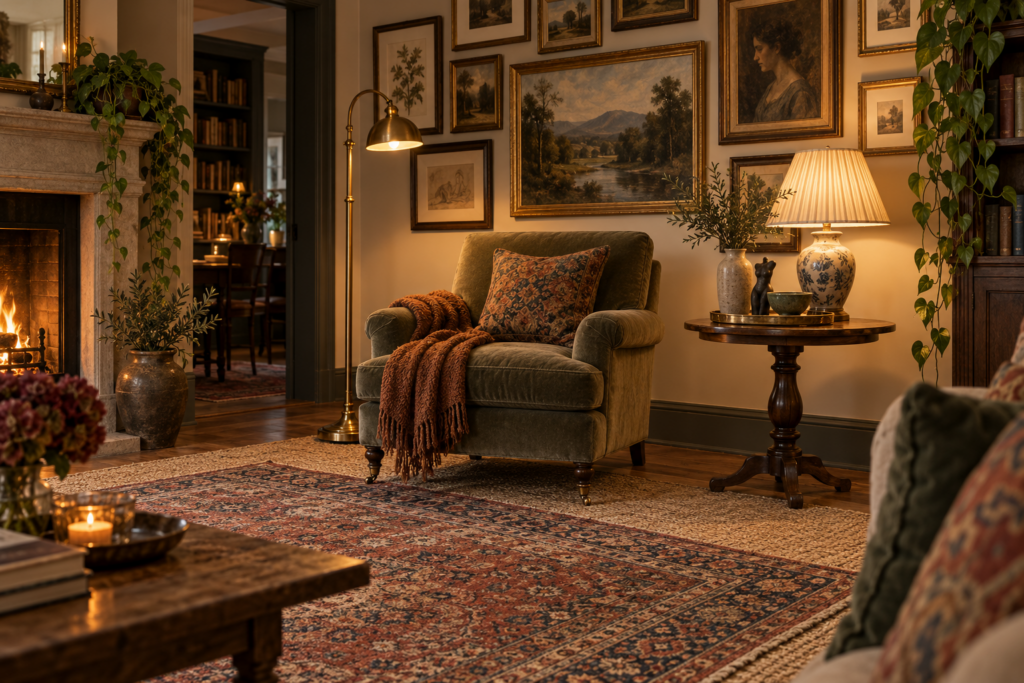
Maximalist rooms are built in a sequence, from the floor upwards and from the largest element to the smallest. Working out of order is why rooms stall halfway and end up looking unfinished rather than deliberately full.
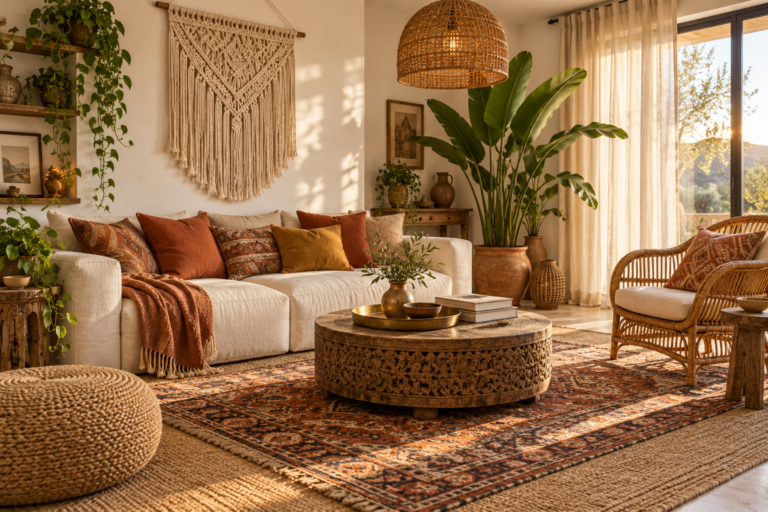
Rugs first. Size is the most common error. In a living room, the front legs of every seating piece should sit on the rug at minimum, and ideally all four legs. In a dining room, the rug needs to extend at least 60cm (24 inches) past the table edge on all sides so chairs stay on it when pulled out. Leave roughly 20 to 45cm of bare floor between the rug edge and the wall. Layering a smaller patterned rug over a larger natural-fibre one is a maximalist staple, and it also solves the problem of an antique rug that is beautiful but two sizes too small.
Large furniture next, positioned before anything decorative is considered. Pull seating off the walls if the room allows, even by 15cm. Floating furniture creates the pockets of depth that make dense rooms feel three-dimensional rather than like a shop display.
Lighting at three heights. This is the step that separates rooms that photograph well from rooms that feel good to sit in at nine at night. Aim for overhead, mid-level and low: a pendant or chandelier, table lamps at roughly seated eye level, and something at floor or low-table height like a floor lamp or picture light. Five or six light sources in a living room is normal for this style, all on warm bulbs, ideally all on dimmers. Overhead light alone flattens pattern and kills texture.
Then art. Standard hanging height puts the centre of a single picture at about 145cm (57 inches) from the floor, which matches average eye level. For a gallery wall, treat the whole arrangement as one unit and centre that unit at 145cm instead. Keep gaps between frames consistent, between 5 and 8cm (2 to 3 inches) works for most walls, and lay the entire arrangement out on the floor first. Cutting paper templates and taping them to the wall takes twenty minutes and saves a wall full of nail holes.
Textiles after art. Cushions in odd numbers, mixed sizes, mixed fabrics. Curtains hung high and wide, with the pole mounted close to the ceiling and extending past the window frame, makes windows look larger and gives the room vertical lift. Throws over chair arms and sofa backs add the softness that keeps dense rooms from feeling brittle.
Objects last, and in groups. Distribute objects in odd-numbered clusters that vary in height, and give each cluster a base that anchors it, a tray, a stack of books, a small mat. Three objects of different heights, one of which is roughly twice the height of the shortest, is the classic arrangement. Scattering single objects evenly across every surface is the fastest way to turn a collection into clutter.
Plants belong in this final layer too, and they do specific work. Trailing foliage softens hard corners of shelving. A tall plant fills the awkward vertical gap between a sofa arm and a window. Foliage also reads as a visual neutral, so it can break up two patterns that are sitting too close together.
Collecting Without Accumulating Junk
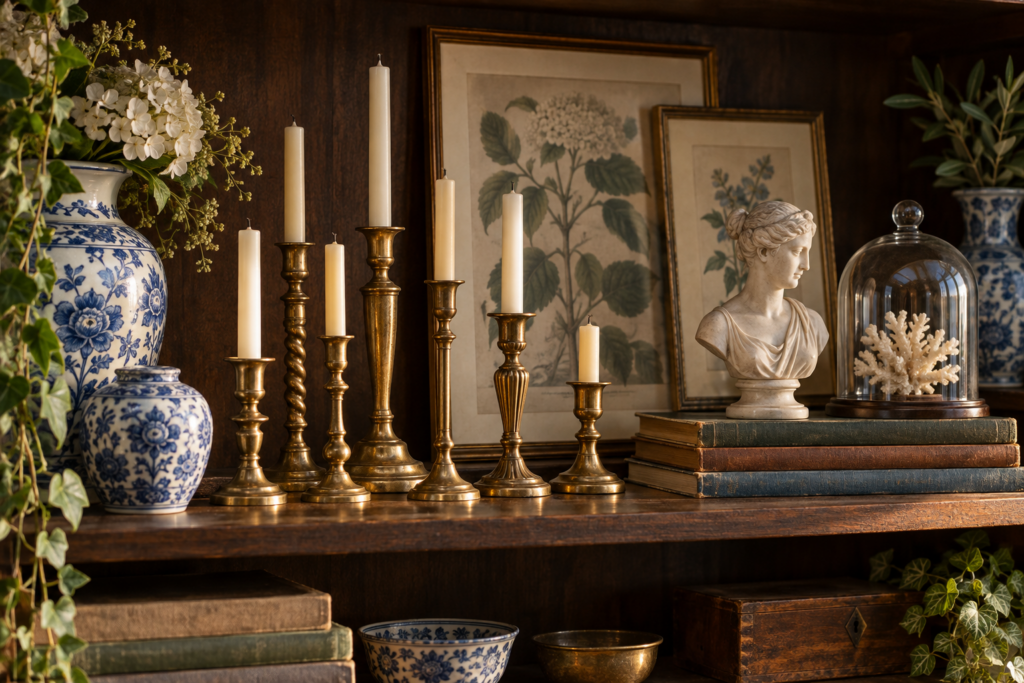
The heart of maximalism is the collection, and collections cannot be bought in an afternoon. The rooms that look effortless are usually ten years deep. The good news is that the sourcing is most of the pleasure, and it is where the style becomes genuinely personal rather than a reproduction of something seen online.
Where to look, roughly in order of value for effort:
Estate sales and house clearances produce the best material because entire households appear at once, usually complete with the odd specific objects nobody would think to stock. Activity tends to peak in spring and late summer. Arrive at opening for the best pieces or in the last hour of the final day for the discounts.
Auction houses, particularly small regional ones, sell brown furniture and mixed lots for very little because the market for large mahogany pieces remains soft. A general sale will often include unsold box lots of ceramics and frames that go for less than a single new cushion.
Charity shops and thrift stores reward frequency over strategy. Ten minutes weekly beats two hours monthly, because stock turns constantly. Frames, ceramics, brass, art books and glassware are the consistent wins.
Architectural salvage yards supply the pieces that make a room feel built rather than furnished: old doors used as headboards, corbels turned into shelf brackets, reclaimed mantelpieces, coloured glass.
Vintage textiles are where maximalist rooms get their soul. Kilim fragments become cushion covers. A worn quilt goes over the back of a sofa. Old grain sacks, embroidered linens and remnant lengths of good fabric from upholsterers’ ends all cost a fraction of new yardage.
The discipline that keeps collecting from becoming hoarding is editing. Frame things, including things that seem unworthy of framing, because a frame declares intent. Group like with like, since seven brass candlesticks together are a collection while seven scattered around the house are objects that need dusting. Keep a rotation box in storage and swap displays seasonally, which also gives you a natural excuse to change a room without buying anything. And buy things because a specific object is good, not because a shelf looks empty. Empty shelf space is survivable. A shelf filled with filler is not.
Can you do maximalism on a small budget?
Yes, and arguably better than with a large one. Maximalism runs on volume of interesting objects rather than a small number of expensive ones, which is exactly the shape of a secondhand budget.
Spend money where it shows structurally: paint, which transforms a room for the cost of a few tins, and lighting, where cheap fittings and cold bulbs are immediately obvious. Spend nothing on the rest until you find it. Cushion covers can be sewn from remnant fabric. A charity shop oil painting in an ugly frame becomes something else entirely in a gold one. Books, which most maximalist rooms need in quantity, cost almost nothing secondhand and provide colour, texture and height all at once.
Small Rooms, Rentals and the Spaces That Fight Back
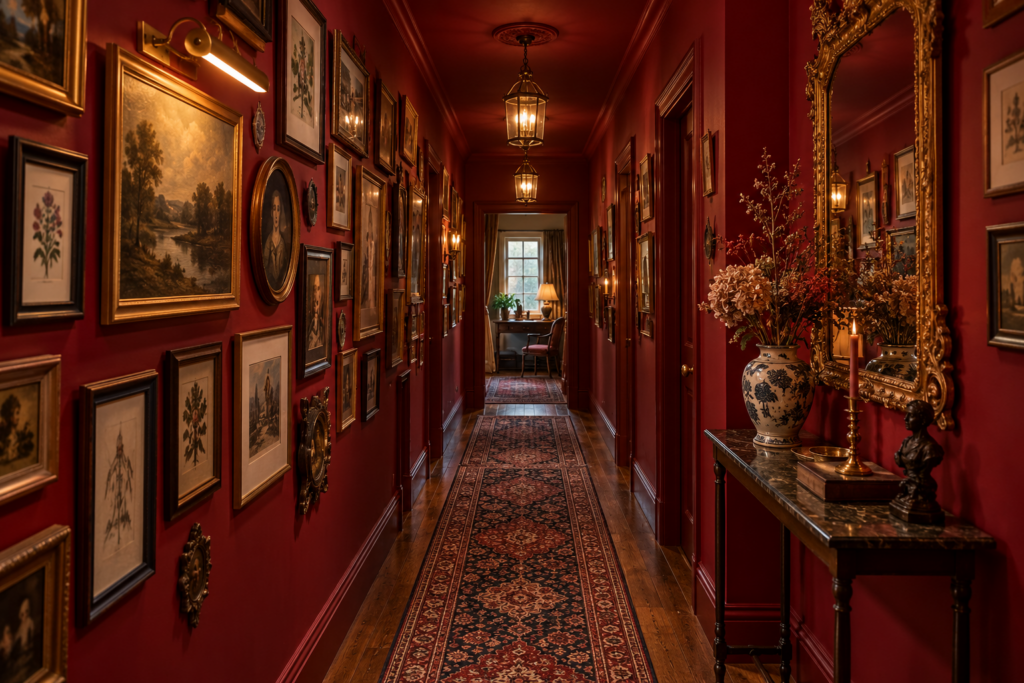
Small rooms are natural maximalist territory. A cloakroom, hallway or box room is too small to be anything other than a moment, so making that moment intense is the most efficient use of it. The conventional advice to keep small spaces pale is about making a room seem larger, but a dark, dense, jewel-box room stops the comparison entirely. Nobody enters a deep crimson powder room and thinks about square footage.
Hallways are the most underused space in most houses. Paint the whole thing including the ceiling, run a gallery wall the full length, add a runner and a picture light, and a corridor becomes a reason to slow down. Bathrooms take pattern remarkably well, though textiles and unglazed prints suffer in a room with poor ventilation, so favour framed prints under glass, ceramics and painted surfaces.
Rental-safe versions of nearly every technique exist. Removable wallpaper works on flat, well-prepared walls and comes off cleanly. Leaning art against the wall on a shelf, mantel or floor avoids drilling altogether. Plug-in wall sconces and clip lights give you the lighting layers without touching the electrics. Large rugs cover the beige carpet almost entirely. Freestanding bookcases, filled and styled, do the work of built-ins and travel with you.
Does maximalism make a small room feel smaller?
Not if the layering is vertical. Small rooms shrink when the middle band of the wall gets crowded and the upper half stays empty, which stops the eye at chest height. Run the pattern and the art all the way up, hang curtains near the ceiling, and use tall narrow furniture rather than low wide pieces.
Two other habits help. Keep the floor as clear as the style allows, since visible floor area reads as space even when every wall is busy. And use mirrors, ideally antique or ornately framed ones, which belong to the style anyway and double the apparent depth of a small room while reflecting lamplight around at night.
Where Rooms Go Wrong, and How to Fix Them
Most failed maximalist rooms suffer from one of a short list of problems, and each has a specific remedy.
Everything is the same tone. The room is full and somehow flat. Fix it by introducing genuine darks and lights, a black lampshade, a white ceramic, a deep-toned frame.
No focal point. The eye has nowhere to land. Choose one thing, an overscaled artwork, a painted fireplace, a bold sofa, and let it dominate. Something must win.
Even distribution. Objects spaced regularly across every surface looks like a display case. Cluster them, weight one end of a mantel more heavily than the other, and leave deliberate gaps.
Patterns all at one scale. Swap one item for something at a dramatically different scale and the whole arrangement settles.
Cheap lighting. A dense room under a single cold overhead bulb looks like a jumble sale. Warm bulbs, multiple sources, dimmers.
Nothing personal in it. A room assembled entirely from current shopping trends is maximalist in density and empty in meaning. The whole point of the style is that it holds evidence of a specific life. Photographs, inherited objects, holiday finds and the slightly odd thing you cannot justify to anyone else are what make a full room feel like yours rather than like a showroom.
Give a finished room a few weeks before judging it. Maximalist spaces settle. Things move, get swapped, find their positions. The rooms that look most assured are the ones that have been lived in long enough for their owners to stop arranging them and start using them.
Frequently Asked Questions
Is maximalism still in style?
Maximalism has been building steadily as a reaction to the long minimalist and grey-neutral period, and its appeal is less cyclical than it looks. Because the style is built around personal collections, inherited pieces and secondhand finds rather than a single seasonal look, a well-executed maximalist room ages differently from a trend-led one. It gets more convincing as more life accumulates in it.
Do maximalist rooms have to have dark walls?
Not at all. Dark envelopes are popular because they make bright objects and gilt frames sing, but intensity matters far more than darkness. Hot pink, saturated turquoise, buttercup yellow and rich terracotta all work as maximalist backdrops. Even white can work if the pattern and object density is high enough, though it is the hardest version to pull off because there is nothing holding the room together at the perimeter.
Can I go maximalist with the plain modern furniture I already own?
Yes, and plain furniture is genuinely useful here. Solid, simple sofas and tables function as the resting zones that a patterned room needs. Keep them and layer everything else around them: throws and cushions on the sofa, a runner and stacked books on the table, art above, lighting beside. A minimalist piece surrounded by abundance reads as a deliberate pause rather than a leftover.
What kind of flooring and rugs suit maximalist rooms best?
Warm wood, patterned tile, and anything with visible texture all work well, and the flooring itself can be a design event in a small room. Vintage Persian and Turkish rugs are the maximalist default because age has softened their colours into something that sits easily beside almost any palette. Layering a smaller patterned rug over a large jute or sisal base gives you pattern, scale and a practical fix for undersized antique rugs.
How do you keep a maximalist home from being a nightmare to clean?
Build in maintenance from the start. Use closed storage for the genuinely unphotogenic things so that what remains on display is there by choice. Choose glass-fronted cabinets for delicate collections, since they display and protect at once. Group objects on trays so an entire surface can be cleared and wiped in one movement. Accept that dusting takes longer, and reduce the frequency by keeping the most fragile groupings away from open windows and high-traffic paths.
Does maximalist decorating hurt resale value?
Paint colour and removable decor have almost no effect on valuation, since buyers price the building rather than the styling, and anything painted can be repainted in a weekend. Permanent changes are the ones worth thinking about, particularly bold tiling, wallpapered ceilings and built-in joinery in unusual colours. If a sale is likely within a year or two, keep the wild choices in paint and textiles and leave the fixed elements neutral.
Where should I start if I like the look but find it intimidating?
Start with one small, low-stakes room, a cloakroom, hallway, landing or spare bedroom. Pick a palette of five colours, paint the space fully including the woodwork, hang a gallery wall, and add two light sources. Small rooms can be completed in a weekend, they cost little, and finishing one teaches the density and layering instincts far faster than reading about them. Once a small room works, the method scales up without changing.