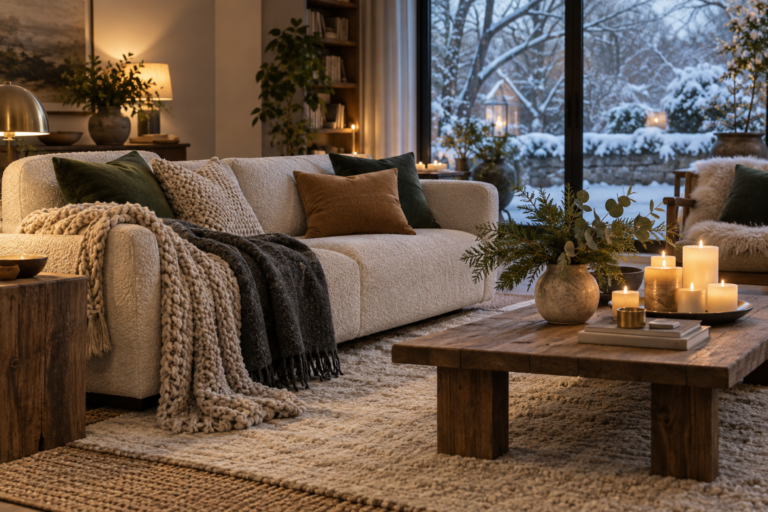
Budget-Friendly Home Decor: Cheap Accents That Look Expensive
Two rooms can contain almost exactly the same amount of money and look nothing alike. One reads as considered and calm. The other reads as a shopping trip. The difference is almost never the price tags. It is the materials, the finishes, the proportions and the restraint, and every one of those is available to someone spending very little.
What follows is the practical version of that idea. Not a list of bargains, because bargains change every season, but the specific signals the eye uses to judge quality, and how to buy for those signals rather than against them. Once you can tell why something looks cheap, shopping gets considerably easier and considerably less expensive.
Why Cheap Decor Reads as Cheap, and What Actually Signals Quality

The eye judges quality mostly through material, finish and weight. High-gloss plastic, printed faux wood grain, thin shiny polyester, visible moulded seams and objects that feel lighter than they look are what register as inexpensive. Matte surfaces, natural fibres, real texture, solid weight and generous scale read as expensive, regardless of what any of it cost.
Work through those signals one at a time and they become useful shopping filters.
Material honesty matters most. A plain stoneware vase costs very little and looks like what it is. A plastic vase printed to look like ceramic does not, because the light bounces off it differently and the seam line gives it away. The same logic applies to laminate printed as oak, or a moulded resin frame pretending to be carved wood. Simple real materials beat imitations of expensive ones every time, even when the imitation costs more.
Finish is the next filter. Matte and low-sheen surfaces almost always look more considered than high gloss in decorative objects. Gloss exaggerates any imperfection in the moulding and reflects light in a hard, uniform way that the brain associates with cheap production. Where you do want sheen, let it come from a material that naturally has it: glass, glazed ceramic, aged brass, polished stone.
Weight is a signal you can test in your hand before you buy. A candlestick, vase, bowl or lamp base with real heft feels resolved. Hollow lightness is why a large decorative object can look impressive online and disappointing in the room.
Scale is the most commonly missed signal of all. Small, timid pieces look inexpensive even when they are not. One large vase, one big piece of art and one generous rug will elevate a room that a dozen small accessories cannot. If a budget is limited, spend it on fewer and larger rather than more and smaller.
Finally, watch for what might be called the giveaway details: printed drop shadows on wall art, ornate mouldings in plastic, glued-on decoration, overly literal seasonal motifs, and anything with a slogan. All of these are inexpensive to produce and instantly readable as such.
Textiles: The Cheapest Upgrade That Looks the Most Expensive
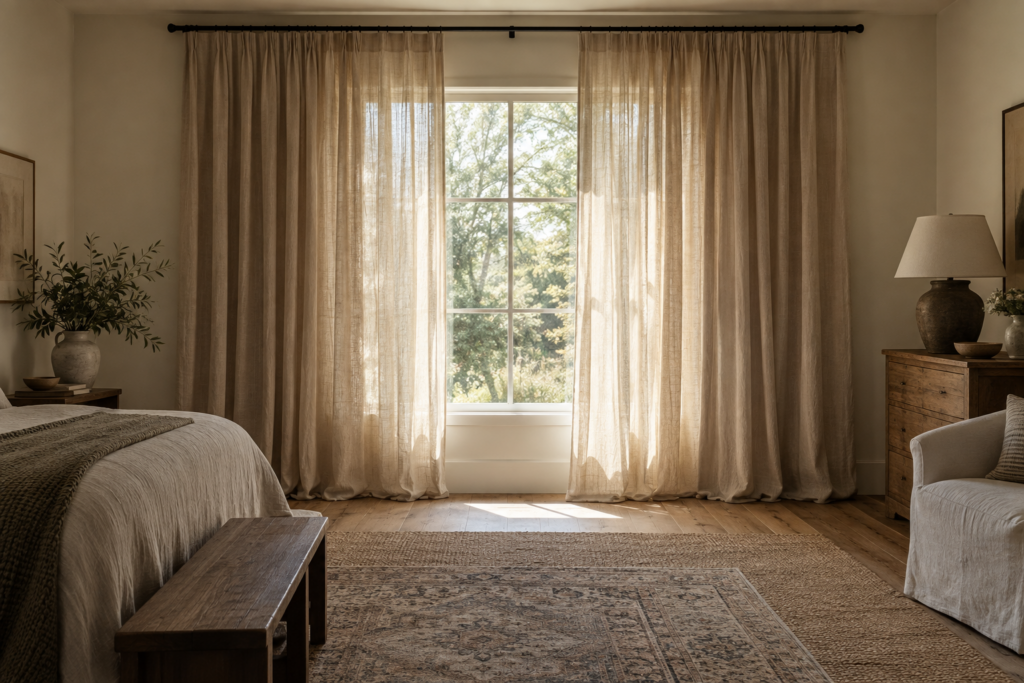
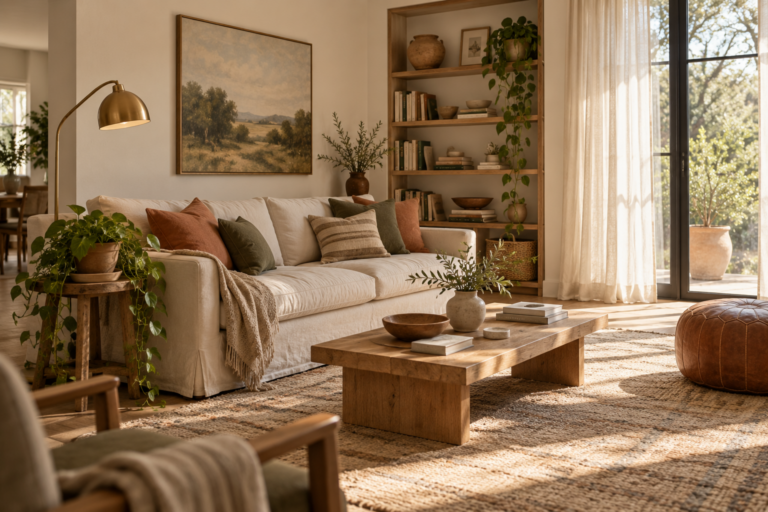
Textiles give the biggest return for the smallest spend. Choose natural fibres in plain weaves, buy cushion pads about two inches larger than their covers so they look full, hang curtains high and let them touch the floor, and layer a smaller rug over a large inexpensive natural-fibre one. These four moves change a room more than new furniture.
Fibre choice is the main thing. Cotton, linen, wool and jute all age visibly and take light softly. Shiny polyester and faux silk reflect light in a flat, hard way that gives them away across a room. Linen and cotton blends sit in a very affordable bracket and look considerably more expensive than their price, particularly in undyed, oatmeal and soft muted tones.
Cushions are where most people underspend on the pad and overspend on the cover, which is backwards. A limp cushion undermines the most beautiful fabric. Buy the pad generously oversized, use feather or a good quality fill if you can, and arrange in odd numbers with varied sizes and textures rather than matching pairs strung across the whole sofa.
Rugs are the largest textile in any room and the one people most often buy too small. A large natural-fibre rug in jute, sisal or seagrass costs far less per square foot than a wool one and makes an ideal base layer. Put a smaller patterned or softer rug on top of it where you want warmth, such as under a coffee table or beside a bed. You get the scale of an expensive rug for a fraction of the price.
Throws should have weight and a real edge. A waffle cotton, wool or chunky knit throw with a proper woven or fringed finish reads well. A thin fleece with a serged edge does not, no matter how nicely it is folded. One good throw, casually draped rather than folded into a neat rectangle, is enough.
How Do I Make Cheap Curtains Look Expensive?
Placement does more than fabric. Fix the pole 4 to 6 inches above the window frame, or higher still if the ceiling allows, and extend it 8 to 12 inches past each side so the curtains stack against the wall instead of covering the glass. Then get the length right: curtains should either just brush the floor or break very slightly on it. Short curtains ending above the sill are the single clearest sign of a rushed budget.
Beyond placement, buy wider panels than you think you need so the fabric gathers generously rather than hanging flat, choose plain natural fabrics over printed shiny ones, add a simple lining or a separate blackout layer for weight and drape, and steam or press them before hanging. Inexpensive cotton or canvas panels treated this way outperform pricier curtains hung badly.
Dyeing is worth remembering here too. Faded natural-fibre curtains, cushion covers and cotton rugs can be taken to a deeper, more current shade in a washing machine dye. Synthetics take dye unevenly, so check the fibre content first.
Art and Framing Without the Gallery Prices

Framing is where inexpensive art becomes expensive-looking art. Go larger than feels comfortable, use a wide mount inside the frame so a generous border surrounds the image, keep frames simple and consistent, and hang so the centre sits at eye level, around 57 to 60 inches from the floor. Scale and mounting matter far more than the artwork’s origin.
Wide mounts are the cheapest professional trick available. A modest print floated inside a deep border reads as a gallery piece, while the same print pushed to the edges of a thin frame reads as a poster. Having mounts cut to size is inexpensive, and it lets you put a small image into a much larger frame, which solves scale and impact at once.
Sources for the art itself are everywhere once you stop looking in the art aisle. Your own photographs printed large by a local print shop. Vintage botanical or architectural plates from old books found secondhand. A length of interesting fabric stretched over a frame. Pressed ferns or grasses from the garden mounted on neutral card. Exhibition posters, old maps, sheet music, textile offcuts. Anything with real texture or real age tends to photograph and hang better than mass-produced canvas prints.
Frames themselves are best bought secondhand and unified. Charity shops and marketplace listings are full of solid wood frames in mismatched finishes for very little. Spray painting a mixed collection in one consistent colour turns a jumble into a deliberate set, and the result costs a fraction of new framing while looking considerably better than budget frames from a box.
One large piece almost always beats a scattering of small ones. If you do want a group, plan it on the floor first, cut paper templates to test the arrangement on the wall, keep consistent gaps of around 2 to 3 inches, and treat the whole cluster as a single rectangle centred at eye level.
Lighting, Hardware and Metal Finishes

Three inexpensive changes lift a room noticeably: replace bulbs with warm dimmable ones in the region of 2700K, swap tired lampshades for plain fabric or paper ones, and unify the metal finishes visible in the room. Handles, curtain poles, hooks, light fittings and switch plates that agree with each other read as designed, and none of that costs much.
Bulbs come first because they are the cheapest item in the house and affect everything else in it. Cool bright light flattens colour and makes inexpensive furnishings look worse than they are. Warm light with a high colour rendering index flatters wood, fabric and skin. Keep the temperature consistent within a single room, since a cool ceiling bulb over warm lamps is the sort of mismatch nobody names but everybody senses.
Add a plug-in dimmer to a main lamp if the fitting allows. Dimmed lighting from several low sources is the single most reliable way to make an ordinary room feel expensive after dark.
Lampshades transform lamps. A dated or shiny shade on a decent base drags the whole thing down, while a plain linen or paper shade in a simple drum or empire shape does the opposite. Thrifted lamp bases in ceramic, glass or brass are widely available and often beautiful, and a new shade turns them into something that looks bought from a design shop.
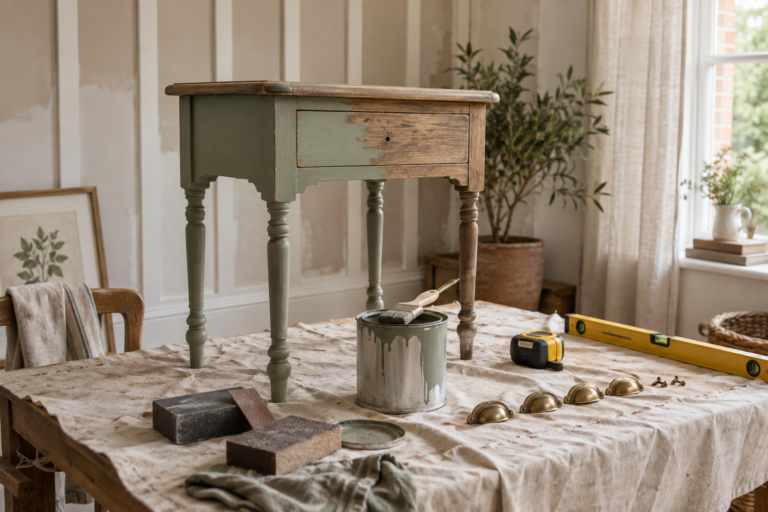
Hardware is the most overlooked cheap upgrade in any home. Replacing plastic or dated handles on cabinets, wardrobes and flat-pack furniture with solid metal ones changes how the whole piece is read. Before ordering, measure the distance between the centres of the existing screw holes, since common spacings vary and a mismatch means filling and drilling. Painted-over switch plates and sockets, and cheap white curtain poles, are similarly easy fixes that most people never think to make.
Does Mixing Metal Finishes Look Cheap?
Mixing metals looks deliberate when it is limited and repeated, and accidental when it is random. A workable approach is to choose one dominant metal for the room, usually whatever appears on the largest or most permanent items, then allow one secondary metal that shows up at least twice so it reads as a choice. Brass with black, or chrome with brushed nickel, both work on that basis. What looks unconsidered is four different finishes appearing once each, which is exactly what happens when hardware, lighting and accessories are bought separately over time without a rule. Fixing this often costs nothing more than spray paint on a curtain pole or a set of hooks.
Fewer, Better Objects: Vases, Ceramics, Trays and Styling

Styling is subtraction more than addition. Group objects in odd numbers at varied heights, leave at least a third of every surface empty, corral small items on a tray or a stack of books, and choose a few substantial pieces over many small ones. An under-styled surface looks calm and expensive. A crowded one looks like a market stall.
Certain object categories punch far above their price. Plain stoneware and glazed ceramic vessels. Clear or smoked glass. Thrifted brass candlesticks and bowls. Wooden boards and bowls with visible grain. Woven baskets in seagrass or rattan, which hide clutter and add texture at the same time. A heavy tray, in wood, rattan or metal, which makes any collection of small items look intentional.
Flowers and greenery are the cheapest luxury available and the one that changes most often. A few tall stems in a heavy vase look better than a supermarket bouquet arranged as it came. Single-variety bunches read as expensive; mixed bouquets with filler read as inexpensive. Eucalyptus, ruscus and similar foliage last for weeks and dry gracefully. Branches cut from the garden, bare in winter and in blossom in spring, cost nothing and fill a corner that furniture cannot.
Books deserve a mention, since they are close to free secondhand and do real styling work. Stacks of hardbacks with the covers removed, showing plain cloth bindings, give you height variation, texture and colour in one object. Use them as plinths under vases and lamps.
The discipline that ties this together is editing. When a room feels like it needs something, the answer is more often to remove three things than to buy a fourth. Put a portion of your accessories away in a box, rotate them seasonally, and the room will feel refreshed several times a year without any further spending.
Where to Find It: Secondhand, End-of-Line and Timing
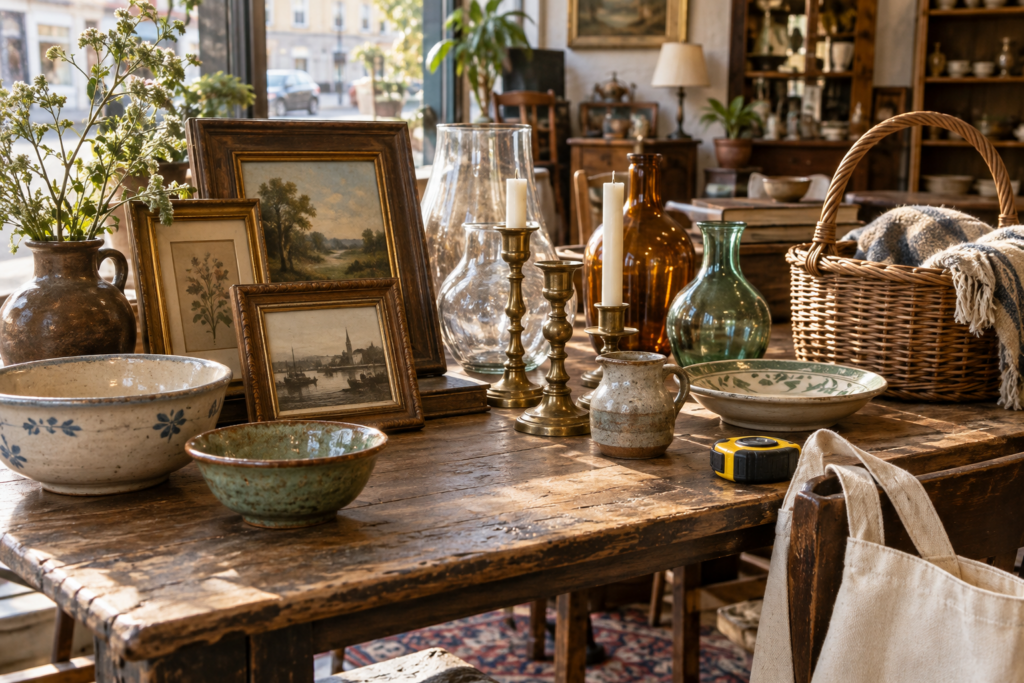
The cheapest high-quality decor is almost always secondhand or end-of-season. Charity shops, marketplace listings, car boot sales and local auctions carry solid wood, brass, glass and framed art at a fraction of new prices. Retail clearance in the weeks after Christmas and at the turn of each season is where new pieces drop most sharply.
Shopping secondhand works best with a short list and a tape measure. Go looking for categories rather than specific items: a heavy vase, a brass lamp base, wooden frames, a wicker basket, a wooden stool, a mirror. Keep the dimensions of your rooms and the measurements of key gaps in your phone, since the most common regret is a piece that was perfect and two inches too wide.
Auctions and estate sales are worth learning if you have patience. Older furniture and objects often sell below the price of new equivalents simply because the styles are out of fashion, and solid timber, brass and glass respond extremely well to cleaning, waxing or painting.
What Is Worth Buying Secondhand, and What Isn’t?
Good secondhand buys include solid wood furniture, picture frames, mirrors, lamps and lamp bases, ceramics and glassware, brass and metal objects, baskets, wooden boards and bowls, books, and art. These are durable, easy to clean or refinish, and rarely carry hidden problems.
Be more cautious with upholstered furniture, which can carry odours or pests and is expensive to reupholster, with mattresses, which are best bought new for hygiene reasons, with flat-pack pieces, which rarely survive a second assembly, and with anything electrical where the wiring or plug looks old or damaged. For cushions and soft items, check whether covers are removable and washable before committing.
Timing applies to new purchases too. Retailers discount seasonal ranges hard once the season turns, so the best prices on cushions, throws, candles and table linen appear in the weeks after major holidays and at the end of summer. End-of-line and discontinued colours are frequently the same product at a substantial reduction. Buying slightly out of step with the calendar is one of the simplest ways to spend less without compromising on anything at all.
Frequently Asked Questions
What actually makes cheap decor look expensive?
Material, finish, weight and scale. Natural fibres, real ceramic, glass, wood and metal look expensive because they behave like themselves under light. Matte finishes hide imperfections that gloss exaggerates. Objects with genuine weight feel resolved in the hand and in the room. And generous scale, meaning one large piece rather than several small ones, reads as confident rather than cautious.
Which budget accents give the biggest impact for the least money?
Warm dimmable bulbs, a plain new lampshade, generously filled cushions in natural fabrics, curtains hung high and wide, a large natural-fibre rug, and one oversized piece of art in a simple wide-mounted frame. Together these cost a modest amount and change a room more visibly than replacing any single item of furniture.
Is it cheaper to decorate with secondhand pieces?
Usually, and often with better materials. Solid wood, brass, glass and real ceramic appear constantly in charity shops, marketplace listings and auctions at prices below new mass-produced equivalents made from cheaper materials. The trade-off is time and patience rather than money, and the pieces you find tend to be more individual than anything bought new.
What colours make a room look more expensive?
Muted, slightly complex shades generally look more considered than bright, flat ones. Warm neutrals, soft earth tones, deep greens and browns, and off-whites with a visible undertone all read as deliberate. Keeping contrast low between walls, ceiling and trim also makes a room feel calmer and larger, which the eye associates with expense.
How can I make a cheap sofa look better without replacing it?
Change everything around and on it. Add a well-fitted cover or throw in a natural fabric, replace the original cushions with generously oversized pads in linen or cotton, anchor the sofa on a larger rug so it looks properly scaled, and put a decent lamp beside it. If the sofa has visible plastic or dated legs, swapping them for simple wooden ones is inexpensive and surprisingly effective.
Should all my metal finishes match?
They do not need to match, but they should look chosen. Pick one dominant finish for the room and allow a single secondary finish that repeats at least twice, so it reads as intentional. What looks unplanned is several different finishes each appearing once, which is the usual result of buying hardware, lighting and accessories separately over several years.
How many objects should go on a shelf or coffee table?
Fewer than instinct suggests. Group items in threes at different heights, leave at least a third of the surface empty, and use a tray or a stack of books to gather anything small. On a coffee table, a tray, one object with height and one low object is usually enough. Shelves benefit from mixing books laid flat and upright with occasional empty space between groupings.
When is the best time of year to buy home decor cheaply?
The weeks immediately after Christmas and the changeover points between seasons are when retailers discount most sharply, particularly on cushions, throws, candles, table linen and seasonal accessories. End-of-line and discontinued colours are reduced throughout the year and are usually identical in quality. Secondhand supply also rises in spring and around common moving periods, when people clear out homes.