Shade Garden Ideas: Best Plants for Low-Light Areas
Every garden has that one spot. The corner under the big maple where grass thins out every summer, the narrow strip along the north side of the house, the bed beside the fence that never seems to see the sun. Most people treat these areas as problems to cover with bark and forget about. They’re…
Every garden has that one spot. The corner under the big maple where grass thins out every summer, the narrow strip along the north side of the house, the bed beside the fence that never seems to see the sun. Most people treat these areas as problems to cover with bark and forget about.
They’re actually some of the most interesting places to garden. Shade suits a huge range of plants with bold leaves, delicate flowers, and textures that would scorch in full sun. A well-planted shady corner stays cool and green through the hottest weeks of summer, needs less watering than a sunny border, and has a calm, layered look that’s hard to create anywhere else.
The key is understanding what kind of shade you’re working with, since it varies more than most people realize. This guide explains how to read the light in your garden, which plants thrive in each type of shade, how to add color through the seasons, how to deal with tricky spots under trees, and how to design a shade garden that looks deliberate rather than leftover.
Understanding the Shade in Your Garden
“Shade” on a plant label covers a wide range of conditions, and choosing the right plants starts with knowing exactly how much light a spot receives, when it receives it, and how moist the soil stays.
What Counts as Full Shade vs Partial Shade?
Full shade means an area gets fewer than three hours of direct sun a day. Partial shade (often labeled part shade or part sun) means roughly three to six hours of direct sun, ideally in the morning. Dappled shade is filtered light passing through a tree canopy for much of the day. Deep shade receives almost no direct light at all.
Each type suits different plants:
- Partial shade is the easiest and most versatile. Many plants sold for sun will grow here, and nearly all shade plants thrive. Morning sun with afternoon shade is ideal for hydrangeas, heuchera, astilbe, and hostas.
- Dappled shade under open-canopied trees such as birch, honey locust, or thinned oaks suits woodland plants perfectly. The moving patches of light support a surprising variety of flowers.
- Full shade narrows the choices but still supports ferns, hostas, hellebores, and many groundcovers.
- Deep shade, such as under dense evergreens or between buildings, is the most challenging. Only the toughest foliage plants manage here.
Timing Matters as Much as Hours
Four hours of morning sun and four hours of afternoon sun are not equal. Morning light is cooler and gentler, while afternoon sun in summer is intense and can scorch the leaves of shade-loving plants even if the total hours seem modest. A west-facing spot that looks shady for most of the day may still burn a hosta.
Map Your Light Before You Plant
The most reliable way to understand your shade is to watch it. On a clear day in late spring or early summer, when trees are in full leaf, check the area every hour or two and note when it’s in direct sun. A quick sketch or a few phone photos taken at different times makes it easy to track.
Remember that shade changes through the year. An area under deciduous trees may be bright in early spring before leaves emerge, then shaded all summer. The sun also sits lower in winter, so buildings cast longer shadows. In the Northern Hemisphere, spaces along north-facing walls and fences receive the least direct light, while south-facing spots receive the most.
Dry Shade vs Moist Shade
The second factor that shapes a shade garden is moisture. Moist shade, such as a low-lying area or a spot along a north wall that stays damp, suits ferns, astilbe, and hostas beautifully. Dry shade, most common beneath large trees whose roots take up much of the water, or under eaves where rain doesn’t reach, is far more demanding and needs plants specifically suited to it.
Best Plants for Shade: Perennials, Ferns, and Groundcovers
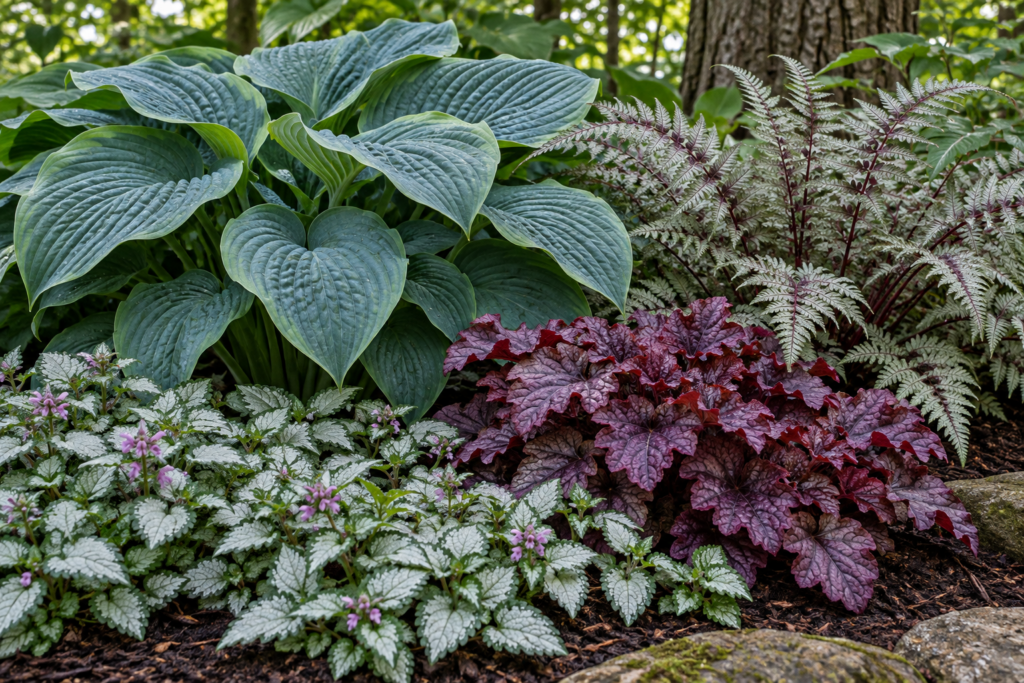
Perennials form the backbone of most shade gardens. Many are grown more for their foliage than their flowers, and because leaves last all season, a shade garden built around foliage looks good for months rather than weeks.
Reliable Shade Perennials
Hostas are the classic shade plant for good reason. They come in a huge range of sizes, from tiny mounds a few inches across to giants several feet wide, with leaves in blue, green, gold, and variegated patterns. They’re easy and long-lived, though slugs and deer are both fond of them.
Heuchera (coral bells) offers foliage in purple, burgundy, lime, amber, and silver, with airy flower spikes in early summer. It suits part shade and grows well at the front of beds and in containers.
Astilbe produces feathery plumes of pink, red, white, or lavender flowers in early to midsummer. It needs consistently moist soil and quickly turns crispy in dry shade.
Hellebores (Lenten roses) bloom in late winter and early spring, when little else is flowering, with nodding flowers in white, pink, plum, and near-black. Their leathery leaves are evergreen in many climates.
Brunnera has heart-shaped leaves, some with striking silver patterns, and sprays of tiny blue flowers in spring that look similar to forget-me-nots.
Pulmonaria (lungwort) combines spotted, silver-flecked leaves with spring flowers that often shift from pink to blue as they age.
Bleeding heart has arching stems of heart-shaped pink or white flowers in spring. The common type often dies back by midsummer, so plant it near later-growing perennials that fill the gap.
Solomon’s seal produces elegant arching stems with small white bell-shaped flowers dangling beneath. It spreads slowly and suits woodland settings.
Japanese forest grass forms cascading mounds of fine, grass-like leaves. The gold and variegated forms light up part shade.
Foxgloves, usually grown as biennials, add tall spires of flowers in part shade and often self-seed.
Ferns
Ferns bring fine, lacy texture that contrasts beautifully with broad-leaved plants like hostas. A few widely grown types:
- Japanese painted fern has silvery fronds with burgundy stems, one of the most colorful ferns available.
- Lady fern is delicate and bright green, best in moist shade.
- Ostrich fern grows tall and upright, forming vase-shaped clumps that spread in moist soil.
- Christmas fern is evergreen in many climates and tolerates drier conditions than most.
- Male fern is tough and adaptable, and handles dry shade once established.
Groundcovers
Groundcovers carpet the soil, suppress weeds, and tie a shade garden together visually. Good options include ajuga, with glossy purple or bronze leaves and blue flower spikes; lamium, with silver-marked leaves; sweet woodruff, with fine whorled leaves and tiny white spring flowers; foamflower (tiarella), with frothy white or pink flower spikes; wild ginger, with rounded, glossy leaves; and epimedium, with delicate spring flowers and tough, heart-shaped leaves.
Some familiar shade groundcovers, including English ivy and periwinkle (vinca), spread aggressively and are considered invasive in parts of North America. Check local guidance before planting them, and choose well-behaved alternatives where they’re a problem.
What Are the Best Plants for Dry Shade?
The best plants for dry shade include epimedium, hellebores, Solomon’s seal, male fern, bigroot geranium (Geranium macrorrhizum), lamium, liriope, and mondo grass. Once established, these tolerate root competition and limited water better than most shade plants. They still need regular watering through their first year while their roots settle in.
Dry shade is the hardest condition in the garden, so choosing tough plants is only part of the solution. Adding plenty of compost or leaf mold when planting, mulching every year, and watering during long dry spells all make a significant difference. Avoid moisture lovers such as astilbe, ligularia, and ostrich fern in these spots, as they will struggle every summer.
Shrubs, Bulbs, and Annuals for Seasonal Color
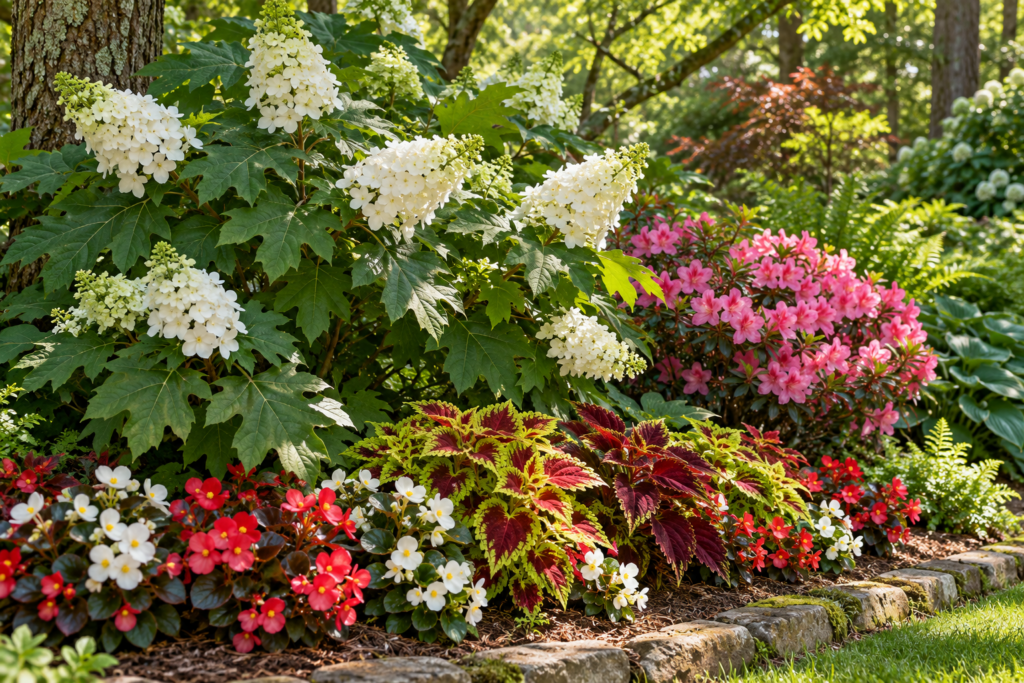
Perennials and ferns provide the structure, but shrubs, bulbs, and annuals extend the season and add color that foliage alone can’t match.
Shrubs for Shade
Shrubs give a shade garden height and year-round shape. Several of the most popular flowering shrubs actually prefer some shade:
- Hydrangeas. Oakleaf hydrangea tolerates more shade than most types and adds rich autumn leaf color. Smooth hydrangea handles part shade well. Bigleaf hydrangea flowers best with morning sun and afternoon shade.
- Rhododendrons and azaleas thrive in dappled shade and acidic, moist, well-drained soil, with spectacular spring flowers.
- Camellias bloom in winter or early spring in mild climates and prefer protection from hot afternoon sun.
- Pieris has glossy evergreen leaves, drooping clusters of white or pink flowers, and bright red new growth in many varieties.
- Mahonia offers spiky evergreen leaves and yellow winter flowers that attract early pollinators.
- Sweet box (sarcococca) is a low evergreen shrub with tiny winter flowers and a remarkable fragrance for its size.
- Japanese maples often grow best in light or part shade, which protects their delicate leaves from scorching.
Spring Bulbs and Woodland Ephemerals
Areas beneath deciduous trees receive plenty of light in early spring before the canopy leafs out. Many bulbs and woodland plants take advantage of this window, flowering and growing quickly before summer shade arrives.
Snowdrops, winter aconites, crocuses, scilla, and wood anemones all naturalize under trees. Daffodils do well in dappled shade. Native woodland wildflowers such as trillium, Virginia bluebells, and bloodroot are beautiful choices in suitable regions; buy them from nurseries that propagate their own stock rather than collecting from the wild. In some areas, Spanish bluebells spread aggressively and cross with native bluebells, so they’re best avoided where that’s a concern.
Plant bulbs in autumn, tucking them among perennials so the emerging hosta and fern leaves hide the fading bulb foliage in late spring.
Annuals for Shade
Annuals give continuous color through summer and are ideal for filling gaps, edging paths, and planting containers on shaded porches:
- Begonias flower for months in shade, with both flowering and foliage types available.
- Impatiens are long-flowering classics. The common bedding type has been affected by a downy mildew disease in many areas, but New Guinea impatiens and newer disease-resistant varieties are good alternatives.
- Coleus is grown for its vivid foliage in combinations of red, pink, lime, purple, and cream.
- Caladiums have large, heart-shaped leaves splashed with pink, red, and white, and thrive in warm, humid shade.
- Torenia (wishbone flower) produces small, snapdragon-like flowers and trails nicely over pot edges.
- Fuchsias bloom freely with dangling flowers and suit hanging baskets in part shade.
What Flowers Bloom in Full Shade?
Several flowers bloom reliably in full shade, including hellebores, bleeding heart, astilbe (in moist soil), foamflower, brunnera, pulmonaria, begonias, and impatiens. Hostas also produce flower spikes in summer. Most shade flowers bloom most heavily in spring, so plan foliage contrast and a few shade annuals to carry color into summer.
Expect somewhat fewer flowers in full shade than in part shade, even with shade-tolerant plants. If flowering matters most in a particular spot, look for ways to increase light, such as raising the tree canopy, which is covered in the next sections.
Shade Garden Design Ideas
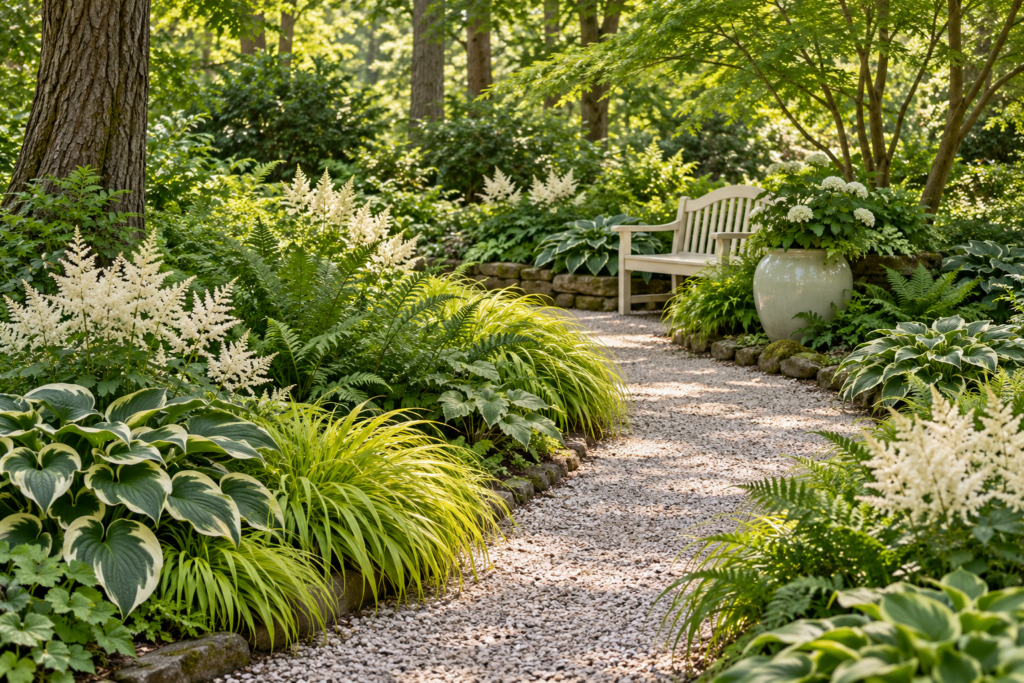
A shade garden succeeds or fails on design more than on any single plant. Without bright flowers to carry the planting, contrast, color, and structure do most of the work.
How Can I Brighten Up a Shady Garden?
To brighten a shady garden, use plants with white flowers and pale foliage, such as silver-patterned brunnera, variegated hostas, gold Japanese forest grass, and white astilbe or impatiens. These reflect the limited light and stand out against dark green. Pale gravel paths, light-colored containers, and white or cream garden furniture add further brightness.
Chartreuse and lime foliage is especially effective. Golden hostas, lime heuchera, and yellow-leaved grasses glow in low light and pair well with deep purple or blue-green leaves for dramatic contrast. Dark colors such as deep red and purple flowers tend to disappear in shade unless placed against a pale backdrop.
Contrast Leaf Size and Texture
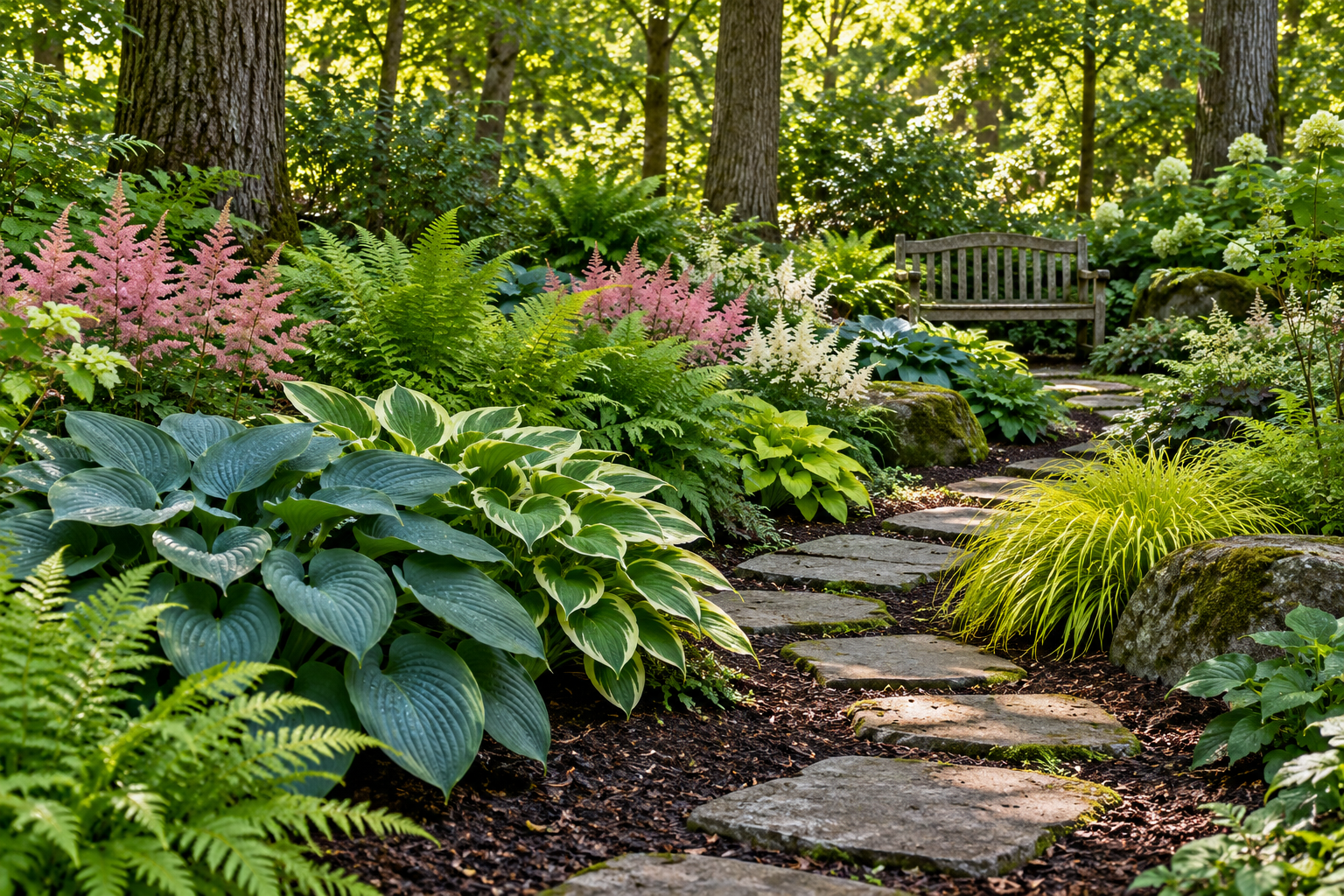
Because many shade plants are grown for their foliage, texture becomes the main design tool. Place broad, bold leaves next to fine, feathery ones: a large blue hosta beside a lacy lady fern, or the rounded leaves of wild ginger against the grassy mounds of Japanese forest grass. Upright plants like Solomon’s seal add vertical interest against low, spreading groundcovers.
Layer Like a Woodland
Natural woodlands are layered, and shade gardens look best when they follow the same pattern. The tree canopy sits above, understory shrubs like hydrangeas or rhododendrons fill the middle, perennials and ferns form the next layer, and groundcovers carpet the soil. This layering creates depth, makes a small space feel larger, and leaves little bare soil for weeds.
Use Repetition
Repeating a few key plants through a bed ties it together. Three or five clumps of the same hosta or fern, spaced through a planting, look more deliberate than a collection of single specimens. This is especially important in shade gardens, where so many plants are green and can blend into a busy mix.
Add Paths and Focal Points
Shady areas invite people to slow down, so give them a reason to walk through. A winding path of stepping stones, bark mulch, or gravel leads the eye through the planting and makes the space feel intentional. A bench, birdbath, sculpture, or large glazed pot placed where a path turns creates a focal point and gives the space a clear purpose.
Soft outdoor lighting, such as low path lights or string lights through tree branches, turns a shade garden into an inviting evening space, especially during summer when shaded areas stay pleasantly cool.
Consider a Moss Garden
In deep shade where little else grows, moss can become a feature rather than a problem. Moss thrives in shaded, acidic, compacted, moist soil, conditions that defeat lawn grass. Clearing debris, keeping the area moist, and letting existing moss spread creates a soft green carpet that pairs beautifully with ferns and stone.
Containers for Shaded Porches and Patios
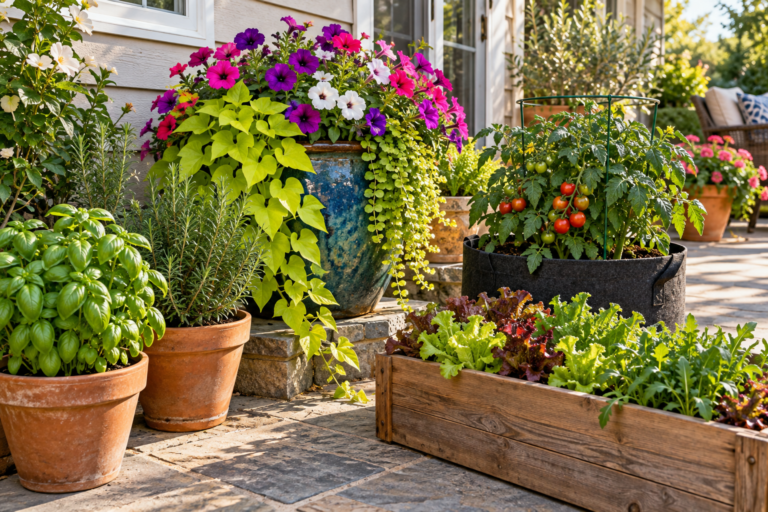
Containers let you bring color into shaded porches, entryways, and patios. Combine an upright plant such as a fern or caladium with mounding begonias or impatiens and a trailing plant such as lamium or creeping Jenny. Use pale or brightly glazed pots to reflect light and make the arrangement stand out.
Planting Under Trees and in Other Difficult Shade
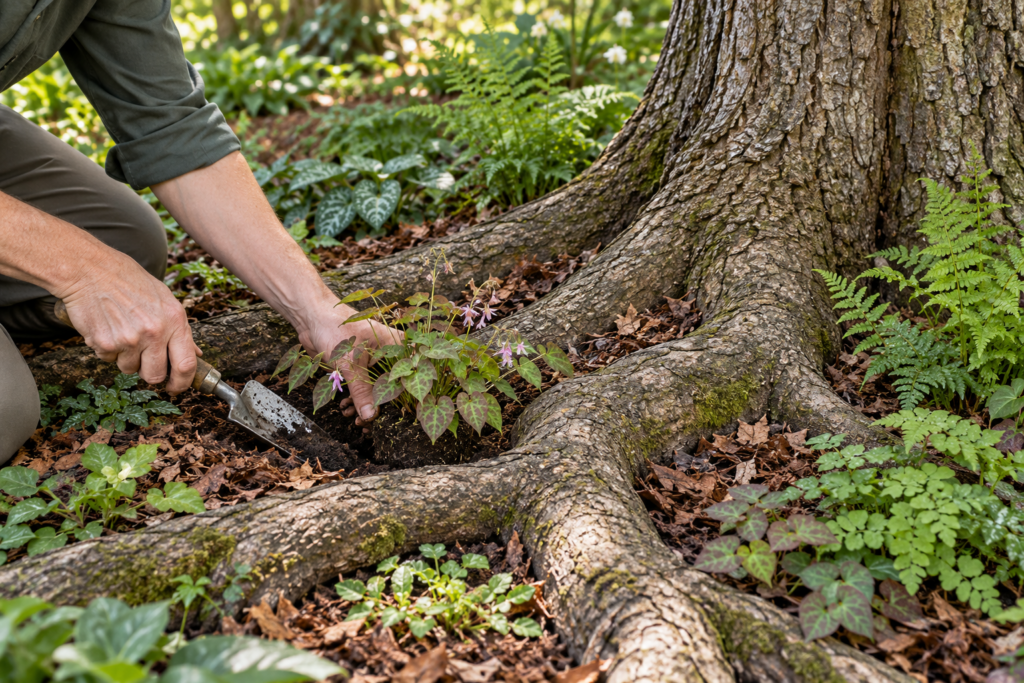
The area beneath a mature tree is one of the most common shade challenges, combining low light, dry soil, and dense root competition. Planting successfully here takes a gentle approach that protects the tree as well as the new plants.
Protect the Tree’s Roots
Most tree roots grow in the top 12–18 inches (30–45 cm) of soil and spread well beyond the edge of the canopy. Avoid heavy digging, rototilling, or cutting large roots, since this can seriously damage or kill a tree. Never pile deep layers of new soil over existing roots; adding more than a couple of inches of soil can starve roots of oxygen. Building a raised bed or berm directly against a tree trunk causes similar harm.
Instead, plant in small pockets between roots using a narrow trowel or planting knife. Choose smaller plants, such as plugs or small pots, which need smaller holes and establish more easily. If you hit a root larger than about an inch across, move the planting hole rather than cutting through it.
Give New Plants Extra Care
Plants under trees compete with far larger, established root systems for water and nutrients. Water new plantings regularly during their first growing season, even in shade, and add a layer of compost or leaf mold around them. Mulch to 2–3 inches (5–8 cm), keeping it away from the tree trunk itself.
Increase the Light
Sometimes the best solution for an overly dark area is to let in more light. Removing lower branches, often called limbing up or raising the canopy, allows more light beneath the tree, especially in the morning and evening. Thinning the crown, which removes selected branches throughout the canopy, creates more dappled light. For large trees, this work is best done by a qualified arborist, who can improve light without harming the tree’s health or structure.
Shade Along Walls and Fences
The narrow space along north-facing walls and fences (in the Northern Hemisphere) is often in shade for most of the day and may sit in a rain shadow where the wall blocks rain. Improve the soil with generous amounts of compost before planting, and choose plants suited to dry shade. Climbers such as climbing hydrangea tolerate shaded walls and can soften bare surfaces.
Replacing Struggling Lawn
Lawn grass needs more light than most shaded areas can offer, and patchy grass under trees is a common frustration. Rather than repeatedly reseeding, many gardeners convert these areas to shade beds, groundcovers, or moss. The result usually needs less maintenance and looks far better than thin grass.
Soil, Watering, and Care for Shade Plants
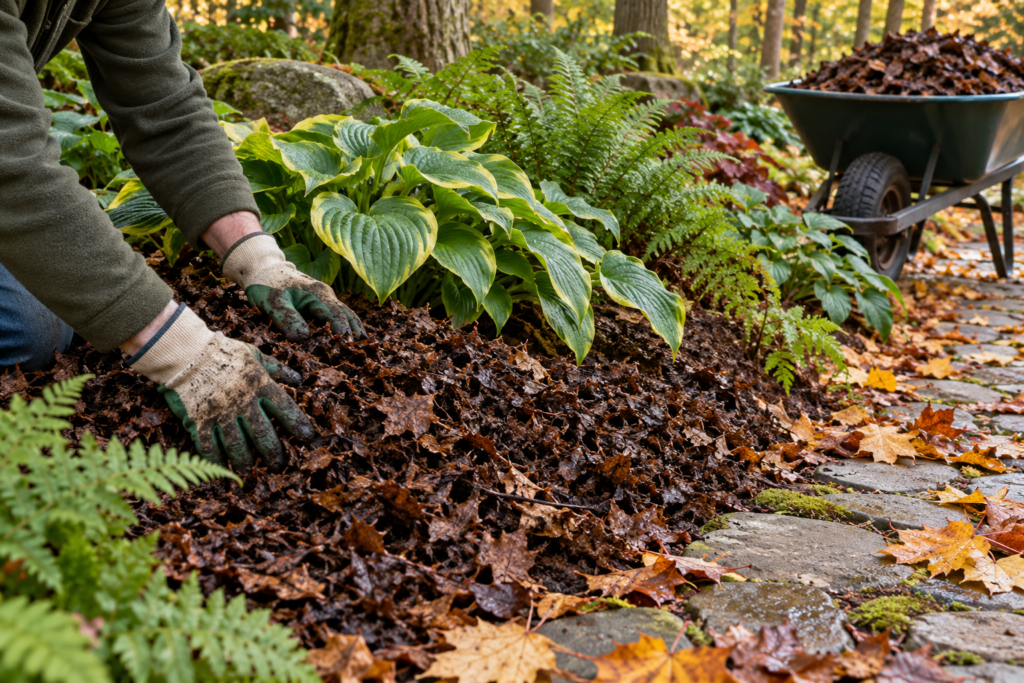
Shade gardens are generally lower-maintenance than sunny borders, but they have their own particular needs.
Build Rich, Woodland-Style Soil
Many shade plants evolved on woodland floors, where soil is rich in decomposing leaves and organic matter. Replicate those conditions by adding compost or leaf mold before planting and topping up with a mulch of shredded leaves or bark each year. This improves moisture retention in dry shade, drainage in heavy clay, and overall soil health.
Fallen autumn leaves are an excellent free resource. Shredding them and spreading them over shade beds mimics the natural woodland cycle. Avoid leaving thick, whole-leaf mats over small or evergreen plants, though, since they can smother them over winter.
Watering
Shaded areas lose less water to evaporation than sunny ones, so moist shade often needs little extra watering once plants are established. Dry shade under trees is the exception, since tree roots take up much of the available water. Water deeply during dry spells rather than little and often, and focus on the root zone rather than the leaves. New plantings need regular water through their first year regardless of the type of shade.
Feeding
Most shade plants grow more slowly than sun-loving plants and need little fertilizer. An annual layer of compost is often enough. Where growth is poor, a light application of balanced, slow-release fertilizer in spring is usually sufficient. Acid-loving shrubs such as rhododendrons, azaleas, camellias, and pieris benefit from fertilizers formulated for acid-loving plants.
Pests and Problems
Slugs and snails are the most common pests in shade gardens, since they thrive in cool, moist, sheltered conditions. Hostas are a favorite target. Clear hiding places such as boards and debris, go out with a flashlight on damp evenings to remove them, and consider thicker-leaved hosta varieties, which tend to resist slug damage better than thin-leaved ones.
Deer find hostas and many other shade plants appealing. In areas with heavy deer pressure, ferns, hellebores, brunnera, Japanese forest grass, and epimedium are generally less favored, though no plant is completely deer-proof when food is scarce.
Powdery mildew and other fungal problems appear where air circulation is poor. Give plants enough space, avoid overhead watering in the evening, and remove affected leaves promptly.
Dividing and Maintaining Perennials
Many shade perennials, including hostas, astilbe, and brunnera, can be divided every few years in early spring or early autumn. Division keeps clumps vigorous and provides free plants to spread elsewhere in the garden. Cut back tattered foliage on hellebores in late winter before new flowers emerge, so the blooms display cleanly.
Common Shade Garden Mistakes
Misjudging the light. Assuming a spot is full shade when it gets strong afternoon sun leads to scorched leaves. Watch the light before choosing plants.
Ignoring moisture. Putting moisture lovers like astilbe in dry shade under trees guarantees a struggle every summer.
Relying on flowers alone. Shade gardens built only for bloom look empty for much of the year. Foliage texture and color carry the design.
Damaging tree roots. Deep digging or piling soil around trees can harm them for years before the damage shows.
Planting too far apart. Sparse planting leaves bare soil for weeds. Groundcovers and layered planting create a fuller, lower-maintenance result.
With the right plants in the right conditions, the shady corners of a garden often become the favorite places to sit on a hot afternoon, and the parts of the yard visitors ask about most.
Frequently Asked Questions
Can grass grow in the shade?
Most lawn grasses need at least four hours of direct sun daily to stay thick and healthy. Fine fescues are among the most shade-tolerant cool-season grasses, and a few warm-season grasses handle part shade in warmer climates. In areas with less light than that, grass usually thins out over time, and groundcovers, moss, or shade beds become better long-term solutions.
Do hostas need any sun?
Hostas grow in full shade but often perform best with an hour or two of gentle morning sun. Blue-leaved hostas keep their color best in shade, since strong sun can turn them green. Gold and chartreuse hostas often color more brightly with some morning light. Almost all hostas should be protected from hot afternoon sun, which scorches their leaves.
What vegetables can grow in the shade?
Leafy greens handle partial shade best, including lettuce, spinach, arugula, kale, chard, and Asian greens. Herbs such as parsley, mint, chives, and cilantro also tolerate part shade. These crops generally need at least three to four hours of direct light. Fruiting vegetables like tomatoes, peppers, squash, and beans need six or more hours and perform poorly in shade.
Can roses grow in shade?
No rose grows well in full shade, but some tolerate partial shade with about four hours of direct sun. Certain climbing and rambling roses and some shrub roses cope better than hybrid teas, which need full sun. Roses in part shade usually flower less heavily and can be more prone to fungal diseases, so good air circulation is especially important.
What is the best mulch for a shade garden?
Shredded leaves and leaf mold are ideal, since they mimic the natural woodland floor where many shade plants originate. Shredded bark and fine wood chips also work well and break down slowly. Pine needles suit acid-loving shrubs such as rhododendrons and azaleas. Apply about 2–3 inches (5–8 cm) and keep mulch away from plant crowns and tree trunks.
When is the best time to plant a shade garden?
Early spring and early autumn are the best times to plant a shade garden. Cooler temperatures and more reliable rainfall help new plants establish roots before facing summer heat or winter cold. Autumn planting is especially effective under deciduous trees, since competition for water eases as trees go dormant. Spring bulbs should be planted in autumn.
How can I tell if a shade plant is getting too much or too little sun?
Too much sun usually shows as scorched, brown, or crispy leaf edges, bleached or faded foliage, and wilting in the afternoon even when soil is moist. Too little light causes leggy, stretched growth, fewer or no flowers, smaller leaves, and variegated or colored foliage fading to plain green. Moving the plant or adjusting nearby branches often solves either problem.
Keep Learning
For more beginner help, see How to Start a Garden: The Complete Beginner’s Guide, How to Start a Vegetable Garden: Step-by-Step Guide for Beginners, and Garden Edging Ideas and Border Design Tips for Beautiful Beds.