Lake House Decor Ideas: How to Get the Look Right
The fastest way to spot a lake house decorated by someone who does not actually use one is the furniture. Pale upholstery with no slipcover. A coffee table with a delicate finish. A rug that cannot be hosed off. Everything chosen for how it photographs in June, and nothing chosen for what happens when four…
The fastest way to spot a lake house decorated by someone who does not actually use one is the furniture. Pale upholstery with no slipcover. A coffee table with a delicate finish. A rug that cannot be hosed off. Everything chosen for how it photographs in June, and nothing chosen for what happens when four people come up from the dock in wet swimsuits, tracking sand and holding a dripping cooler.
Lake houses are working buildings. They absorb wet feet, muddy dogs, borrowed towels, fishing tackle, sunscreen on fabric, and a constant rotation of guests who do not know where anything lives. They also sit in front of the single best view most people will ever own, which changes every hour and does not need help from a feature wall.
Getting the decorating right means solving for both of those things at once: a house tough enough to be genuinely used, and calm enough that the water stays the loudest thing in the room. That is a different problem from coastal decorating, and it is a much more interesting one than the anchors-and-rope version of lake style suggests.
Lake House Style Is Not Beach House Style
Lake house decorating draws on woodland and freshwater surroundings rather than ocean and sand. The palette runs greener and warmer, materials lean toward wood, stone and woven fibre rather than bleached driftwood and white, and the mood is closer to cabin comfort than coastal brightness. The two styles are neighbours, not the same thing.
The difference comes from what is outside the window. A beach house sits in relentless light, reflected off pale sand and open water, which is why the style evolved toward white, pale blue and bleached wood that could hold their own against the glare. A lake house sits among trees, with water that reads as dark green, slate or deep blue rather than turquoise, and light that filters rather than blasts. Cool white in that setting can look thin and unwelcoming, particularly in spring and autumn.
Regional traditions matter too. The Adirondack tradition of the American northeast built great camps from local timber, twig furniture, birch bark, stone fireplaces and hunting-lodge trophies. The upper midwest developed a softer version around pine, plaid and screened porches. Mountain lake houses lean alpine, with heavier timber and wool. English and European lakeside houses tend toward simpler painted cottage interiors. Most contemporary lake houses borrow from several of these, which is fine, as long as the borrowing is deliberate.
What runs through all of them: natural material, visible wood, comfortable rather than formal furniture, a connection to outdoor space, and storage designed around gear.
What’s the difference between lake house and cabin or rustic decor?
They overlap heavily and the distinction is mostly about light and formality. Cabin and rustic decorating leans darker and heavier, with stained timber walls, exposed log construction, heavy leather, wool plaid, antlers, and a deliberately enclosed, sheltered feeling. It is a style built for winter and for keeping weather out.
Lake house decorating is the lighter version of the same instinct. Walls are more often painted or whitewashed rather than left dark, palettes include more blue and green, windows are larger and less covered, and the whole scheme points outward toward the water rather than inward toward the fire. Both use wood heavily, but a cabin uses it as the dominant dark surface while a lake house often paints it and lets it act as texture instead.
In practice most lake houses run somewhere between the two, and the deciding factor is usually season. A house used mainly from May to September can go light. A house used year-round needs the warmth and weight of the cabin end, or it will feel bleak in February.
Build the Palette Around the View, Not Against It
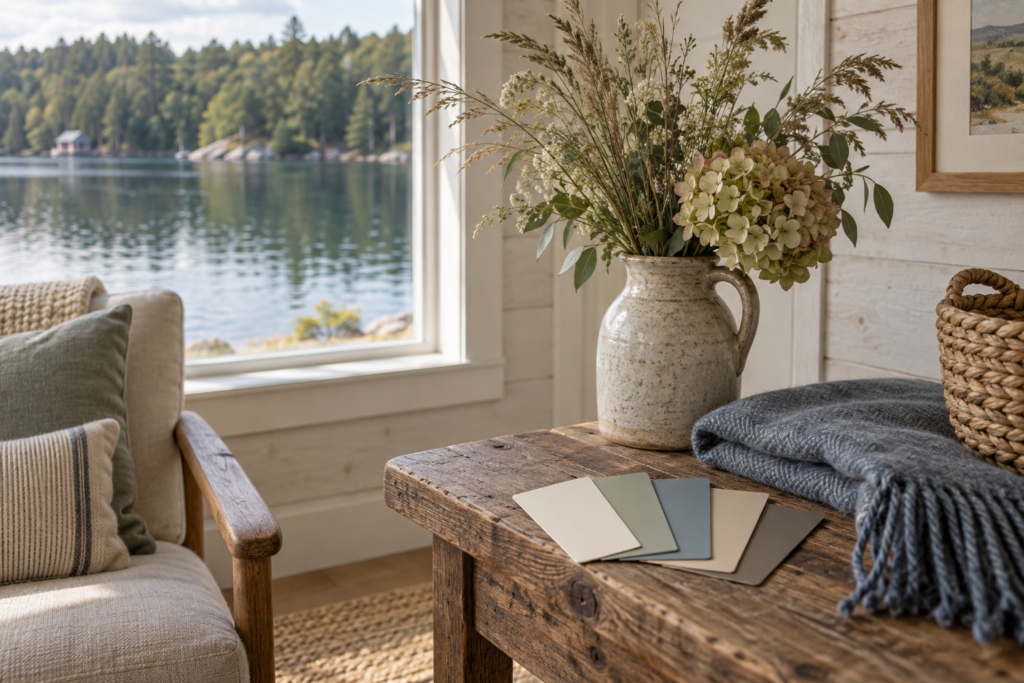
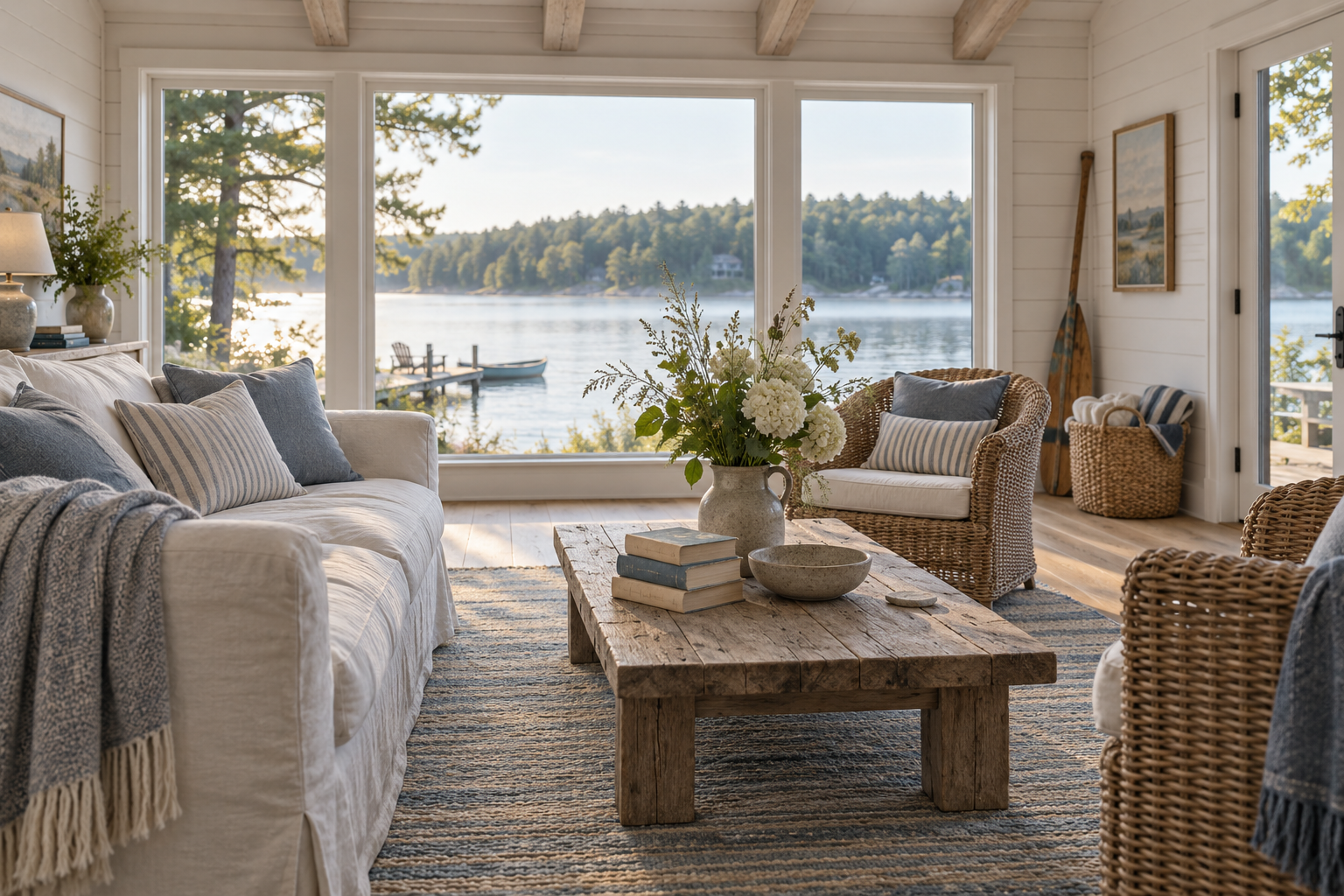
The reliable approach is to take the palette from what is outside the window. Look at the actual water, trees, rock and sky at different times of day, pull three or four colours from them, and let those run through the house. The result is a scheme that changes with the seasons instead of fighting them.
That usually lands somewhere in this range: soft white and warm cream as the base, with muted blue, slate, sage and forest green, warm sand and oatmeal, weathered grey-brown, and the honey tone of natural wood. Accents come from deeper navy, moss, rust or a faded red, used sparingly.
Keep the neutrals warm. This is the single most useful rule in a lakeside setting, because trees and water together throw a lot of cool green light into a room. A cool grey-white on the walls in that light turns flat and slightly institutional, particularly on overcast days, which at most lakes is a great many days. Choose whites and neutrals with a yellow, cream or faintly pink undertone and the same rooms stay warm on a grey afternoon in October.
Three wall approaches work well, depending on the house:
Warm white or soft off-white throughout, which is the default for houses with good light and a strong view. It disappears, which is the point, and lets the window do the work.
Whitewashed or limewashed timber, meaning paint applied thinly enough that the grain still reads through. This keeps the texture of wood without the darkness, and it is one of the most characteristic lake house finishes there is.
A muted colour in the interior rooms, particularly bedrooms, bunk rooms, bathrooms and anywhere without a view. Deep slate blue, sage, olive or a soft clay give those rooms a reason to exist rather than making them feel like the leftover parts of the house.
Build in tonal range or the scheme goes flat. A house of cream, oatmeal, pale blue and pale wood needs something genuinely dark: a stone fireplace, a navy painted island, dark window frames, black metal hardware, or the deep tone of a leather chair. Photograph a room and convert the image to black and white. If everything reads the same pale grey, add weight.
One more thing about colour here that matters more than it does elsewhere: consider the house in every season it will be occupied. A scheme that looks crisp under July light can look cold and empty in November. If the house is used year-round, test paint colours on a grey day, not a sunny one.
Materials That Survive Wet Swimsuits and Sandy Feet
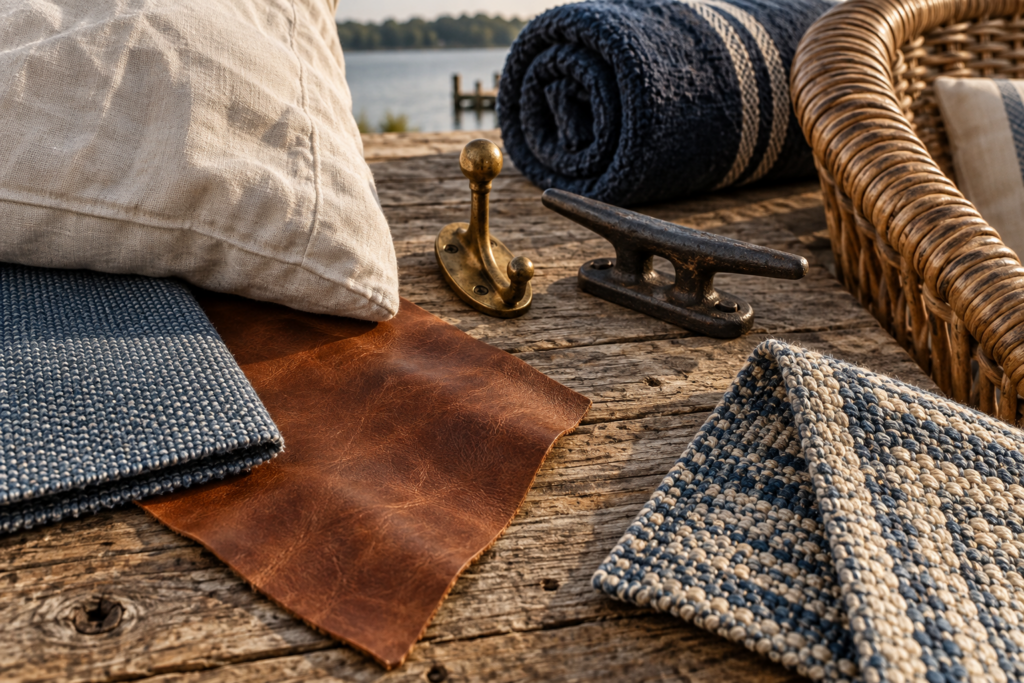
Lake house furniture is chosen for durability first and looks second, and the good news is that the materials which survive hard use are also the ones that look right. Performance fabric, slipcovers, solid wood, woven fibre, leather and indoor-outdoor rugs all belong to the style anyway.
Slipcovers are the single best decision in a lake house. A slipcovered sofa in washed cotton or linen can be pulled off and washed when someone sits on it in sunscreen, which will happen. Buy a second set if the fabric is available, so one can be in the wash while the other is on the furniture. The slightly rumpled look of a washed slipcover is correct for the style rather than a compromise.
Performance fabrics have improved enormously and are worth specifying on anything that is not slipcovered. Solution-dyed acrylic and performance weaves resist fading, water and stains far better than standard upholstery cloth, and many now feel close to ordinary linen or cotton rather than like outdoor furniture.
Leather ages in your favour. A cognac or dark brown leather chair absorbs wet, sandy and generally careless use, wipes clean, and looks better for the wear. It is also the dark anchor a pale room needs.
Indoor-outdoor rugs are the correct choice in every high-traffic lakeside room. Polypropylene flatweaves can be taken outside and hosed down, which solves the whole problem. Natural jute and sisal look right but hold moisture and can mildew in a damp lake house, so keep them to dry rooms well away from the door.
Wood should be finished for use. Reclaimed timber, oak, pine and painted finishes all work, but the finish matters more than the species. A matte oiled or waxed surface can be touched up in place when it gets marked. A high-gloss lacquer shows every ring and scratch and can only be fixed by refinishing the whole piece. Where possible, choose pieces that already have marks. A table that is already scuffed cannot be ruined.
Woven fibre carries much of the texture in lake interiors: rattan and cane chairs, seagrass and abaca baskets, woven pendant shades, rush seats. It is light, it is cheap secondhand, and it adds pattern without adding pattern.
Metals run to aged brass, oil-rubbed bronze, black iron and galvanised steel. Note that humidity and, on some lakes, hard or mineral-heavy water are rough on finishes. Unlacquered brass will darken quickly, which is fine if that is the intention. Chrome shows water spots badly in a bathroom used by wet swimmers.
Mildew is the quiet enemy in any building that sits near water and gets closed up between visits. Favour materials that dry fast, keep upholstery off exterior walls in damp rooms, use washable cotton rather than heavy lined curtains in bathrooms, and store bedding and cushions in breathable cotton bags rather than sealed plastic when closing up for the season.
What flooring works best in a lake house?
The requirements are specific: it has to tolerate standing water at entry points, sand underfoot, and wide swings in humidity between occupied and empty periods. Luxury vinyl plank and good-quality engineered wood both handle this well, since engineered boards move far less than solid timber across seasonal humidity changes.
Solid wood does work and looks better, particularly in older houses, provided it has a durable matte finish that can be spot-repaired and provided the house is not left unheated through a damp winter. Tile and stone are the right answer at every entry point, in mudrooms, and in bathrooms, because water there is not an accident, it is the normal condition.
Whatever goes down, plan the transition from outside to inside properly. A tiled or stone landing zone at the lake-facing door, a drain or at least a sloped surface if there is an outdoor shower, a boot tray, and a washable runner past the door will keep the rest of the house intact.
Furniture and Layout: Designing for the View and the Crowd
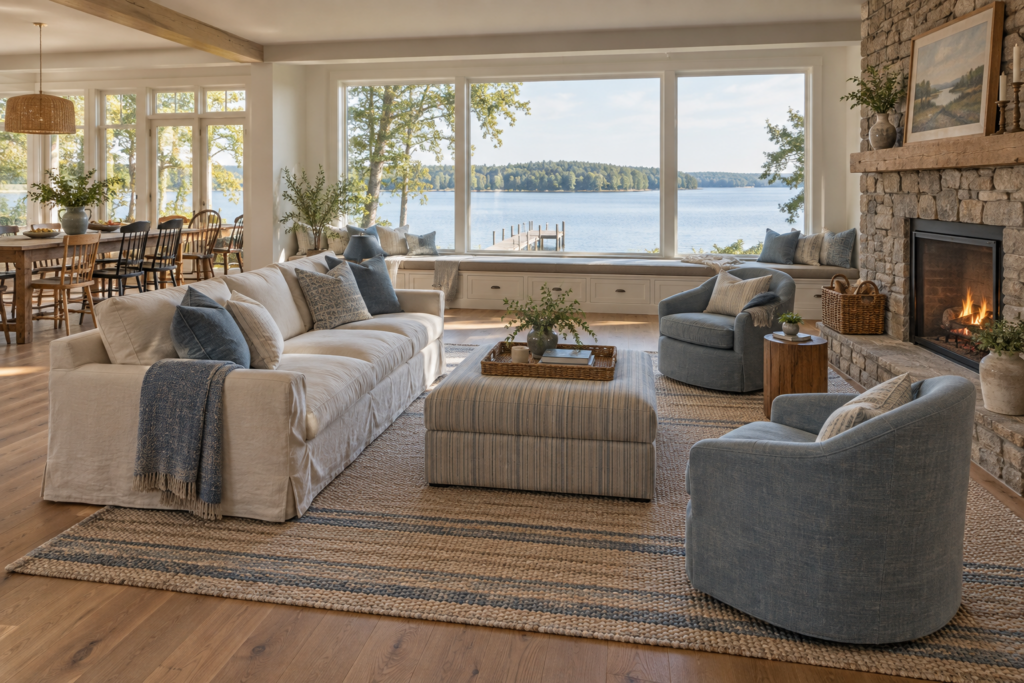
Two planning decisions define a lake house interior. The first is orienting the main seating toward the water. The second is accommodating a guest count that fluctuates wildly between two people and fourteen.
Orient toward the view, but do not abandon conversation. The common error is lining every seat up facing the window like a cinema, which kills conversation and leaves the room with no centre. The better arrangement is an L or U shape angled toward the water, so people can see the view by turning their heads but still face each other. Keep the furniture low near the windows so sightlines stay clear from further back in the room.
Solve the two-focal-point problem. Many lake houses have a fireplace on one wall and the view on another, and both want to be the centre. Workable solutions include angling the seating between them, using a swivel chair or two so people can turn from one to the other, or accepting a seasonal rearrangement where furniture faces the water in summer and the fire in winter. Swivel chairs are genuinely useful here and are one of the few pieces of furniture advice specific to this kind of house.
Plan for flexible seating. A lake house needs more places to sit than its regular occupancy suggests. Ottomans that work as extra seats or footrests, a bench along one side of the dining table, stacking or folding chairs stored in a closet, floor cushions, and a window seat with storage underneath all expand capacity without filling the room permanently.
The dining table should seat more than you think. Meals are the centre of lake house life, and a table that handles ten is more useful than one that handles six beautifully. Extension tables work. So does a long, plain table with mismatched chairs collected over time, which suits the style better than a matched set anyway.
Bunk rooms are worth the space. A dedicated room of built-in bunks sleeps a crowd of children or extra guests without turning the living room into a dormitory. Built-in bunks with individual reading lights, a shelf or small ledge, a hook for a towel and a curtain for privacy are more comfortable than any equivalent number of air mattresses, and they take up remarkably little floor area.
Keep sightlines low. Tall bookcases and high-backed seating placed between the room and the window waste the entire reason the house exists. Low furniture, low profiles and open bases keep the water visible from as much of the room as possible.
Window treatments should mostly get out of the way. On the water side, the ideal is nothing at all, or very simple panels that stack entirely off the glass. Bedrooms are the exception, since summer light at a lake arrives early. Roller blinds or woven wood shades with a blackout lining solve that without visual weight. Woven wood shades in particular suit the style and filter light beautifully in rooms where privacy matters but the view does not.
How do I decorate a small lake cottage without it feeling cramped?
Small lakeside cottages work best when the furniture is low, the palette is consistent throughout, and storage is built in rather than freestanding. Running the same wall colour through every room makes a small cottage read as one continuous space rather than a series of boxes.
Beyond that, a few specifics help. Use built-in benches and window seats with storage inside, which give you seating, storage and a view-facing spot in the same footprint. Choose furniture with visible legs so floor shows underneath, since visible floor reads as space. Hang curtains close to the ceiling to lift the eye. Put a large mirror on the wall opposite the water, which doubles the view and the light at once. And keep the number of different materials low, since a small room with five wood tones and four fabrics feels busier than a large one with the same mix.
The other small-cottage advantage is that you can be bolder in the rooms without views. A tiny bathroom or bunk room painted deep slate blue or forest green becomes a moment rather than a compromise.
Getting the Nautical Touches Right
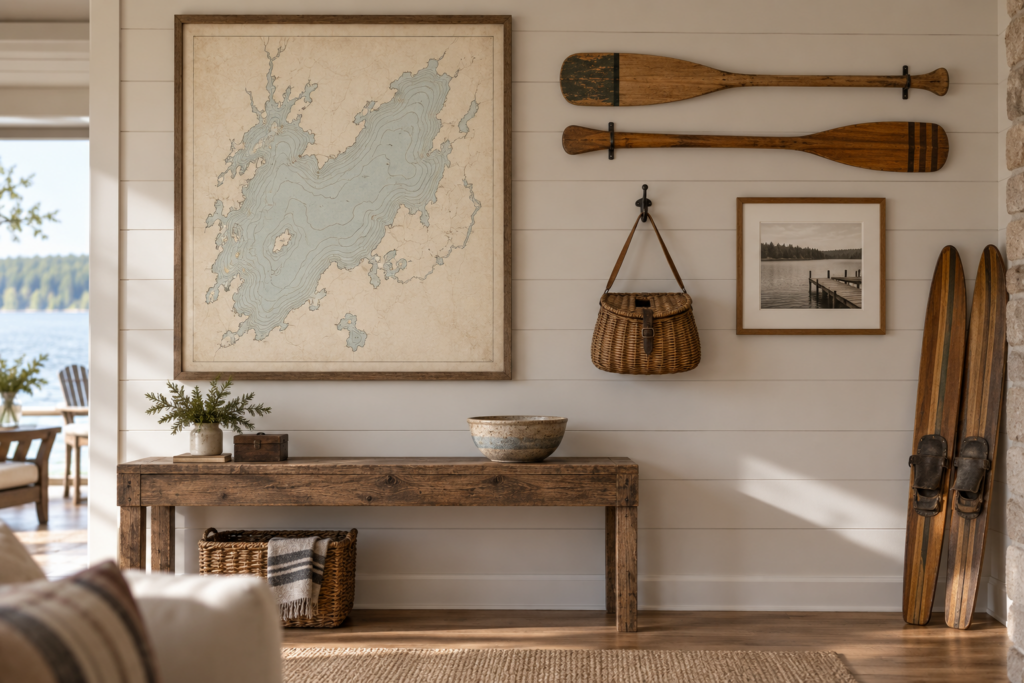
Lake house decorating has a cliché problem, and the cliché is the anchors-rope-and-lighthouse version, which mostly belongs to the ocean anyway and reads as a theme rather than a home. The workable rule is to use objects that would genuinely be at that specific lake, and to use very few of them.
What works, because it is real: vintage canoe paddles, wooden oars, old fishing creels and lures, fishing rods on a wall rack, wooden water skis from the sixties, cane fish traps, a vintage outboard on a shelf if that is your kind of thing, old life rings from a boat that actually existed, bell buoys and cleats used as hooks, enamel camp mugs, and antique maps or nautical charts of the lake itself.
That last one deserves emphasis. A framed chart or survey map of your actual lake is the single best piece of lake house wall art available, and it is specific, useful and personal in a way that nothing bought as a theme can be. Old plat maps, topographic sheets and depth charts of individual lakes turn up regularly in secondhand shops and archives.
Other art that suits: black and white photographs of the house, the dock or family at the lake across different decades, pressed botanicals of local plants, simple landscape paintings, and framed vintage postcards of the area. Anything tied to this place rather than to lakes in general.
Vintage sports equipment does a lot of work here and is cheap secondhand. Old wooden tennis rackets, snowshoes, wooden sleds and skis, a wooden toboggan, croquet mallets in a rack. These read as evidence of a family that has used the place for years, which is exactly the feeling the style is after.
The restraint rule that keeps it from tipping into theme: pick two or three categories and stop. A house with paddles, a map, and a few pieces of old fishing gear looks like somebody’s lake house. The same house with paddles, a map, fishing gear, rope-wrapped lamps, anchor cushions, a ship’s wheel, striped everything and a sign reading Lake Rules looks like a gift shop.
Pattern should stay similarly restrained. Ticking stripe, buffalo check, simple plaid, small geometrics and faded florals all belong. Vary the scale, hold the colours constant, and keep roughly a third of the visible surface plain so the eye can rest. One patterned element per room is usually enough.
Storage, Gear and the Practical Systems That Make It Work
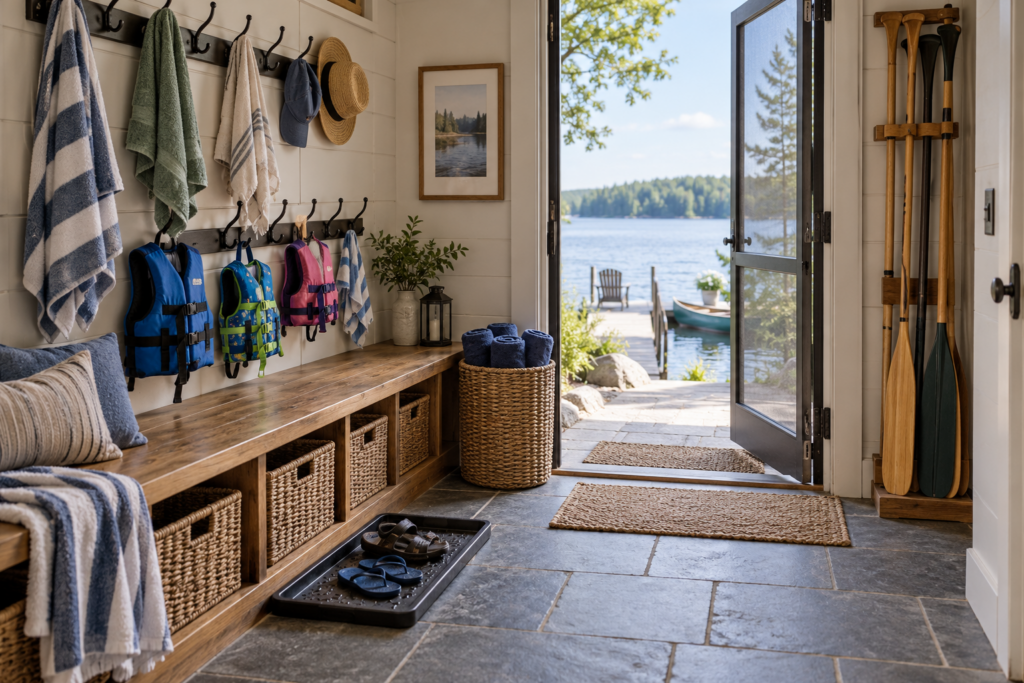
The difference between a lake house that functions and one that descends into chaos by August is storage designed around what actually accumulates. This is the least glamorous part of the decorating and the part guests will notice most.
The entry from the water is the critical zone. It needs a hard surface underfoot, a row of hooks at two heights so children can reach their own, a bench to sit on while dealing with shoes, a boot tray, and baskets or cubbies for each person. Open hooks beat a closet here, because wet things need air.
Towels need a system. They are the single highest-volume item in a lake house. A dedicated basket or shelf of rolled towels near the water door, hooks outside for drying, and a firm rule about where wet ones go will prevent the slow migration of damp towels onto every piece of furniture. Dark or patterned towels hide use better than white.
Life jackets, paddles and gear want a dedicated rack, ideally in a garage, boathouse or covered outdoor space rather than indoors. Vertical paddle racks and wall-mounted life jacket bars dry the gear as they store it.
Guest logistics. A house with rotating guests runs better with extra bedding stored in clearly labelled bins, a basket of spare toiletries in each bathroom, and a simple written note about wifi, rubbish, boat rules and where the extra towels are. This is not decorating exactly, but it is what makes the house feel generous rather than anxious.
Closing up for the season should be designed into the storage from the beginning. Outdoor cushions need somewhere dry indoors. Bedding needs breathable storage. A deck box near the dock for towels and toys saves dozens of trips. If the house sits empty in a damp season, leaving interior doors open and cupboards ajar helps air circulate, and a dehumidifier makes a real difference in a closed-up house near water.
Outdoor living spaces carry as much of the season as the interior. A screened porch is the most valuable room in a lake house in mosquito country, and it deserves proper furniture rather than leftovers: a dining table, comfortable seating, a fan, and lighting good enough to sit out after dark. A dock with two or three chairs is a room in its own right. Fire pit seating extends the evening and the season. Outdoor lighting should be warm and low, and worth keeping minimal, since one of the real luxuries of a lake is a dark sky.
How do I decorate a lake house that I rent out?
Rental lake houses need a different specification, built around durability, neutrality and things that photograph well without being fragile. Everything in a rental gets used harder than anything in a family house, and by people with no reason to be careful.
The practical checklist: performance fabric or slipcovers on all upholstery, indoor-outdoor rugs throughout, commercial-grade or very durable flooring, solid wood or laminate furniture with no delicate finishes, and dark or patterned towels and bedding that hide stains. Avoid anything genuinely irreplaceable, since it will eventually break.
For bookings, the details that photograph well are the ones worth investing in: good lighting, a generous dining table, a well-equipped kitchen, made-up beds with layered bedding, and a clear shot of the view from the main living space. And bolt down or at least secure the outdoor furniture, since wind off a lake moves more than people expect.
Frequently Asked Questions
What colours are best for a lake house?
Warm whites and creams as the base, with muted blues, sage and forest greens, sand, oatmeal and weathered grey-brown drawn from the surroundings. Keep every neutral on the warm side, since the cool green light reflected from trees and water makes grey-based whites look flat and cold. Save deeper colours like navy, slate or olive for interior rooms without a view, where they give the space character it cannot get from a window.
Should a lake house be decorated in a nautical theme?
Heavy nautical themes read as decoration rather than as a home, and much of the standard nautical vocabulary, meaning anchors, lighthouses and ship’s wheels, belongs to the ocean rather than to freshwater. A lighter touch works better: a few genuine objects tied to the specific lake, such as a chart of the water, old paddles, vintage fishing gear or family photographs from previous decades. Pick two or three categories and leave it there.
What are the most durable fabrics for lake house furniture?
Slipcovers in washed cotton or linen are the most practical option, because they can be removed and laundered. Performance fabrics, including solution-dyed acrylics and performance weaves, resist fading, moisture and stains while feeling reasonably close to ordinary upholstery. Leather is excellent for hard use and improves with wear. Avoid silk, delicate linens and anything pale that cannot be washed.
How do I stop a lake house from smelling musty when it’s closed up?
Air circulation and moisture control do most of the work. Before closing up, leave interior doors and cupboards open, pull furniture slightly away from exterior walls, and store bedding, towels and cushions in breathable cotton rather than sealed plastic. A dehumidifier, ideally one that drains continuously, makes the largest single difference in a house that sits empty near water. Fix any small leak or damp patch before it becomes a smell.
Can I use a lake house style in a home that isn’t on a lake?
Yes, because most of what makes the style work is material and palette rather than location. Natural wood, woven fibre, slipcovered comfortable furniture, warm neutrals with blue and green, and simple durable finishes read as relaxed and unfussy anywhere. What will not travel is the place-specific element, meaning the chart of a particular lake or the vintage boat gear, which works because it is genuinely tied to somewhere. Substitute with objects tied to wherever the house actually is.
What kind of window treatments work best with a lake view?
On the water side, as little as possible, ideally nothing, or simple panels that stack entirely clear of the glass when open. Where privacy or light control is needed, woven wood shades filter light beautifully and suit the material palette, and roller blinds disappear completely when raised. Bedrooms usually need a blackout lining, since summer light at a lake arrives very early. Avoid heavy lined curtains with valances, which add bulk and trap moisture in a damp environment.
How do I make a lake house feel warm in the off-season?
Layer in weight that comes out when the weather turns. Wool blankets and throws over the arms of chairs, heavier bedding, a sheepskin or wool rug over the summer flatweave, and cushions in heavier fabrics like wool or velvet. Beyond textiles, warm lighting at three heights with dimmers matters enormously in short winter days, and a working fireplace or wood stove changes the whole character of the house. A room that feels breezy and bright in July needs something to pull it inward in November.