Cottagecore Home Decor: How to Get the Cozy, Vintage Look
There is a version of cottagecore that exists mainly as a shopping list. Buy the mushroom-print cushion, the fake dried flowers, the enamel jug that has never held anything, hang a wreath, done. It photographs beautifully and feels like nothing when you stand in the room. The real appeal is older and considerably less purchasable….
There is a version of cottagecore that exists mainly as a shopping list. Buy the mushroom-print cushion, the fake dried flowers, the enamel jug that has never held anything, hang a wreath, done. It photographs beautifully and feels like nothing when you stand in the room.
The real appeal is older and considerably less purchasable. Cottagecore is nostalgia for a way of living where things were slow, useful and mended rather than replaced. The aesthetic that grew out of it borrows from English country cottages, American farmhouse kitchens, French rural interiors and the arts-and-crafts idea that handmade objects belong in ordinary homes. What makes those rooms work is evidence of use. Worn edges on a table. Odd chairs around it because they were collected rather than bought. A jar of whatever is flowering outside, which this week is nothing much.
None of that requires a cottage, a garden or a particular budget. It requires a specific set of choices about colour, texture, furniture and what you allow to be visible. Below is that set of choices, in the order they actually matter.
What Cottagecore Decorating Really Is
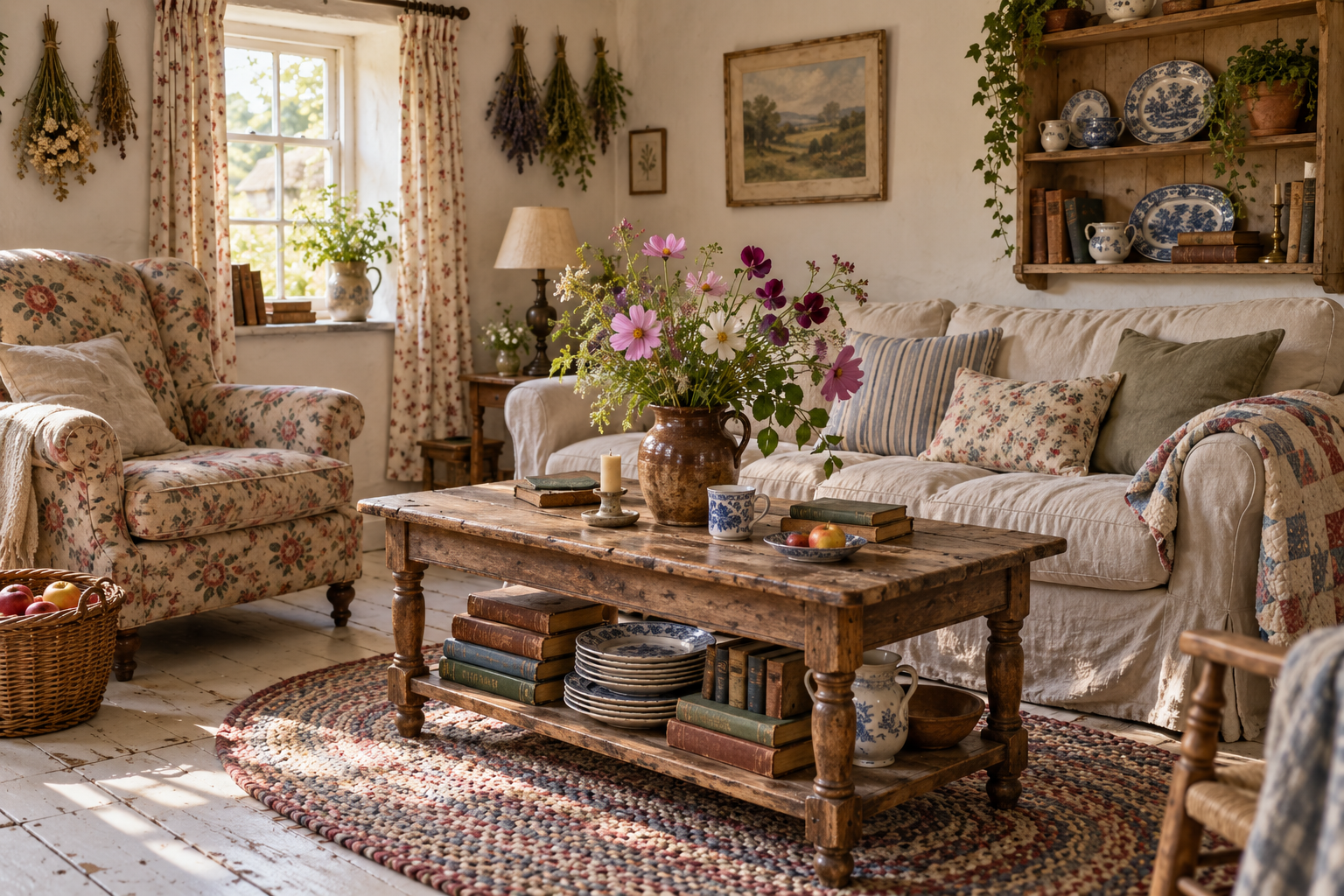
Cottagecore decorating builds a home around softness, age and utility. The core elements are warm muted colours, natural materials, floral and gingham pattern used lightly, secondhand wooden furniture, plenty of visible textiles, and objects that look used rather than styled. The guiding instinct is that a room should feel like somebody lives there and makes things there.
The look pulls from several real traditions rather than inventing one. English country cottage interiors supply the chintz florals, the mismatched china and the general comfort with clutter. American farmhouse contributes the practical kitchen, the quilts and the plain painted furniture. French country brings toile, linen, worn stone and the soft faded palette. The arts and crafts movement, which was itself a reaction against mass production, supplies the underlying conviction that handmade is better than perfect.
The consistent visual markers across all of it: floral prints, checks and ginghams, ticking stripe, white or cream painted walls, exposed or painted wood, open shelving instead of closed cupboards, baskets used as storage, vintage crockery on display, and flowers or foliage somewhere in almost every room.
It is worth being clear about what cottagecore is not, because the confusion causes most of the mistakes. It is not modern farmhouse, which is a much tidier, higher-contrast, black-and-white descendant. It is not shabby chic, which leans on deliberately distressed painted furniture and a pastel palette. And it is not minimalism with a floral cushion. Cottagecore rooms are genuinely full, just full of soft, useful, mismatched things rather than bold statement pieces.
The style’s real subject is time. A cottagecore room reads as somewhere that has accumulated rather than been installed, which is why the single most effective thing you can do is buy old things slowly instead of new things quickly.
What’s the difference between cottagecore and modern farmhouse?
They share rural references and get confused constantly, but their instincts run opposite. Modern farmhouse is high contrast, crisp and controlled: white walls with black window frames, shiplap, barn doors, matte black hardware, clean lines and very little pattern. Its charm depends on things looking sharp.
Cottagecore is low contrast, soft and layered. Walls are cream or a muted colour rather than bright white. Metal is aged brass or worn iron, never matte black. Pattern is everywhere, particularly florals. Furniture is genuinely old and mismatched rather than new and coordinated. Where modern farmhouse edits surfaces down to three objects, cottagecore fills a dresser with plates and a windowsill with jars.
The shorthand that settles it: if the room’s charm depends on things looking clean-lined and graphic, it is farmhouse. If it depends on things looking soft, faded and slightly imperfect, it is cottagecore.
The Palette: Soft, Warm and Slightly Faded
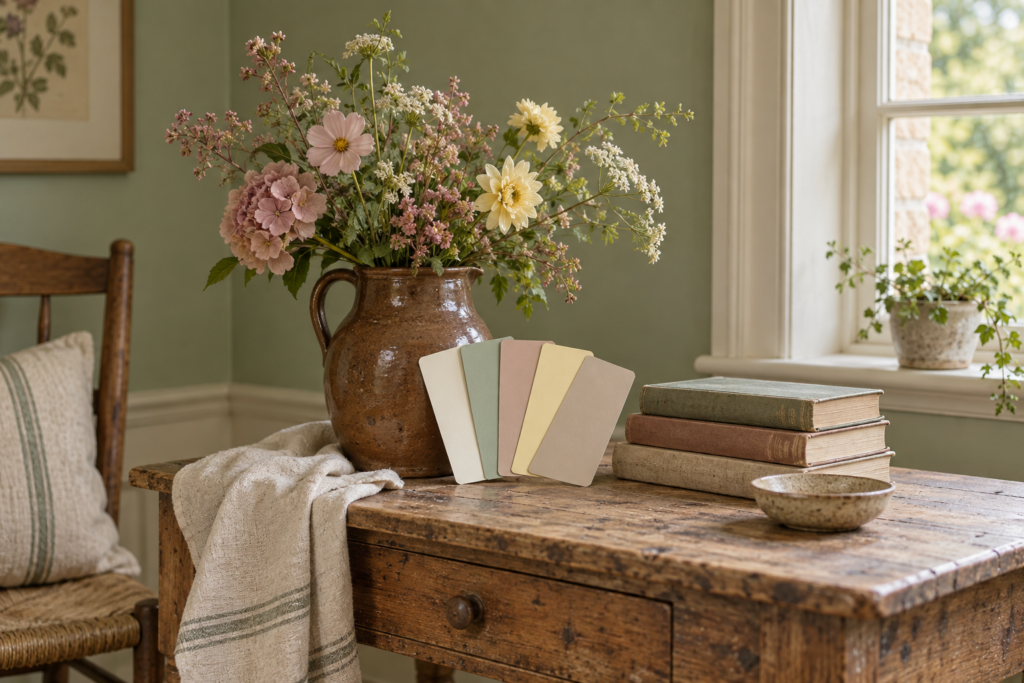
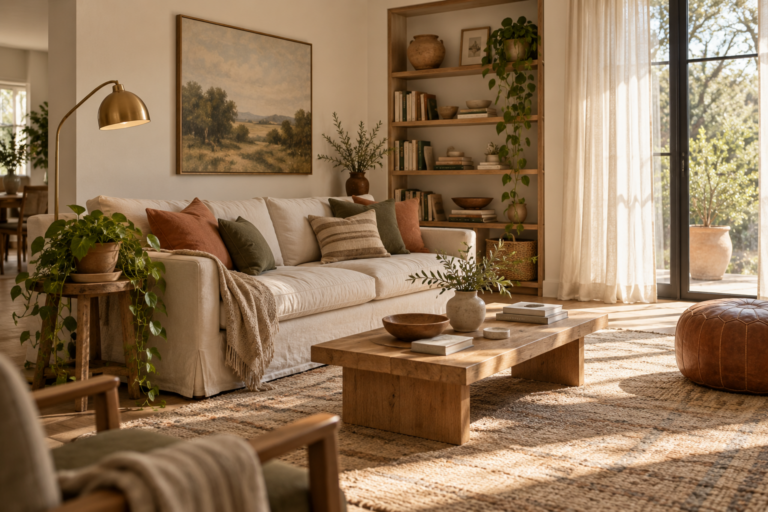
Cottagecore colour runs on warm muted tones borrowed from the garden and the countryside rather than from a paint trend. The working base is cream, oatmeal, warm white and soft putty, with colour coming in at low saturation: sage and olive green, dusty rose, butter yellow, washed-out sky blue, terracotta and soft lavender. Everything looks like it has been in the sun for years.
The single most useful rule is to avoid anything bright and anything cool. Saturated primary colours break the spell instantly, and so do grey-based neutrals. A cool grey-white on the walls will make wooden furniture look dull and dead, and it is the most common reason a room that contains all the right objects still feels wrong. Test every neutral against your actual wood and fabric in daylight, and pick the one with a yellow or pink undertone.
For walls, three approaches all work well:
Warm white or cream throughout, which is the safest and lets the textiles and furniture carry all the character. Choose something with a visible warmth rather than a pure brilliant white, and prefer a matte or chalky finish over anything with sheen, since flat paint reads as old plaster and bounces light softly.
A muted colour on the walls, most commonly sage green, soft clay, buttermilk or a dusty blue. This is strongly period-correct, particularly in kitchens and bedrooms, and it makes cream and wood objects look considerably richer.
Painted woodwork as the colour, leaving the walls cream and putting sage or soft blue on doors, skirting, window frames or built-in cupboards. A cheap and very effective route, and one that instantly reads as an old house even in a new one.
Small-scale floral wallpaper is the other classic option. Ditsy prints, trailing sprigs and faded botanicals all suit the style, and a single papered wall or one small papered room gives you the effect without committing the whole house. Bathrooms, landings and box bedrooms take it particularly well.
Build in tonal range so the room does not go flat. A scheme made entirely of cream, oatmeal and pale sage will look washed out with nothing to anchor it. You need something genuinely dark, which might be an old wooden dresser, a dark green painted cupboard, a black cast iron fireplace or the spines of old books, and something genuinely light, usually the walls or a cream quilt. Photograph the room and convert the picture to black and white. If every element sits at the same pale grey, add weight.
Furniture, Wood and the Case for Buying Secondhand
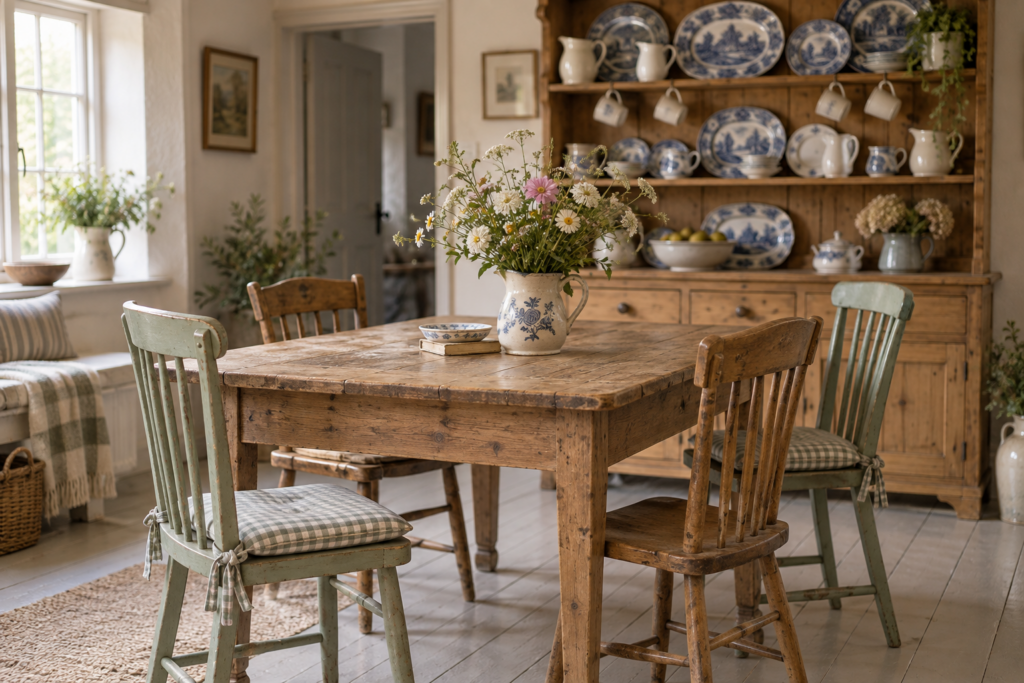
Cottagecore furniture is old, wooden and mismatched, and this is the part of the style that genuinely cannot be shortcut. The look depends on pieces that have visible age and slightly different proportions from one another, which is exactly what you get from buying secondhand over time and exactly what you never get from buying a matched set.
The pieces that do the most work:
A dresser or Welsh dresser, meaning a cupboard base with open shelves above. It is the defining cottage furniture item because it stores and displays simultaneously, and a dresser stacked with mismatched china will carry an entire kitchen or dining room on its own.
A farmhouse table, ideally in pine or oak with a scrubbed or waxed top and visible marks. Table marks are the point, not a flaw to sand out.
Mismatched chairs around it. Four different wooden chairs, whether spindle-backs, ladder-backs, bentwood or painted, look far more convincing than a matched set. Unify them loosely by painting two of them the same colour, or by adding tie-on seat cushions in the same fabric.
A bench or settle along one side of a table, which is both period-correct and practical in a narrow room.
Painted cupboards and armoires for storage, since freestanding furniture suits the style much better than fitted units.
A comfortable, slightly sagging sofa, ideally slipcovered in linen or cotton so the cover can be washed, which is the entire reason slipcovers existed.
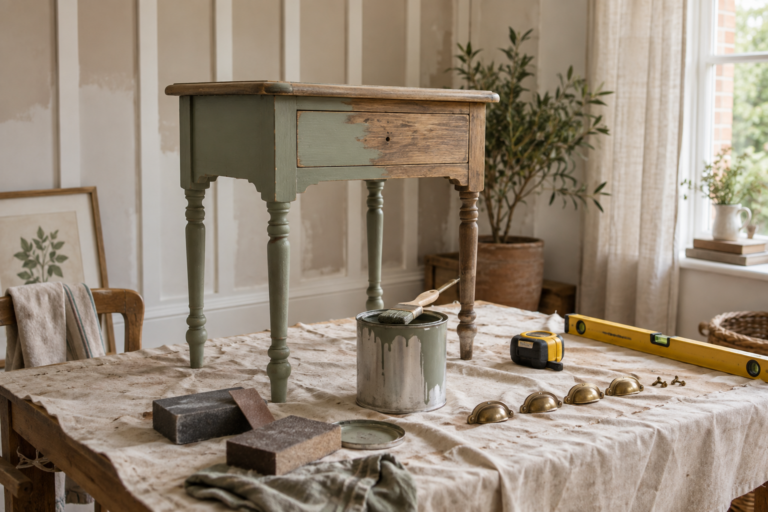
Wood tones should vary and should be warm. Pine, oak and elm all suit. Mixing three or four different woods is correct here in a way it is not in most styles, because mismatching is the aesthetic. What does not work is orange-toned modern varnish with a plastic sheen, or very pale grey-washed timber. If a piece has an unpleasant modern finish, stripping it back and waxing or oiling it transforms it, and chalk paint in a muted colour is the easier alternative.
On the subject of distressing furniture: do it sparingly or not at all. Deliberately sanded edges on new paint is the tell that separates shabby chic from genuine cottage style. Real wear happens where hands and feet go, meaning drawer pulls, chair arms, table edges and the bottoms of cupboard doors. Anything else looks applied.
How do you get the cottagecore look on a small budget?
Almost perfectly, because the style prefers old things and old things are cheap. Brown furniture, meaning traditional wooden pieces, currently sells for a fraction of what comparable new furniture costs, and the mismatching that the style requires means you never need to find a set.
Where to look: charity shops for china, linens, books and small objects, with frequency mattering more than strategy since stock turns constantly. Local classified listings and marketplace apps for furniture, searching terms like pine dresser, farmhouse table, Welsh dresser, wooden chairs and vintage. Regional auction houses for mixed lots, where a box of assorted crockery or linens often costs less than a single new cushion. Estate sales and house clearances for the best material, since whole households appear at once. Fabric remnants, upholsterers’ ends and old curtains, which can be remade into cushion covers, tablecloths and seat pads for very little.
Spend the money on paint, which changes a room more than anything else for the cost of a few tins, and on one good comfortable seating piece. Everything else can be found.
Textiles, Pattern and the Layering That Creates Warmth
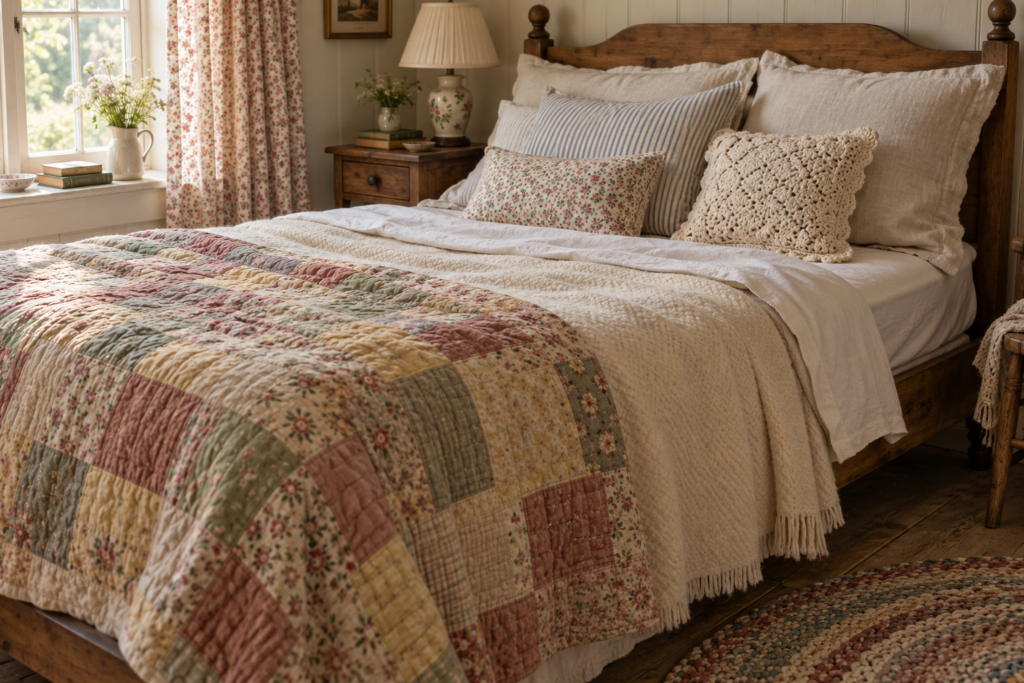
Textiles are what make cottagecore rooms feel warm rather than merely old. The materials are all natural and all slightly imperfect: cotton, linen, wool, ticking, gingham, chintz, toile, lace, crochet and quilted cotton. Nothing shiny, nothing synthetic, nothing tightly tailored.
Pattern mixing is the skill, and the method is straightforward once the palette is doing its job. Vary the scale, hold the colours constant. One large floral, one medium check or gingham, and one or two fine stripes in the same muted colour family will sit together happily. Four florals at the same size will not, however well matched they are.
The patterns that belong to the style:
- Florals: ditsy sprigs, chintz, faded cabbage roses, trailing botanicals
- Checks: gingham in small and medium scales, plaid, windowpane
- Stripes: ticking, fine cotton stripes, woven bands
- Toile: pastoral scenes in a single colour on cream
- Texture as pattern: crochet, lace, waffle weave, quilting, chunky knit
A room can run three or four of these at once as long as they share a palette and vary in scale. Keep at least a third of the visible surface area plain so the eye has somewhere to rest, which usually means a plain sofa, a solid rug or a bare stretch of wall.
Where to put the textiles, in rough order of impact:
Curtains. Simple gathered or pinch-pleat panels in a small floral or a plain washed linen. Hung on a slim wooden or aged brass pole, high and wide. A gathered valance or a simple pelmet is genuinely appropriate here, unlike in most contemporary styles. Café curtains covering only the lower half of a window are a strong cottage detail for kitchens and bathrooms.
Quilts and throws. A patchwork quilt over the back of a sofa or folded at the foot of a bed does more for the style than almost any single purchase. Old quilts are widely available secondhand, and minor damage is part of the charm.
Cushions in odd numbers, mixed sizes and mixed fabrics. Avoid matching sets.
Table linen, which is a habit rather than an object. A tablecloth that actually gets used, cloth napkins, a runner, an embroidered cloth over a side table.
Rugs. Braided rag rugs, worn wool runners, flatweaves and faded florals all suit. Layering a smaller patterned rug over a larger natural-fibre base adds depth and rescues an antique rug that is too small.
Beds deserve specific mention because the bedroom is where this style is most effective. Layer properly: a fitted sheet, a flat sheet turned down over the blankets, a wool blanket, a quilt or eiderdown on top, and pillows in mixed sizes with at least one in a different fabric from the rest. Linen bedding creases and that is correct. Crisp hotel bedding is the opposite of this look.
The Kitchen, the Garden and the Details That Sell It
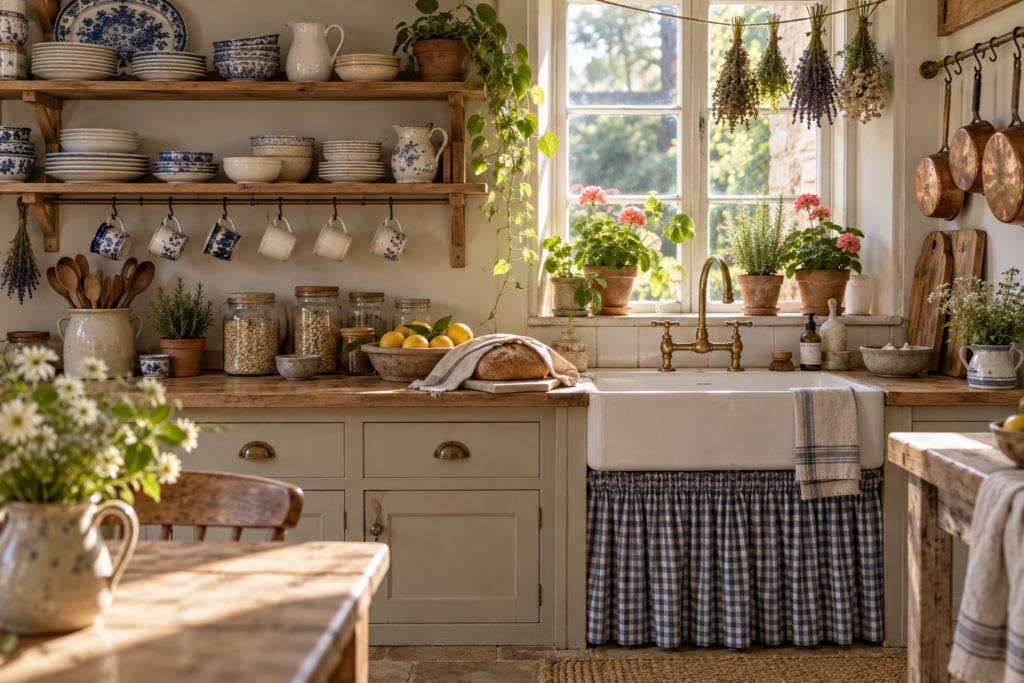
The kitchen is the heart of cottagecore, and it is the room where the style is most functional rather than decorative. What makes a kitchen read as a cottage kitchen is that everything useful is visible.
Open shelving instead of wall cupboards, holding stacked plates, bowls and mugs in mismatched patterns. Mugs and jugs on hooks under the shelves. A wooden or ceramic crock holding wooden spoons. Copper or enamel pans hanging from a rail. Glass jars of dry goods along a shelf. A butler’s or farmhouse sink with a skirt of gingham fabric beneath it instead of a cupboard door. A wooden worktop or scrubbed butcher’s block. Aged brass or plain iron hardware rather than anything chrome or matte black.
Crockery choice matters more than it seems. Blue and white transferware, plain cream ironstone, small-print florals, enamelware in cream with a coloured rim, and brown glazed stoneware are all strongly period-correct and all findable secondhand cheaply. Building a collection of mismatched plates in a loose colour family is more convincing than any single matched dinner set.
Food and its preparation are part of the aesthetic, which is unusual and worth taking advantage of. A bowl of lemons or apples. A loaf under a cloth. A bunch of herbs drying on a string. A jar of something fermenting on the windowsill. Bread, jam and preserves in reused jars with handwritten labels. None of this is decoration exactly, which is why it works.
Flowers and foliage run through every room in this style, and the way they are arranged matters as much as what they are. Loose and slightly untidy, gathered in a jug, jar or enamel pitcher rather than a formal vase. Garden flowers rather than florist bouquets, meaning cosmos, sweet peas, dahlias, roses, lavender, hydrangeas and whatever is actually in season. A single stem in a small bottle on a windowsill counts.
Dried flowers extend this through winter and are genuinely traditional rather than a recent trend. Lavender, hydrangeas, statice, yarrow, wheat and honesty all dry well, hung upside down in a dry, dark, airy place for two to three weeks. Herb bunches drying in the kitchen serve the same visual purpose and get used.
Houseplants tilt toward the old-fashioned in this style: geraniums on a windowsill, ferns in the bathroom, a Christmas cactus, trailing ivy, a spider plant, herbs in terracotta pots by the kitchen window. Terracotta, enamel and glazed stoneware pots rather than anything sleek.
Can you make an apartment feel cottagecore without a garden or period features?
Yes, and the absence of period architecture is less of a problem than most people assume, because this style lives in furniture, textiles and objects rather than in the building.
The changes that do the most in a plain modern flat: paint walls in a warm cream or a muted colour and use a matte finish, which softens flat modern plasterboard considerably. Replace whatever lighting is fitted with warm bulbs and add table lamps with fabric shades, since overhead light alone kills the softness. Cover as much of the floor as possible with layered rugs. Bring in two or three genuinely old wooden pieces, which supply the age the building lacks. Hang curtains rather than using blinds, high and wide and floor length. Put open shelving on a wall and fill it with china and books.
For the garden element, a windowsill of herbs in terracotta pots, a few pots of geraniums, and dried flowers through the winter will do it. Window boxes work on most balconies and many windows. And a jug of supermarket flowers, arranged loosely rather than as they came, reads as a garden gathering more than anyone expects.
Keeping It Cosy Instead of Cluttered
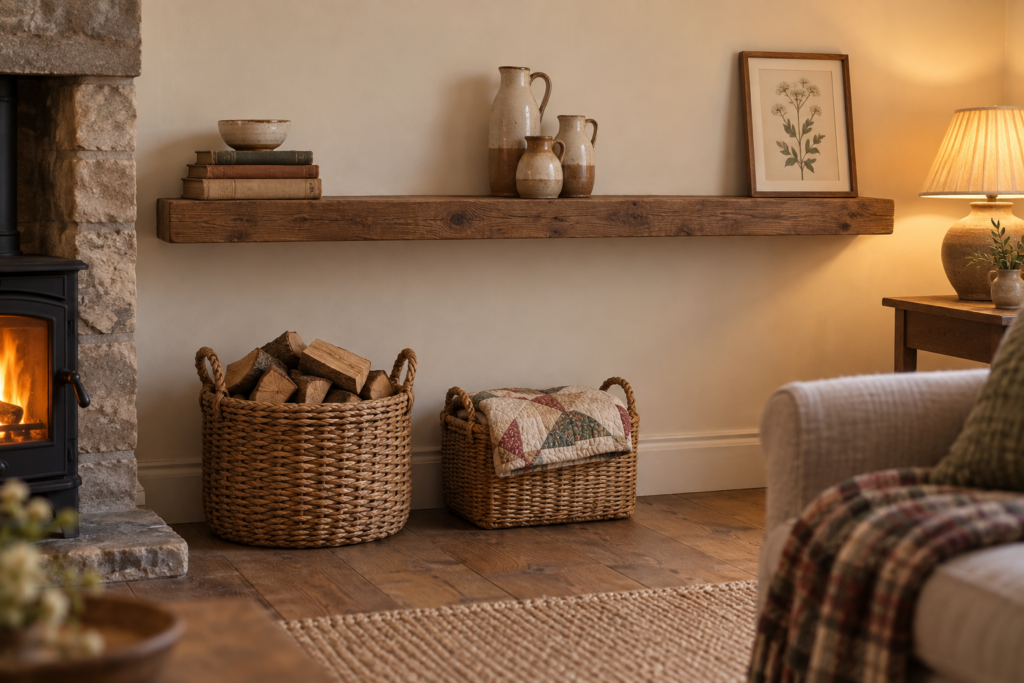
The line between a cottagecore room and a jumble is thinner than the style’s fans admit, and the difference is almost entirely about arrangement rather than quantity.
The organising principle is that objects should be grouped, not scattered. Seven pieces of china on a dresser shelf, stacked and arranged, read as a collection. The same seven distributed across a kitchen look like washing-up nobody put away. Cluster things in odd numbers, vary the heights within each cluster, and give each group a base that anchors it, whether a tray, a stack of books, a cloth or a shelf edge.
Give the eye somewhere to rest. Aim for roughly a third of visible surface and wall area to stay quiet. In a room with floral curtains, a patchwork quilt and a dresser full of china, that means plain walls, a solid sofa and a clear stretch of table.
Use containers rather than surfaces. Baskets, wooden boxes, crocks, tins and glass jars are all period-correct and all turn loose mess into something deliberate. A basket of firewood, a crock of utensils and a tin of odds and ends are storage that happens to look right.
Make sure most of it is genuinely used. The instinct that separates a convincing cottage interior from a staged one is that the objects have jobs. The jug holds flowers. The quilt gets pulled over someone on the sofa. The jars have things in them. Decorative objects that do nothing accumulate faster and look worse.
Then edit on a rhythm. Keep a box in storage and rotate displays seasonally, swapping summer flowers for autumn foliage and dried arrangements, and lighter cottons for heavier wool and quilts. This gives you a way to change rooms without buying anything, which is very much in the spirit of the thing.
The failures worth naming, since each has an obvious fix: a room of entirely new items bought at once, which has no age in it and needs two or three genuinely old pieces; a room with no dark elements, which looks washed out and needs a dark wood piece or a deep painted cupboard; too many patterns at the same scale, fixed by swapping one for something much larger or smaller; bright white walls with cool undertones, fixed with warmer paint; artificial flowers and plastic-based fabrics, which read as false immediately next to natural material; and a single cold overhead light, which flattens everything the style depends on.
On lighting specifically, layer at three heights with warm bulbs throughout, ideally on dimmers. Table lamps with fabric or pleated shades at seated eye level, a floor lamp or low source, and something overhead. Candles and real firelight belong here more than in most styles and are worth building into how a room is used, not just how it looks.
Frequently Asked Questions
Is cottagecore still popular, or has it passed?
The label itself became very visible a few years ago and the hashtag-driven version of it has cooled, but the underlying decorating instincts have not. Warm neutrals, secondhand wooden furniture, floral pattern, visible textiles and handmade objects have all continued moving into the mainstream, largely as a reaction against a long period of grey minimalism. Because the style rewards collecting slowly and looks better as things age, a genuine cottagecore room dates far less obviously than a trend-led one.
Do I need a period cottage for this to work?
No. The style depends on furniture, textiles, colour and objects far more than on architecture, and plenty of convincing cottage interiors exist in modern flats and new-build houses. Where a period property has an advantage is in the ready-made character of beams, uneven plaster, fireplaces and small windows. You can substitute for that with matte paint, layered rugs, genuinely old furniture, curtains instead of blinds, and warm layered lighting, which together soften hard modern surfaces convincingly.
What colours should I avoid in a cottagecore room?
Cool greys and blue-toned brilliant whites are the main problem, because they drain the warmth out of wood and make muted colours look dirty. Also be cautious with fully saturated brights, which break the faded, sunlit quality the style depends on, and with matte black, which belongs to modern farmhouse rather than here. If a colour looks like it has been left in the sun for twenty years, it will work.
How do I mix cottagecore with furniture I already own?
Let the existing pieces become the plain background and bring the character in through textiles, colour and a few old objects. A modern plain sofa is genuinely useful, since a room full of pattern needs solid resting zones. Add a quilt over the back, mixed cushions, a floral curtain, a rug underneath and a lamp with a fabric shade beside it, and the sofa reads as part of the scheme. Prioritise one or two genuinely old wooden pieces, which supply the age that new furniture cannot.
Which rooms take cottagecore best?
Kitchens and bedrooms are the strongest, because both are rooms where the style’s practical elements make sense. In a kitchen, open shelving, visible crockery and hanging herbs are useful as well as decorative. In a bedroom, layered bedding and soft pattern suit the function of the room exactly. Bathrooms take it well with ferns, a small-print wallpaper and cotton rather than modern towels. Home offices and hallways are easy follow-ups. Rooms with a lot of technology in them are the hardest, though concealing screens behind cupboard doors or in a cabinet helps considerably.
How do I care for vintage linens, quilts and old wooden furniture?
Wash old cotton and linen gently in cool water, dry in shade rather than direct sun, and expect some fading, which is usually an improvement. Avoid bleach on anything with colour or embroidery. Quilts are better aired than washed frequently, and should be stored folded in cotton rather than plastic so the fabric can breathe. Waxed and oiled wood wants a clean and a fresh coat of wax or furniture oil once or twice a year rather than polish sprays, which build up. Keep old wood out of direct sun and away from radiators, since both dry it out and cause splitting.
Where should I start if the whole thing feels overwhelming?
Start with one small room and one shopping trip, not a plan for the house. Paint the walls a warm cream or a muted colour in a matte finish, hang curtains, put a rug down, and add a single lamp with a warm bulb. Then spend a few weeks looking secondhand for two things: one old wooden piece and a quilt or set of mismatched china. Those two additions teach you more about the style than any amount of reading, and the room will already feel different before you buy anything else.