Fall & Autumn Home Decor Ideas for a Warm, Cosy Home
Autumn arrives in a house before anyone decorates for it. The light drops lower and turns yellow. Rooms that worked all summer suddenly feel underlit at four in the afternoon. The floor gets cold underfoot. Good seasonal decorating is really just a response to those changes, which is why the most effective autumn ideas have very little to do with pumpkins and a great deal to do with warmth, texture and where the light comes from.
That distinction matters because the alternative is a house full of seasonal objects that get unpacked, admired for a fortnight and then feel tired by early November. What follows is the version that lasts the whole season: a palette that works with the rooms you already have, textiles that genuinely make a difference to how a room feels, lighting that handles the shorter days, and natural decorating material that mostly costs nothing because it grows outside.
What Actually Makes a Room Feel Like Autumn
The seasonal feeling comes from four things: warmth underfoot and against the skin, low golden light rather than overhead light, tactile natural texture, and a scent that reads as cooking or woodsmoke rather than perfume. Get those right and a room feels like autumn even with no seasonal objects in it at all.
It helps to think about what changes outdoors and mirror it indoors. Light gets lower and warmer, so lamps at low level beat ceiling fixtures. Surfaces get rougher and drier outside, so bring in wood, wool, dried stems, unglazed clay, baskets and linen. Colours in the garden shift from fresh green to russet, gold and brown, so the accents change with them. Temperature drops, so the house needs weight: heavier throws, denser curtains, more layers on the bed.
This approach has a practical advantage over object-based decorating. Texture and light do not look dated in the second week of November the way a shelf full of novelty items does, and almost all of it carries straight into winter with one or two swaps.
The other useful principle is restraint by room. Choosing three rooms to treat seasonally, usually the living room, the entrance and wherever people eat, gives more impact than spreading a small budget thinly across the whole house. A single deeply autumnal room reads as intentional. Six lightly decorated ones read as clutter.
An Autumn Colour Palette That Isn’t Just Orange

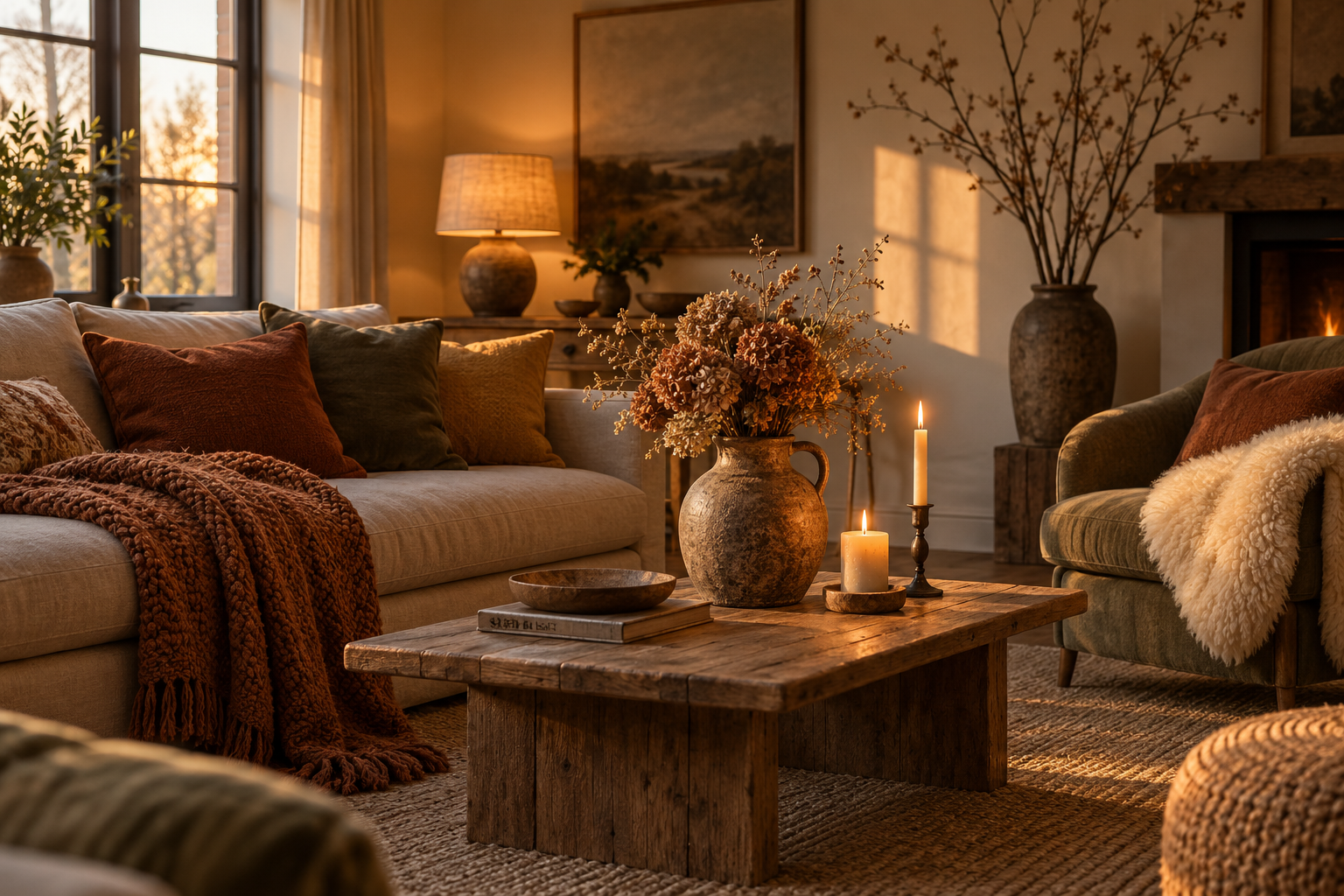
Autumn is far wider than orange. The most sophisticated seasonal palettes draw from late-season gardens: rust, ochre, mustard, olive and moss, chestnut, plum, mushroom, oatmeal and warm cream. Choose two or three of these, introduce them through small swappable items, and let them sit against whatever neutral scheme the room already has.
The mistake most people make is treating seasonal colour as a replacement rather than a layer. You are not redecorating. You are adding perhaps three accents to a room that already works, which is why the palette needs to relate to your existing furniture rather than fight it.
If your scheme is cool and grey, avoid warm orange entirely and lean into plum, deep green, charcoal and bronze, which sit comfortably with cool undertones. If your scheme is already warm, with oak, cream and beige, rust, ochre and moss will look as though they were always meant to be there. Rooms with strong existing colour need the smallest seasonal intervention: a single deeper accent repeated two or three times is usually enough.
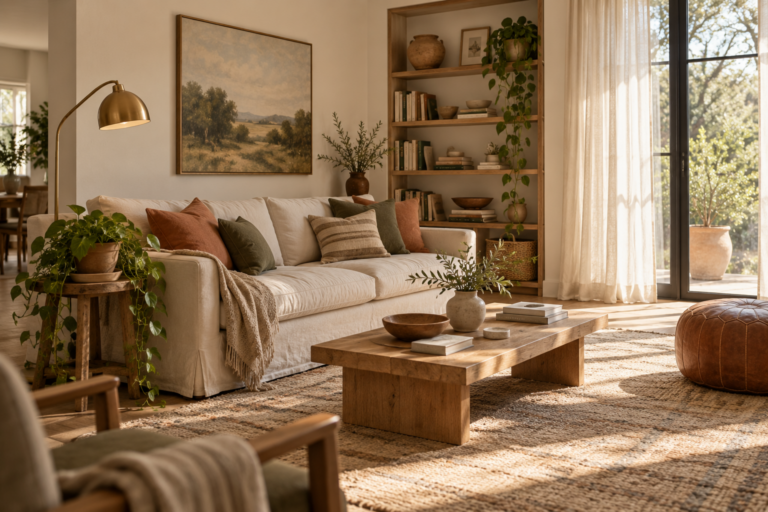
A useful discipline is the rule of three. Pick one dominant seasonal accent, one supporting shade and one darker anchor. Repeat the dominant accent at least three times around the room at different heights, so the eye reads it as a scheme rather than as one stray cushion. Three rust cushions, a rust-toned throw and a bowl of russet leaves will do more than a dozen unrelated seasonal items.
Natural materials carry colour for free. Dried hydrangeas fade to exactly the dusty pink, green and parchment tones that suit the season. Bare branches bring near-black vertical lines. Terracotta, unglazed stoneware, wicker, jute and untreated timber all sit in the autumn range without being bought specifically for it.
Consider the light your room receives when choosing. North-facing rooms take warm colours particularly well in autumn, because the accent colour supplies the warmth the light does not. South and west-facing rooms already glow in late-afternoon sun, so they can carry deeper, cooler autumn shades such as plum, forest green and dark brown without feeling heavy.
Layering Textiles for the Cooler Months
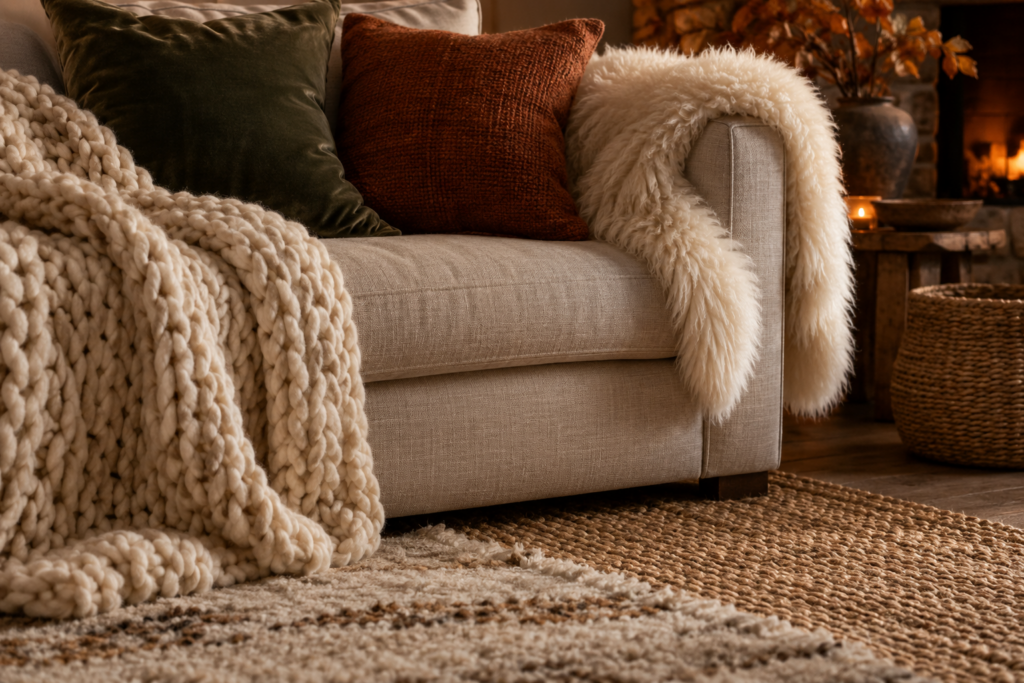
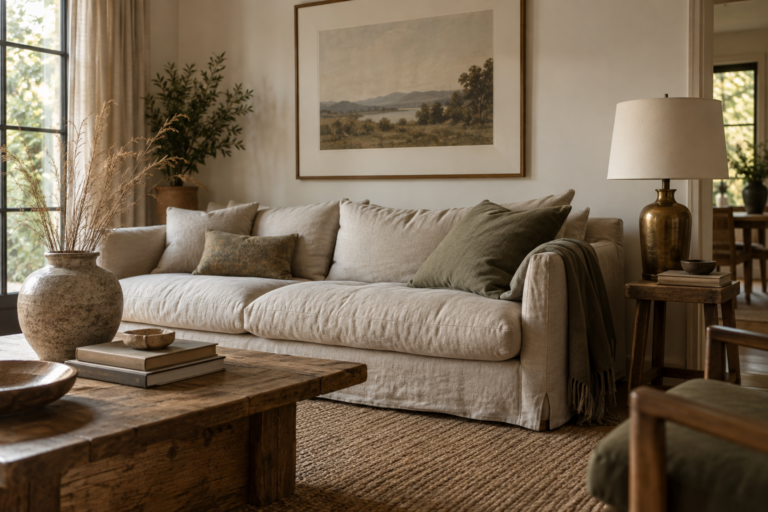
Textiles do the most work of anything in this guide. Swap lightweight summer cushion covers for wool, velvet, boucle and chunky knit, add throws with real weight, layer a soft rug over a larger flat-weave one, put heavier bedding on the bed, and let curtains hang full and lined. This single rotation changes how a house feels within an afternoon.
Weight is the thing to buy for. A thin fleece throw provides almost no physical warmth and reads as cheap, while a proper wool, waffle cotton or knitted throw with a woven or fringed edge is a genuine object of comfort. One good throw per seating area is enough. Drape it rather than folding it into a neat rectangle, since a slightly casual fold is what makes a room look occupied rather than staged.
Cushions are the cheapest seasonal change available if you buy covers rather than whole cushions. Keep the same pads year round and store the summer covers flat. Mix textures rather than matching: one velvet, one chunky knit, one woven wool, one plain linen. Odd numbers, varied sizes, and pads about two inches larger than the covers so nothing looks deflated.
Rugs matter more in autumn than at any other time because floors get cold. Layering a smaller soft rug over an existing large natural-fibre one gives warmth exactly where feet land, beside the bed, under the coffee table, in front of the sofa, without the cost of a full-size wool rug. Sheepskins or small wool rugs over hard chairs do the same job at a smaller scale.
Beds need a proper seasonal change rather than an extra blanket thrown on top. Move to a heavier duvet or add a wool blanket between the sheet and duvet, switch to flannel or brushed cotton bedding if the house runs cold, and add a folded throw across the foot of the bed. Layered bedding photographs well, but more importantly it lets people regulate their own temperature during a season when nights vary wildly.
Do not overlook curtains. Heavier, lined curtains hung high and wide reduce heat loss noticeably as well as looking more generous. If you use lightweight curtains in summer, autumn is when the heavier pair earns its storage space.
How Do I Make a Room Feel Cosy Without Buying Anything New?
Rearrange for the season instead of shopping for it. Pull seating closer together to create a tighter conversation area, since wide summer layouts feel exposed in winter. Turn a chair towards a window or a fireplace. Move a floor lamp beside a chair so there is somewhere obvious to read. Bring a rug from a less-used room into the main one. Take the throws and blankets already in the airing cupboard and put them where people actually sit. Clear the surfaces, then add one bowl of whatever is in season outdoors. Cosiness is largely a function of scale, light level and enclosure, all of which you can adjust for free in an hour.
Light and Scent as the Days Get Shorter
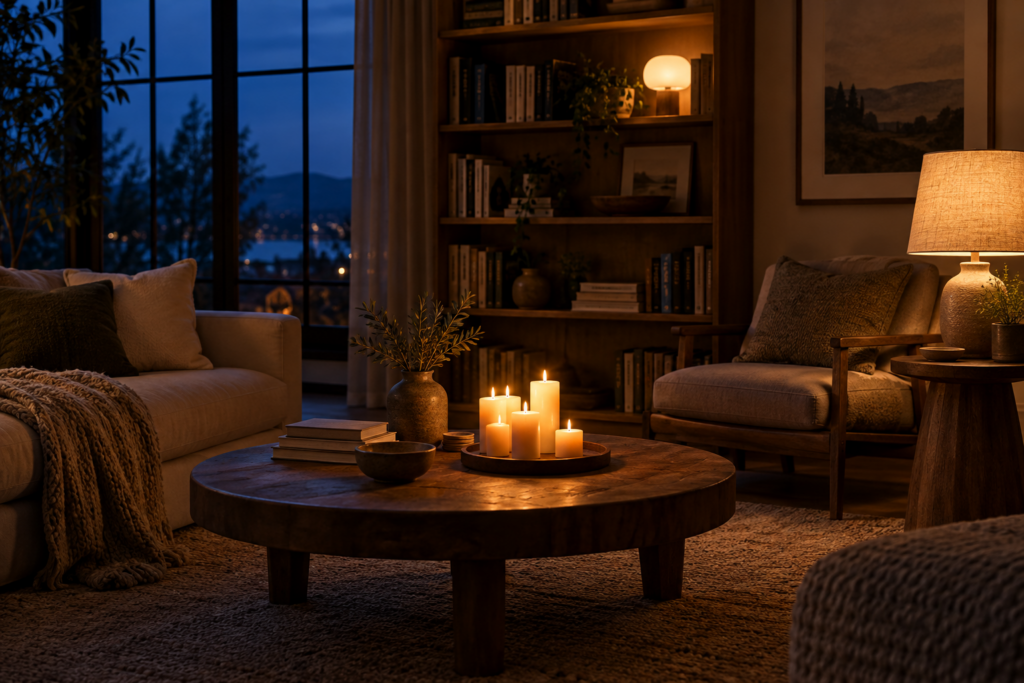
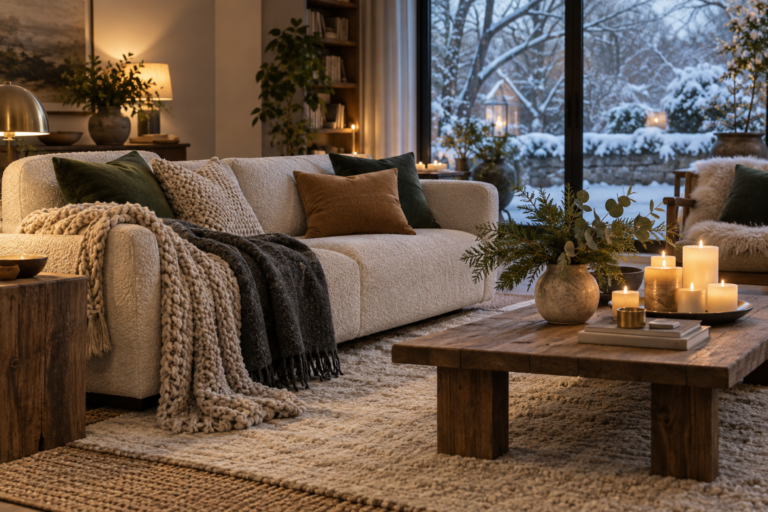
As daylight shortens, move light downwards and warm it up. Use several low-level lamps instead of a ceiling fixture, fit warm bulbs in the region of 2700K, add a dimmer to the main lamp, and introduce real or battery candlelight at different heights. The change in atmosphere from switching off the overhead light and turning on three lamps is immediate and costs almost nothing.
Position lamps where people actually sit rather than symmetrically around the room. A lamp beside the chair someone reads in is worth more than two matching lamps on a sideboard nobody uses. Aim for at least three separate light sources in a main room, on more than one switch, so you can drop the level in the evening rather than choosing between full brightness and darkness.
Candles are the classic autumn element and the one with real safety considerations. Trim wicks to a short length before each burn to reduce soot and flaring. On the first burn of a new candle, let it stay lit until the melted pool reaches the edges, which prevents it tunnelling and wasting most of the wax. Keep flames well away from curtains, shelves above, dried foliage and anything overhanging, place holders on stable heat-resistant surfaces, keep them out of draughts, and never leave them burning unattended or within reach of children or pets. For high shelves, mantels dressed with dried material and anywhere near fabric, good-quality flameless candles with warm flickering light are the sensible choice.
Grouping is what makes candles look styled rather than scattered: odd numbers, varied heights, on a tray or a slab of wood or stone, with a little clear space around them.
String lights deserve rehabilitating. Warm white lights, used sparingly and with the cable concealed, look genuinely lovely wound through a branch arrangement, along a shelf edge or inside a large glass vessel. Cool blue-white lights, or lights draped over everything, are what make the effect look like a student flat.
Scent works best when it smells like something happening rather than something sprayed. A pan of water simmering gently on low heat with orange peel, a cinnamon stick, a few cloves, sliced apple and a sprig of rosemary fills a house convincingly, costs nothing and uses up peelings. Keep an eye on it and top up the water, since the pan should never boil dry. Beyond that, one scented candle or a reed diffuser in a hallway is plenty; layering several competing scents through a house is overwhelming rather than welcoming. Households with cats should be cautious with essential oil diffusers, as several common oils are not safe for them.
Natural and Foraged Autumn Decor From the Garden
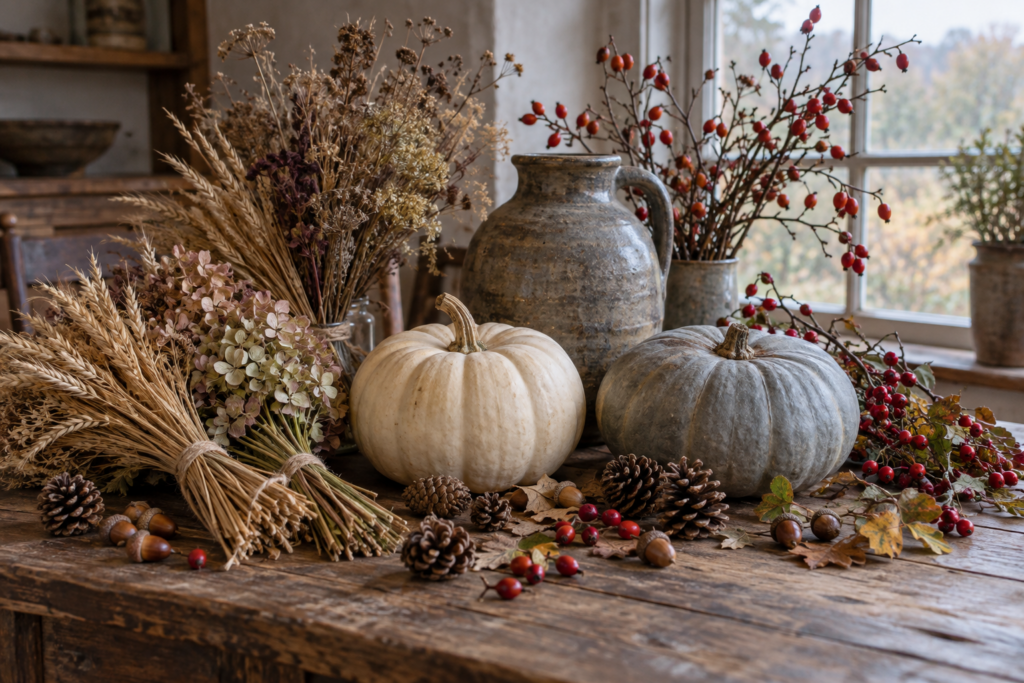
The best autumn decorating material is free and seasonal. Branches, seed heads, ornamental grasses, hydrangeas, rosehips, teasels, acorns, conkers, pine cones, apples and squash all look better than anything manufactured to resemble them. Gather in dry weather, dry properly where needed, and check that anything you bring indoors is safe around pets and children.
Drying is simpler than it sounds. Most stems dry well hung upside down in small bunches, bound with an elastic band that tightens as they shrink, in a dark, dry, airy place for two to three weeks. Grasses, statice, strawflowers, lavender and seed heads all respond to this. Hydrangeas are the exception and prefer the water method: cut them late in the season when the petals already feel slightly papery rather than soft, stand them in a vase with an inch or two of water, and simply let the water evaporate. They hold their shape and fade to beautiful dusty tones.
Branches are the most underused autumn decoration. A few tall bare or berried branches in a heavy floor vase fill a corner that no piece of furniture can, and they last all season. Cut on a slant, strip anything that would sit below the water line if using fresh stems, and keep the arrangement loose and asymmetric rather than evenly fanned.
Leaves can be preserved if you want them to last. Pressing between sheets of paper under a stack of heavy books for a week or two works for individual leaves destined for framing. For whole branches that stay supple, standing the cut stems in a solution of roughly one part glycerine to two parts warm water for a couple of weeks lets the foliage draw it up and keeps it pliable rather than brittle.
Pumpkins and squash are worth choosing carefully. Beyond the standard orange, look for pale cream, blue-grey, deep green and ribbed heirloom varieties, which sit far better in a neutral interior. Group them in odd numbers with varied sizes, or use a single large one as a sculptural object rather than lining up a row.
A wreath made from foraged material is an afternoon project. Start with a grapevine or wire base, build small bundles of three to five stems, and wire each bundle onto the base overlapping the previous one, all facing the same direction, until the base is covered. Mixing textures, something feathery, something round like seed heads or rosehips, and something structural like eucalyptus or dried hydrangea, is what stops it looking flat.
One safety note worth making: several decorative berries, seeds and foliage are toxic to cats, dogs and small children, and conkers and acorns are a hazard if chewed. Place natural arrangements above reach, and look up anything you are unsure about before bringing it inside.
How Do I Stop Real Pumpkins From Rotting?
Choose firm, unblemished pumpkins with the stalk still attached, since a broken stalk lets rot in. Wash the outside gently and dry it completely before displaying, keep them off damp surfaces, out of direct sun and away from radiators, and lift them occasionally to check the underside. Uncut pumpkins kept somewhere cool and dry will usually hold for a couple of months, which comfortably covers the season. Once cut or carved, the clock speeds up dramatically and you should expect days rather than weeks, so carve late in the season rather than early. Displaying them outdoors on a shaded, well-drained porch step rather than a sun-baked doorstep also buys considerable extra time.
Entryways, Mantels, Tables and the Shift Into Winter

Concentrate seasonal decorating where it is seen and used: the entrance, one mantel or shelf, and the table where people eat. Each has a simple formula, and together they deliver most of the seasonal feeling in a house for a modest amount of effort.
The Entrance
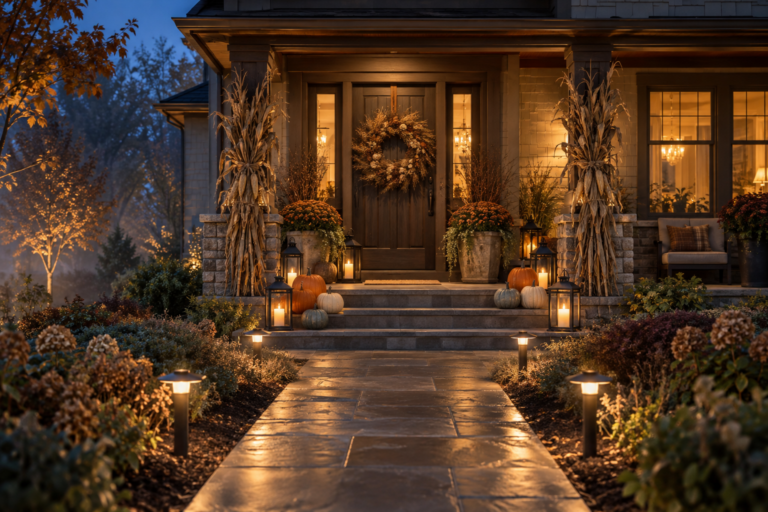
The entry sets the tone before anyone takes their coat off. A wreath or a bundle of dried stems on the door, a pair of pumpkins or a large planted pot on the step, a doormat that copes with wet leaves, a lamp on the console rather than only a ceiling light, and a basket for boots covers almost every hallway. Somewhere to hang damp coats and a runner that tolerates muddy shoes are the practical half of autumn entry decorating, and they matter more than the decorative half.
Mantels and Shelves
The reliable formula is asymmetric layering. Put something tall at one end, such as a branch arrangement or a large candlestick. Lean a mirror or a framed piece behind rather than centring it. Add a cluster of objects at a different height on the opposite side, keep to odd numbers, let one element trail over the edge, and leave real breathing space between groupings. Vary materials: something wooden, something ceramic, something dried, something with a flame or glow.
The Table
Autumn is the season of people eating together, so the table deserves attention. A runner reads as more relaxed than a full cloth. Keep any centrepiece low, well under the eye level of a seated person, so conversation carries across the table, or use a line of small vessels instead of one large arrangement. Mixed candle heights, taper candles in simple holders, linen napkins tied with twine and a single sprig, and a few leaves or small gourds laid directly on the wood will cover almost any gathering. Add a little more than you think you need in the way of serving surfaces and trivets, since that is what actually makes hosting easier.
When to Start and How to Move Into Winter

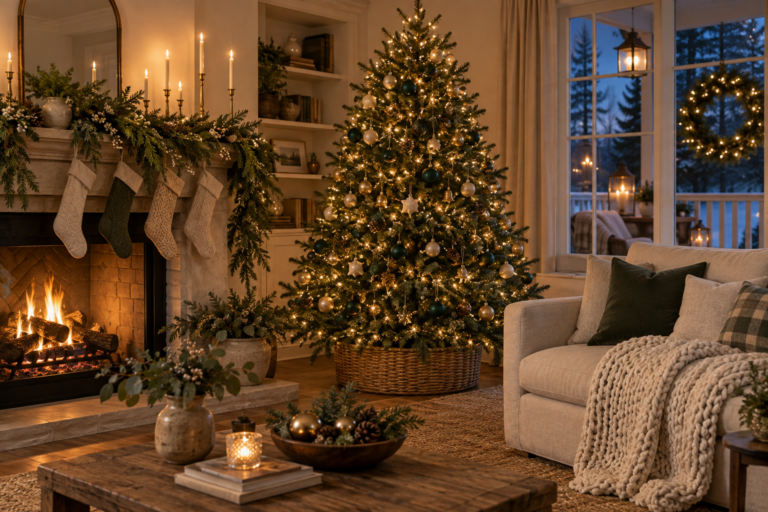
Begin subtly in early autumn with texture, warmer lighting and greenery rather than full seasonal colour, then build depth through October as the light drops. Come late November, the transition into winter is a subtraction rather than a new project: remove anything overtly orange or harvest-specific, keep the textiles, candles, dried arrangements and neutral natural elements, and add evergreen foliage and a little metallic or white. The rooms carry straight through without a break.
Store what comes down properly so it is worth using again next year. One labelled box per season, textiles washed and stored flat or in breathable bags rather than sealed plastic, dried arrangements wrapped loosely in tissue in a rigid box, and candles kept somewhere cool and dark so they do not warp. Discard anything genuinely tired rather than storing it out of guilt, since the point of rotation is that everything you unpack still feels good.
Frequently Asked Questions
What colours work best for autumn home decor?
Draw from the late-season garden rather than from a novelty range: rust, ochre, mustard, olive and moss green, chestnut, plum, mushroom, oatmeal and warm cream. Choose two or three that work with your existing scheme rather than replacing it. Cool grey interiors suit plum, deep green and bronze, while warm neutral interiors take rust, ochre and terracotta comfortably.
How can I decorate for autumn on a very small budget?
Start with what is free. Foraged branches, seed heads, grasses, pine cones, rosehips and dried hydrangeas cost nothing and look better than manufactured equivalents. Then rearrange rather than buy: move lamps, layer throws and rugs you already own, and light the room from low level. If you spend anything, spend it on cushion covers rather than whole cushions, and on one good throw.
How do I make my home smell like autumn without artificial air fresheners?
Simmer a pan of water on low heat with orange or apple peel, a cinnamon stick, a few cloves, star anise and a sprig of rosemary, topping up the water as it reduces and never leaving it unattended. Baking, dried lavender and cedar in cupboards, and one good beeswax or soy candle in a main room will do the rest. Keep it to one dominant scent rather than several competing ones.
How long do real pumpkins last as decoration?
An uncut, undamaged pumpkin with its stalk intact, kept cool, dry and out of direct sun, will usually last one to two months and often longer, which covers the full season. Carved pumpkins last only days to a week or so, depending on temperature. Keep them off damp ground, check the underside periodically, and carve as late in the season as you can.
Are dried flowers better than fresh for autumn arrangements?
For seasonal decorating, usually yes. Dried grasses, hydrangeas, seed heads and branches last the entire autumn, cost nothing if you grow or gather them, and their faded tones suit the season precisely. Fresh flowers are better for a specific occasion such as a dinner, where their short life is not a drawback. Many people combine both, using a permanent dried base and adding a few fresh stems when guests come.
How do I transition autumn decorating into winter?
Treat it as removal rather than replacement. Take away anything specifically harvest-themed or bright orange, keep the textiles, candles, lamps, dried arrangements and natural neutral materials, then add evergreen foliage, a few metallic or white accents and slightly more candlelight. Because the underlying layer is texture and warmth rather than seasonal objects, most of an autumn scheme carries straight into winter untouched.
How should I store seasonal decor so it lasts?
Use one labelled box per season and keep it accessible rather than buried. Wash textiles before storing and keep them flat or in breathable cotton bags rather than sealed plastic, which traps moisture. Pack dried arrangements loosely in tissue inside a rigid box so nothing crushes, and store candles somewhere cool and dark so they do not bend or bloom. Be ruthless about discarding anything that no longer looks good.
How do I decorate for autumn in a small flat or a rental?
Work with light, texture and scent rather than anything fixed. Swap bulbs for warm ones, add two lamps, layer throws and a small rug, put a branch arrangement in a corner where furniture will not fit, and set a bowl of seasonal fruit or gourds on the table. A wreath can hang from a removable adhesive hook or over a door using a slim door hanger, with no drilling required, and every part of it packs away into one box.