Christmas Home Decorating Ideas for Indoors and Outdoors
The houses that look best at Christmas are almost never the ones with the most decorations in them. They are the ones where somebody made a few decisions early: one colour family rather than four, warm lights rather than a mixture, three or four areas done properly rather than every surface covered. Restraint is the whole secret, and it also happens to be cheaper and considerably less exhausting.
This guide covers both halves of the job, the indoor decorating that people live with for six weeks and the outdoor decorating that has to survive weather and wiring. It includes the practical things that rarely make it into seasonal articles: how to keep a real tree alive, how to hang lights outside without damaging the house or risking a shock, which festive plants are a problem around pets, and how to pack everything away so next December starts well instead of with a box of knotted lights.
Plan Before You Unpack: Palette, Zones and a Realistic Timeline
Decide three things before opening a single box: the colour family you are working in, which areas of the house you will decorate properly, and when the work happens. A scheme built around two or three colours that already suit your rooms, concentrated in three or four zones, looks considered. Decorations spread evenly across every room look like storage.
Start with an inventory. Open the boxes in late November, lay everything out, and see what you actually own before buying anything. Almost everyone discovers duplicates, a set of lights that no longer works, and three things they never liked. Test every string of lights at this stage rather than at the top of a ladder in December.
Choose the palette from your house rather than from a shop display. A room with warm oak, cream and brass takes traditional green, red and gold beautifully. A cool grey and white interior looks better with silver, deep blue, white and natural wood. Neutral homes can carry the understated scheme of greenery, brass, cream and dried material that reads as expensive precisely because it is quiet. Whatever you pick, apply it consistently, because a single unified colour family is what separates a decorated house from a cluttered one.
Pick your zones honestly. For most homes the list is the tree, the main mantel or one shelf, the entrance including the front door, and the table where people eat. Adding a fifth, such as a staircase banister or a kitchen window, is a bonus rather than an obligation. Bedrooms and spare rooms rarely repay the effort.
On timing, most households decorate on the first weekend of December or at the start of Advent, which gives a good six weeks of use without the decorations feeling tired by the actual holiday. If you use a real tree, buying it in the first half of December and keeping it well watered is the balance between having it for the season and having it survive the season.
One more planning note: light and power. Work out where the sockets are before deciding where the tree goes, and count how many light sets you will be running from each one. Planning that now avoids the classic December scene of an extension lead snaking across a doorway.
The Tree: Choosing It, Positioning It and Decorating It Properly
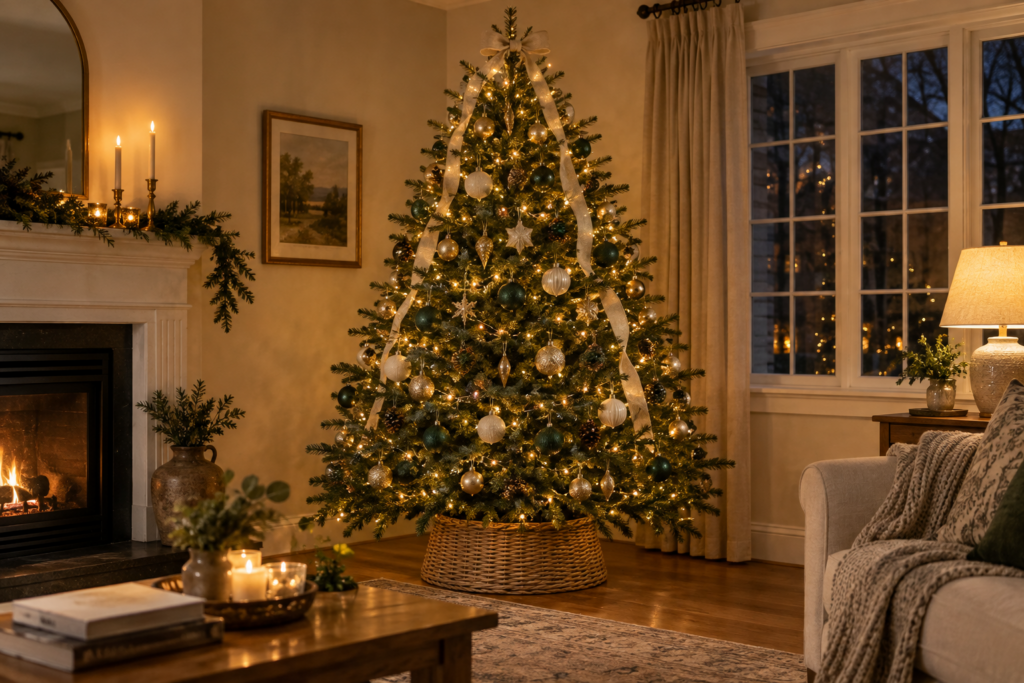
Light the tree first, then decorate it. Work the lights branch by branch from the trunk outward rather than spiralling them around the outside, so the depth of the tree glows rather than just its surface. Then layer ornaments in three passes: plain fillers deep inside, mid-size pieces in the middle, and your best pieces on the outer tips.
If you choose a real tree, variety matters more than people expect. Firs generally hold their needles far better than spruces, which is why they dominate the market, while spruces have the stronger traditional scent and typically cost less. If needle drop on the carpet is your main concern, a fir is the safer choice; if scent matters more and you buy late, a spruce is fine.
Real tree care is simple and almost always skipped. Have a fresh cut taken across the base, or saw an inch or two off yourself, immediately before putting it in the stand, because the cut end seals with resin within hours and stops drawing water. Use a stand with a genuine water reservoir rather than a decorative pot with no water. Fill it as soon as the tree is up and check it daily, since a freshly cut tree can drink a surprising volume in its first week, and a stand that runs dry once will often refuse to take up water again. Keep the tree away from radiators, fires, heated vents and direct sunlight, all of which accelerate drying and needle drop.
Artificial trees have their own logic. Buy the best quality you can afford and keep it for a decade rather than replacing a cheap one every few years, look for a realistic mix of branch tip shapes, and spend a full ten minutes fluffing and separating the branches when you assemble it. That single step is the difference between a convincing tree and an obviously fake one.
Position matters. A tree looks best where it can be seen from the doorway and where it is not blocking a walkway or a radiator. Raising a smaller tree on a sturdy box or a side table, covered with a cloth, gives it presence in a room where a full-height tree will not fit.
For decorating, work in this order: lights, then ribbon or any garland element, then filler baubles, then statement ornaments, then the topper. Ribbon looks better in loose vertical cascades falling from the top than wound horizontally around the outside. Place ornaments in clusters of three at varied depths rather than spacing them evenly, and be deliberate about hanging some pieces well inside the tree, since that interior shadow and shine is what gives a tree dimension. Finish the base with a basket, a fabric collar or a folded length of linen, which looks better than most manufactured skirts.
How Many Lights Do I Need for My Tree?
A widely used guideline is around 100 lights for every foot of tree height for a full, generous look, so a six-foot tree takes roughly 600 lights and a seven-foot tree closer to 700. Halve that for a deliberately sparse, minimal effect, and add more if the tree is unusually wide or dense. Use one colour temperature throughout, since mixing warm white and cool white on the same tree is the most common lighting mistake and reads as unfinished. Check the manufacturer’s limit on how many sets may be connected end to end, and never exceed it.
Indoor Decorating Beyond the Tree
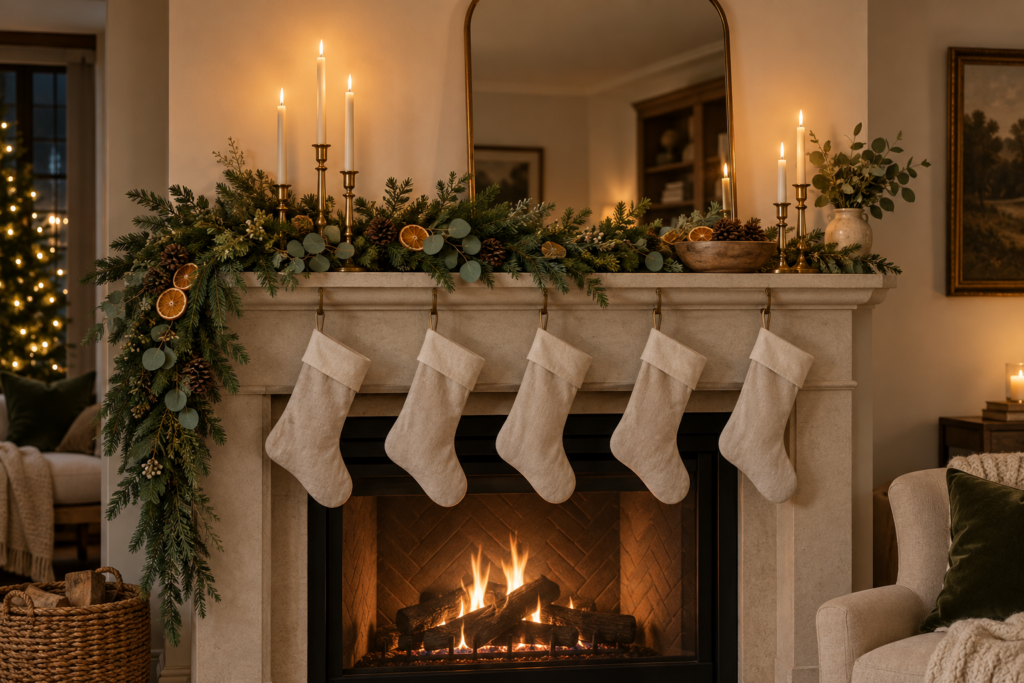
Concentrate the rest of the indoor work on the mantel or one main shelf, the staircase if you have one, the dining table, and windows visible from the street. Each of these has a simple repeatable formula, and together they carry the whole house without a single decoration reaching the spare bedroom.
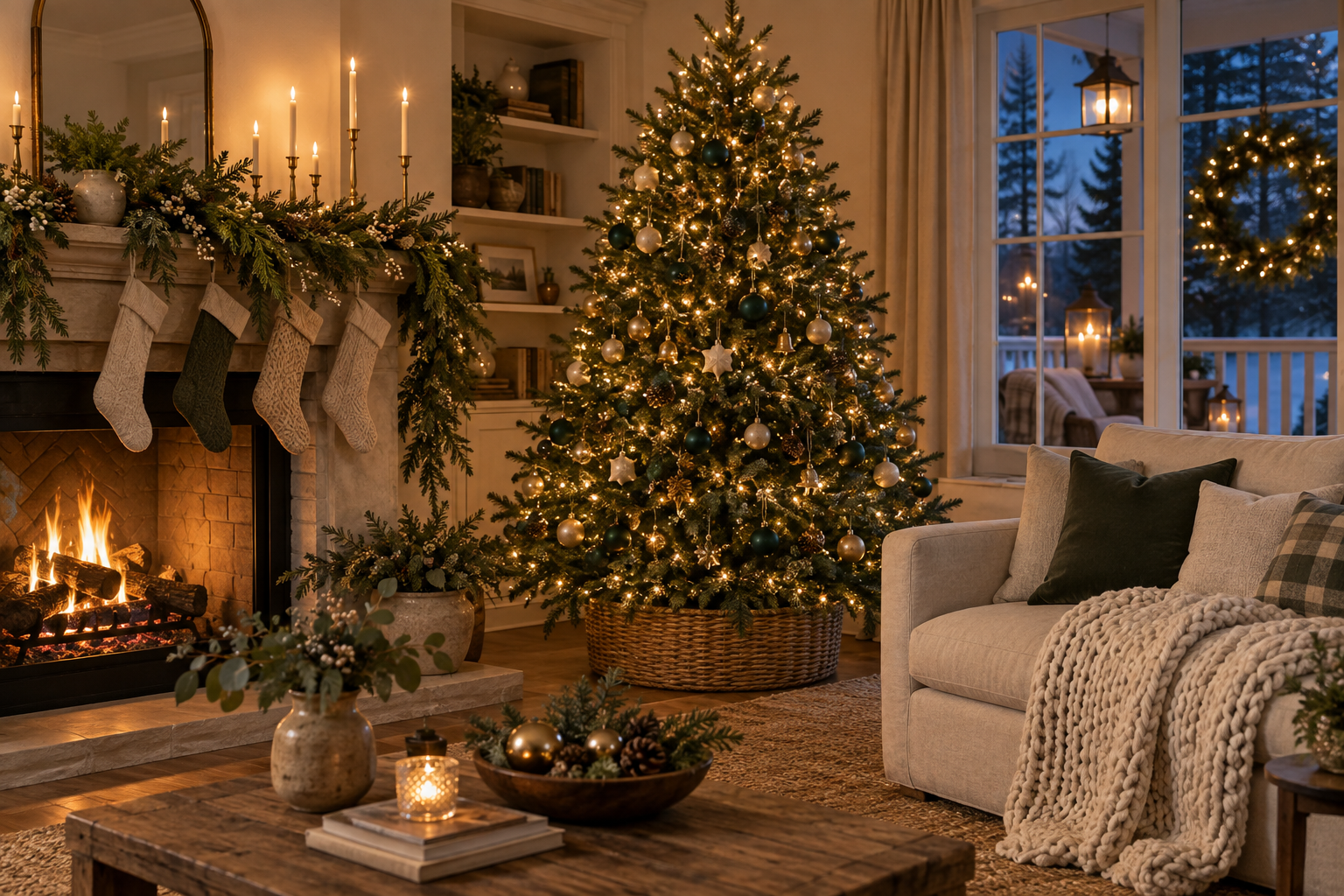
Mantels work best asymmetrically. Lay a garland along the shelf, letting it fall longer at one end than the other rather than draping it symmetrically. Add candlesticks in varied heights at one end, lean a mirror or framed piece behind and slightly off-centre, and cluster smaller objects, such as small brass bells, pine cones, or a few baubles in a bowl, on the opposite side. Leave real gaps between groupings. If you hang stockings, space them evenly and use proper mantel hooks rather than anything relying on adhesive over a working fireplace.
Staircases are the most dramatic indoor opportunity in a house that has one. Run garland along the outside of the banister, securing it at intervals with floral wire or ribbon ties rather than anything that marks the wood, and let it swag gently between fixing points rather than pulling it tight. Add lights woven through the greenery if the garland is not pre-lit, and make sure nothing obstructs the handrail, since people will be using the stairs in the dark and often carrying things.
Windows are worth decorating for their effect from outside as much as inside. A simple row of warm candle-style lights on sills, a small wreath hung in the centre of a window on ribbon, or a few branches with lights in a large vase will do more for the look of your house from the street than a lot of what goes on the front of it.
The table deserves its own thought because it is where people actually spend Christmas Day. Keep any centrepiece low enough to see across, or use a line of small vessels instead of one large arrangement. A linen runner, taper candles at mixed heights, a sprig of greenery on each napkin, and small name cards will look better than anything elaborate, and leaves more space for the food, which is the practical constraint everyone forgets.
Smaller homes have good options that are not just a miniature version of the same thing. A slim or half-depth tree against a wall, a tabletop tree raised on a console, a branch arrangement in a heavy floor vase strung with lights, a wall-hung arrangement of foliage, or simply concentrating everything into one well-decorated mantel and doorway all look deliberate rather than compromised.
Greenery, Scent and Natural Materials

Fresh greenery outperforms almost anything manufactured, and much of it is free. Pine, spruce, fir offcuts, eucalyptus, holly, ivy, rosemary, bay, pine cones, dried citrus and berried branches all cost little or nothing and give a house the scent and texture that plastic cannot. Most of it will stay good for two to four weeks indoors with a little care.
Ask at a tree lot for offcuts, since the trimming of tree bases produces a large quantity of usable branches that are often given away. Cut from your own garden where you can, and take sparingly and responsibly from anywhere else, with permission.
Making a wreath is an afternoon’s work. Start with a wire or moss-filled base, build small bundles of three to five stems mixing textures, and wire each bundle onto the base overlapping the last, all facing the same direction. A moss base soaked in water before you begin will keep fresh material alive considerably longer than a bare wire ring.
Dried orange slices are the classic homemade decoration and genuinely easy. Cut oranges into thin, even slices, blot them thoroughly on kitchen paper, lay them on a rack or lined tray, and dry them in an oven on its lowest setting for several hours, turning occasionally, until they are leathery and no longer damp in the centre. They will hang from ribbon on a tree, thread onto garlands, or sit in a bowl with cloves and cinnamon sticks. Clove-studded oranges, left to dry for a few weeks, do the same job and scent a room for the whole season.
How Do I Keep Fresh Wreaths and Garlands From Drying Out Indoors?
Heat is the enemy. Keep fresh greenery away from radiators, fires, heating vents and direct sunlight, and accept that a garland along a mantel above a working fire will dry fastest of anything in the house. Mist it with water every day or two using a spray bottle, ideally in the evening so it is not sitting wet under lights. Soak the wreath base before assembling if it is moss or foam, and rehydrate it by lying the whole wreath face down in shallow water for an hour every week or so. Outdoor wreaths last far longer than indoor ones simply because it is cold and damp outside, so if a wreath is looking tired, a night on the doorstep often revives it.
A word on safety with festive plants. Holly and mistletoe berries, ivy and yew are toxic if eaten, and lilies are dangerous to cats even in small amounts. Poinsettias are generally considered only mildly irritant rather than seriously poisonous, but they are still better kept out of reach. Cats are particularly drawn to tinsel and ribbon, which can cause serious internal injury if swallowed, and many households with cats simply skip both. Keep tree water covered where pets drink, and avoid additives in the reservoir if animals can reach it.
Outdoor Christmas Decorating That Looks Good and Stays Safe

Outdoor decorating has two rules that matter more than any aesthetic advice: use only lights and extension leads specifically rated for outdoor use, and protect the circuit with a residual current device or equivalent safety cutout. Beyond that, restraint and consistency do the work. One colour temperature, one or two ideas executed properly, and a scheme scaled to the house.
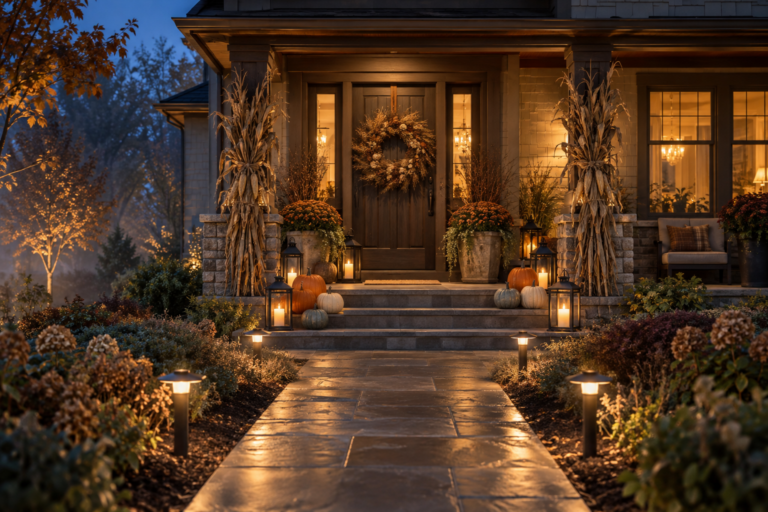
Begin at the front door, which is the highest-impact spot. A generous wreath, larger than instinct suggests, a garland around the frame, and a matched pair of planted pots or small clipped evergreens on either side is a complete scheme on its own. Winter planters filled with evergreen foliage, birch stems, dogwood branches and a few berries look good from late November through February, well past the holiday.
Lighting the exterior is where most of the effort and most of the risk sits. Work through it methodically.
Use outdoor-rated lights and cables throughout, and check the rating on every set and every connector. Keep all connections off the ground and out of standing water, or use proper weatherproof connector boxes. Plug everything into a socket protected by a safety cutout device. Do not daisy-chain more light sets together than the manufacturer permits, and do not run cables through a doorway or window where they will be pinched and eventually damaged. A timer switch is worth fitting; it saves electricity, saves you going out in the cold, and means the display is off overnight.
Fixing method matters for the house as much as for the lights. Use plastic light clips designed for gutters, roof edges and shingles, or outdoor-rated adhesive hooks on smooth painted surfaces. Never staple, nail or screw through a cable, and avoid anything that punctures roofing material or rendering. Clips take longer to fit and come off cleanly in January, which is the entire point.
Ladder safety is genuinely the most dangerous part of Christmas decorating. Work with someone else present, place the ladder on firm level ground and never on ice or wet decking, keep three points of contact, move the ladder rather than reaching sideways, and stop entirely if it is windy, icy or dark. Roofline lighting is not worth a fall, and there is no display that cannot be achieved at a lower height.
For the look itself, choose one colour temperature and stay with it. A house where the door garland is warm white, the hedge is cool white and the window is multicolour looks chaotic, while a single warm white scheme across the whole frontage looks expensive. Outline architecture rather than covering it: the roofline, the door frame, a single tree, the edge of a path. Let dark areas remain dark, since contrast is what makes the lit parts read.
Ground-level ideas often beat roofline ones. Stake lights along a path, lanterns on steps, a lit wreath on a gate, a single specimen tree wrapped at the trunk, and light strings woven through a hedge are all safe to install and effective. Check every fixing after the first serious wind or storm, and be ready to switch things off in severe weather.
How Do I Hang Outdoor Lights Without Damaging the House?
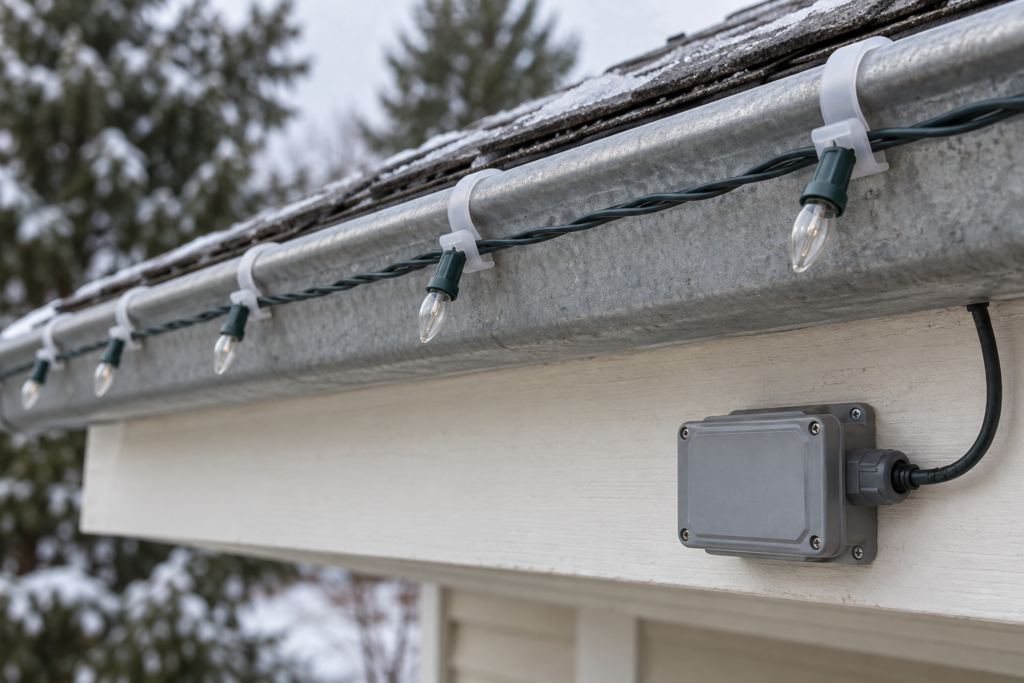
Use purpose-made light clips that hook over gutters, fascia boards and roof edges, and outdoor-rated adhesive hooks on smooth painted surfaces such as door frames and porch ceilings. For brickwork, brick clips that grip the mortar line avoid drilling altogether. Avoid staples, nails and screws through or near cables, and never fix anything through roofing felt, tiles or render. Wrap tree trunks and railings with the cable rather than fixing to them, and secure garlands around a door frame with floral wire looped to hooks rather than tape, which lifts paint when removed in the cold.
Taking It Down, Storing It Well and What to Buy Next Year
Most households take decorations down around the fifth or sixth of January, following the traditional twelve days. There is no rule beyond custom, and the practical argument is that a real tree will be dropping heavily by then anyway. What matters far more is how you pack it all away, because that decides how the following December begins.
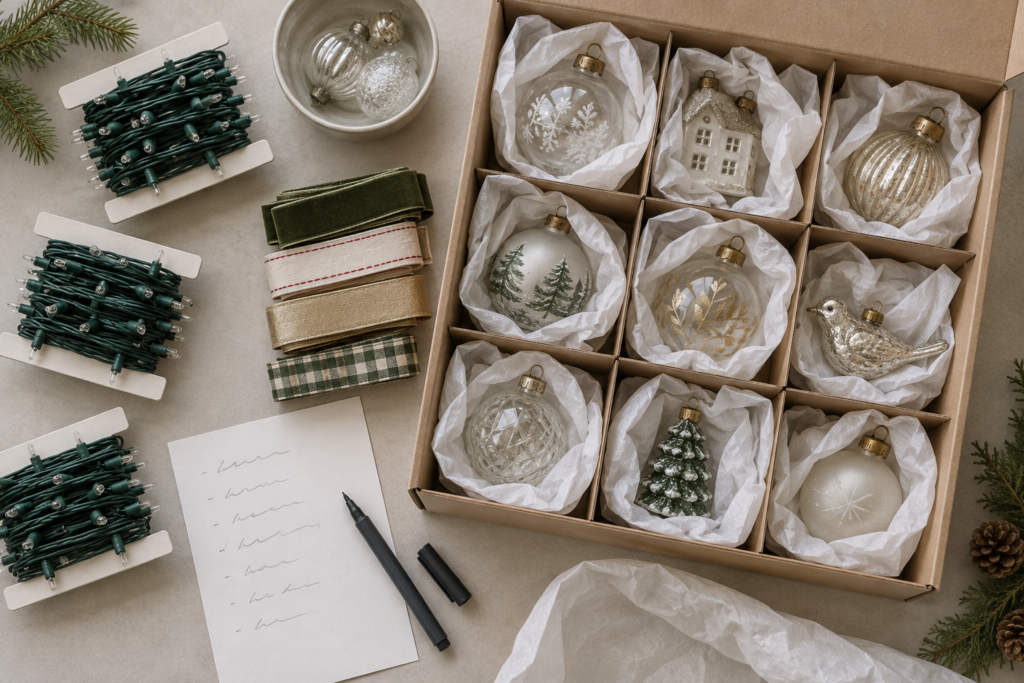
Lights are the main culprit. Wind each set around a reel, a piece of stiff card or a short length of timber rather than coiling it loosely, secure the end, and label which part of the house it belongs to. Ten minutes in January saves an hour of untangling next year. Discard any set with damaged insulation or a failing plug rather than storing it to deal with later.
Ornaments keep best in compartmented boxes or wrapped individually in tissue inside a rigid container, with heavier pieces at the bottom. Avoid newspaper, which can transfer ink. Artificial trees and garlands go into breathable bags rather than sealed plastic, ideally somewhere that does not swing between freezing and hot, since lofts are hard on both branches and wiring.
Real trees are widely collected for chipping in January, and many councils and garden centres run collection or drop-off schemes. Chipped, the material makes excellent mulch, and if you have space, the trunk can be cut for logs or left as habitat. A potted tree with roots can go back outside and be reused for several years if it was kept cool, well watered and indoors for no more than a week or two.
January is also the cheapest time to buy for next year. Lights, garlands, ribbon, wrapping and decorations are reduced sharply in the days after the holiday, and quality does not change with the calendar. Keep a short list on your phone of what was missing or broken this year, buy those specific things in the sales, and write what you bought on the outside of the box so you do not duplicate it in November.
Finally, keep an inventory list inside the first box you open. Even a scrap of paper listing what is in each container, and what needs replacing, turns the whole process from an annual excavation into a straightforward afternoon.
Frequently Asked Questions
When should I put up Christmas decorations?
Most households decorate on the first weekend of December or at the beginning of Advent, which gives several weeks of enjoyment without everything looking tired before the holiday itself. If you use a real tree, buying it in the first half of December and keeping the stand topped up with water is the best balance between a long season and a tree that still looks good on the day.
How many lights do I need for a Christmas tree?
Roughly 100 lights per foot of tree height gives a full, generous look, so about 600 for a six-foot tree. Use half that for a deliberately sparse effect and more for an unusually wide or dense tree. Stay with one colour temperature throughout, and check how many sets the manufacturer allows to be connected together before you start.
Is a real or artificial Christmas tree the better choice?
Real trees give scent, texture and a natural shape, need watering, drop needles and are usually recyclable through local collection schemes. Good artificial trees are convenient, allergen-free and cost effective if kept for many years, but cheap ones look it and do not last. The environmental comparison depends heavily on how long an artificial tree is kept and how a real one is disposed of, so the honest answer is that either can be a reasonable choice.
How do I stop a real tree dropping its needles?
Choose a fir rather than a spruce if needle retention is your priority, have a fresh cut taken across the base immediately before it goes into the stand, and get it into water within a few hours. Use a stand with a proper reservoir, check the water daily, and never let it run dry. Keep the tree away from radiators, fires and direct sun, which are the main causes of rapid drying.
How can I decorate for Christmas on a small budget?
Lean on greenery and lights. Free offcuts from a tree lot, foliage from the garden, pine cones, dried orange slices and clove-studded oranges cost almost nothing and look better than inexpensive plastic decorations. Spend what budget you have on one good string of warm white lights and one generous door wreath, then concentrate everything on the door, the mantel and the table rather than spreading it thinly.
Which Christmas plants and decorations are unsafe around pets?
Holly and mistletoe berries, ivy and yew are toxic if eaten, and lilies are seriously dangerous to cats. Poinsettias are usually only mildly irritant but are still best kept out of reach. Tinsel and ribbon are a significant risk to cats if swallowed, tree water should be covered where animals can drink it, and any additive in the reservoir should be avoided in a household with pets.
Should I choose warm white or cool white lights?
Warm white suits most homes, particularly those with wood, brass, cream or traditional colour schemes, and reads as cosy rather than clinical. Cool white or icy blue tones suit modern grey and white interiors and can look striking outdoors against snow. The important thing is consistency: pick one and use it throughout a given space, since mixing temperatures on the same tree or the same house front is what makes a display look accidental.
When should decorations come down, and how should I store them?
Tradition puts it at the fifth or sixth of January, and a real tree will be shedding heavily by then in any case. Wind each set of lights onto a reel or card and label it, wrap ornaments in tissue inside rigid compartmented boxes, store artificial greenery in breathable bags rather than sealed plastic, and keep a written inventory in the top box. Note anything broken or missing and buy those items in the January sales.