Luxury Home Decor: Top Designers, Brands and High-End Style Ideas
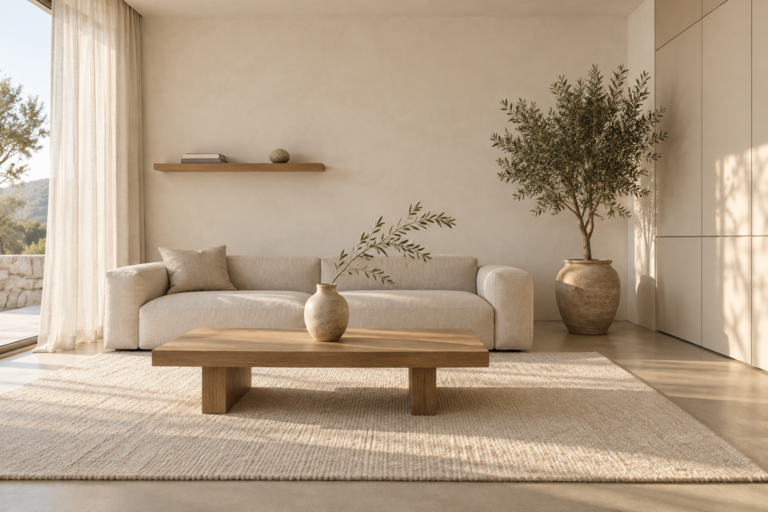
The most expensive room I have ever stood in did not look expensive. Plaster walls, a plain linen sofa, a rug you could have walked past without noticing, and almost nothing on any surface. What registered instead was a kind of stillness. The light fell differently because the plaster absorbed it. The door closed with…
The most expensive room I have ever stood in did not look expensive. Plaster walls, a plain linen sofa, a rug you could have walked past without noticing, and almost nothing on any surface. What registered instead was a kind of stillness. The light fell differently because the plaster absorbed it. The door closed with a soft, weighted click. Nothing in the room had a visible seam in the wrong place.
That is the first thing worth understanding about high-end decorating: at the top of the market, the money stops going into things you can see from across a room and starts going into things you notice only when they are absent. Solid material instead of veneer. Joinery instead of fixings. Hand-finished surfaces that shift as the light moves.
It also means the gap between a genuinely luxurious room and an expensive-looking one is not primarily a budget gap. A great deal of very costly decorating produces rooms that feel like hotel lobbies, and a great deal of modest decorating produces rooms that feel considered and rich. What follows covers the designers who shaped the field, the brands worth knowing and what each is actually known for, where the money genuinely goes, and how to borrow the principles without the budget.
What Actually Makes a Room Read as Luxury
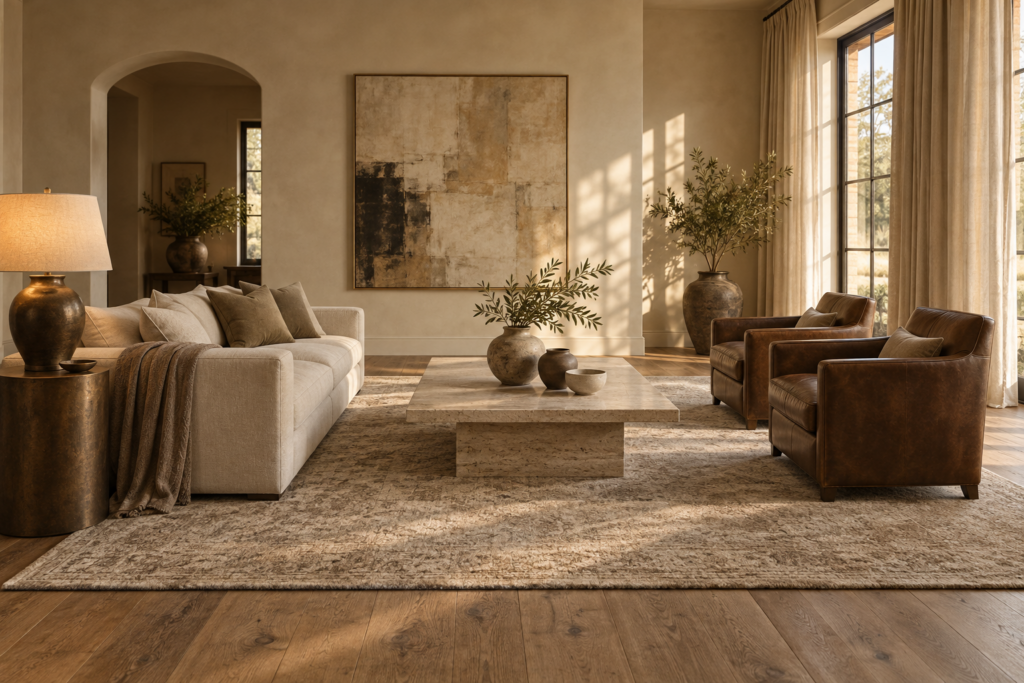
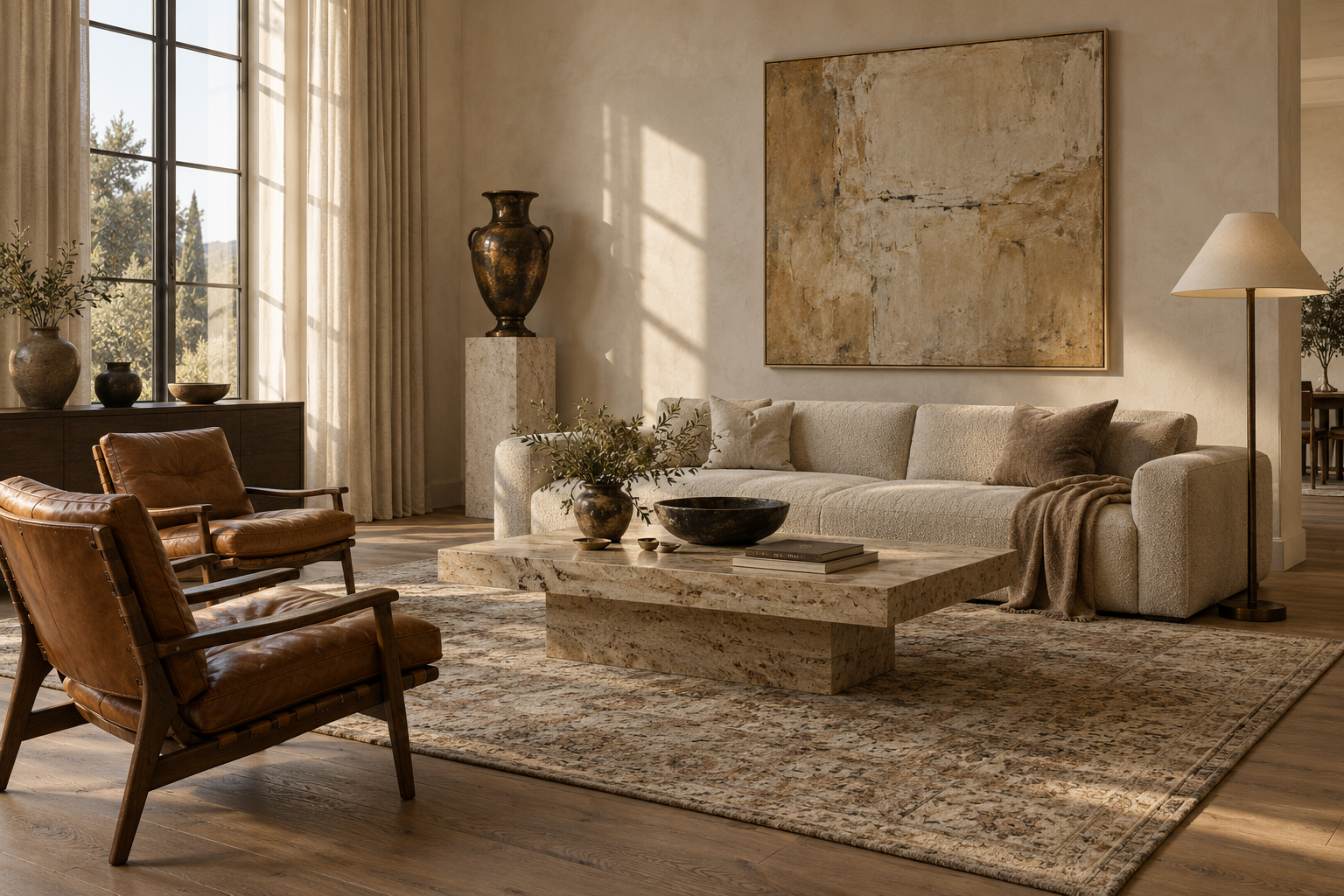
Luxury in interiors comes from four things: proportion, material quality, restraint in the number of elements, and the quality of light. Price is not on that list. A room with correct proportions, honest materials, a small number of well-chosen pieces and layered warm lighting will read as high-end even when very little in it was expensive.
Proportion is the most invisible and the most decisive. Furniture scaled correctly for the room, art hung at the right height, curtains that reach the floor, a rug large enough to hold the whole seating arrangement, a coffee table within a few centimetres of the sofa seat height. Get these wrong and no amount of spending recovers the room. Get them right and an ordinary sofa looks deliberate.
Material honesty is the second pillar. Solid wood rather than printed foil over chipboard. Real stone rather than a photograph of stone. Wool, linen, leather and cotton rather than polyester imitating them. Brass and bronze that develop a patina rather than a lacquered gold finish that stays identical for a decade and then chips. What separates these is not only how they look on day one but how they age. Expensive materials get better. Cheap ones announce their age all at once.
Restraint does more work than most people expect, though it is worth separating restraint from minimalism. A high-end room can be densely layered. What it rarely is, is arbitrary. Every element earns its place, and the number of competing focal points stays low. When people describe a room as feeling calm despite being full, they are usually responding to a controlled palette and a clear hierarchy rather than to emptiness.
Light is the pillar most often neglected. Designers working at this level treat lighting as a design layer in its own right, with separate circuits, dimmers on everything, warm colour temperature throughout, and fixtures chosen for the quality of light they cast rather than only their appearance. A beautiful room under a single cool overhead fixture looks like a showroom after hours. The same room with five warm sources at three heights looks like somewhere you want to stay.
Then there is the fifth thing, which is harder to systematise: evidence of a specific person. Rooms assembled entirely from current retail stock are technically correct and completely forgettable. The interiors that feel genuinely rich almost always contain something inherited, something collected slowly, or something odd that only makes sense to the person who chose it.
Is luxury decor the same as expensive decor?
No, and conflating the two is the most expensive mistake in decorating. Expensive decor is a spending level. Luxury is a set of qualities, principally material integrity, correct proportion, hand-finishing and good light, that can be partly achieved at many price points and can be entirely missed at the top of the market.
The distinction shows up most clearly in what is often called quiet luxury, a way of decorating that removes visible branding, avoids ostentation and puts the entire budget into material and craft. A cashmere throw with no logo, a hand-plastered wall, a solid oak door with a concealed hinge. None of it announces itself. All of it costs considerably more than the equivalent that does.
The opposite approach, sometimes called logo-driven or aspirational decorating, spends on signals: recognisable pattern, high-shine finishes, visible branding, obvious references to expensive things. It photographs well and reads as expensive rather than as good, and it dates faster because the signals it relies on are tied to a moment.
Neither is morally superior, but they age very differently. If you want a room to look expensive next year, buy the signals. If you want a room to look good in twenty years, buy the material.
The Designers Who Shaped High-End Interiors
Knowing the major names is useful less for name-dropping and more for shorthand. Each represents a coherent approach you can borrow deliberately rather than absorbing second-hand through a thousand copied images.
The historical figures established the field. Elsie de Wolfe is generally credited with inventing the profession of interior decorator in the early twentieth century, stripping out Victorian darkness in favour of light, chintz and comfort. Jean-Michel Frank pioneered a luxurious minimalism in 1930s Paris, working in shagreen, parchment, straw marquetry and vellum, and his influence on contemporary quiet luxury is enormous. Syrie Maugham made the all-white room famous. Billy Baldwin built a reputation on comfort, dark walls and slipper chairs. Sister Parish and Albert Hadley defined American decorating for decades, mixing grand antiques with genuinely comfortable, slightly worn furniture. David Hicks brought bold geometric pattern and sharp colour into English interiors. Madeleine Castaing created rooms of eccentric, layered romanticism. Andrée Putman reintroduced rigour and black-and-white restraint in the eighties.
Among contemporary designers, a few approaches are worth understanding because they represent genuinely different philosophies:
Axel Vervoordt built a following around what is often described as wabi-sabi luxury, meaning ancient materials, weathered surfaces, deep neutrals, antique objects placed sparsely, and a near-monastic calm. Rooms in this mode are expensive precisely because everything is real and old.
Peter Marino is known for high-luxury residential work and for designing flagship retail environments for major fashion houses, typically combining serious commissioned art, hard-edged architecture and rich material contrast.
Kelly Wearstler works in the opposite register, with bold colour, sculptural forms, mixed periods and a deliberately theatrical sense of scale. Her influence on contemporary American hospitality interiors is difficult to overstate.
Joseph Dirand produces a pared-back Parisian modernism, working with marble, plaster, brass and restrained palettes in rooms defined by architectural proportion rather than objects.
India Mahdavi is recognised for saturated colour and playful geometry, largely in hospitality settings, and for demonstrating that high-end need not mean neutral.
Rose Uniacke and Ilse Crawford both work in a softer English idiom, emphasising comfort, tactile material and a human-centred approach to how rooms are actually used.
Vincent Van Duysen and John Pawson sit at the architectural minimalist end, where the luxury is entirely in proportion, natural light, and the perfection of junctions between surfaces.
Jean-Louis Deniot works in a classical French mode updated with contemporary lines, and Studio KO in a Mediterranean and North African register of earth tones, plaster and stone.
The practical value of this list is in diagnosis. If you find yourself drawn consistently to images from one of these worlds, you have identified your palette, your material preferences and your tolerance for colour in a single move. Trying to combine two opposing philosophies in one room, say Vervoordt’s austerity with Wearstler’s exuberance, is where a great deal of expensive confusion comes from.
The Brands Worth Knowing, and What Each Is Actually Known For
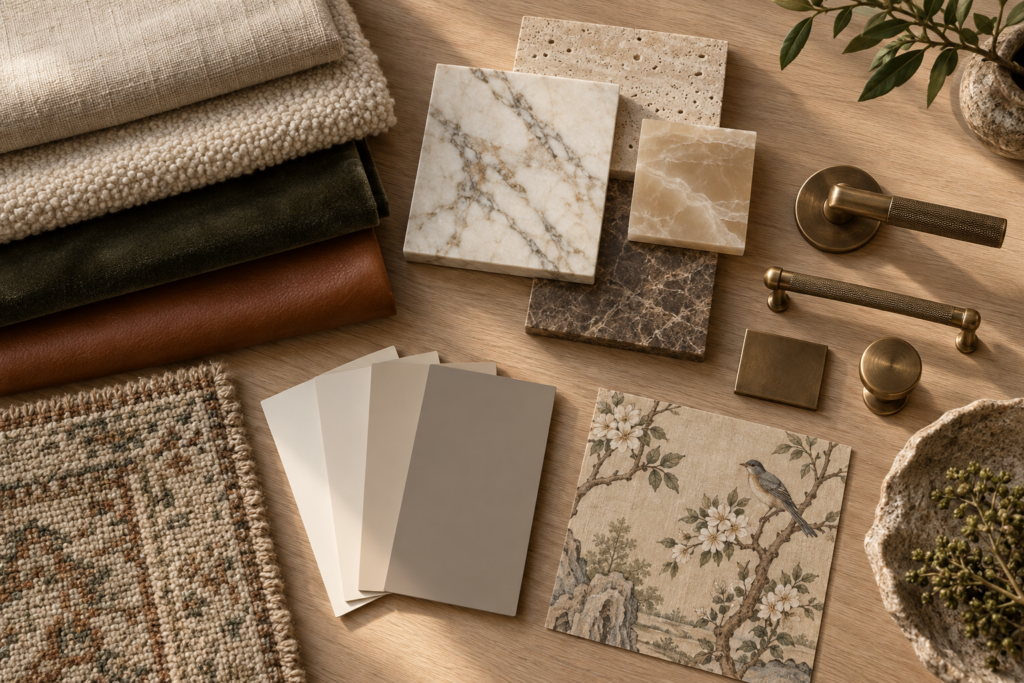
High-end brands are best understood by category, because almost none are good at everything. A designer specifying a room will typically pull from a dozen different houses, each chosen for the one thing it does better than anyone else.
Upholstery and furniture. The Italian houses dominate contemporary upholstery, with B&B Italia, Minotti, Flexform, Molteni&C, Poliform, Giorgetti, Baxter and Poltrona Frau each occupying a recognisable position between architectural sharpness and deep comfort. Cassina and Knoll hold licences to produce many twentieth-century design classics to the original specifications. Vitra and Herman Miller do the same for a different set of icons. Christian Liaigre built a reputation on dark, restrained, architectural furniture. Promemoria works in a more decorative Italian mode. On the English side, George Smith is known for deep traditional upholstery and Howard-style seating.
Fabric and wallcovering. This is where high-end interiors quietly spend a great deal. Fortuny still produces its distinctive printed cottons in Venice using a closely guarded process developed over a century ago. Pierre Frey, Rubelli, Dedar, Lelièvre, Nobilis, Zoffany, Colefax and Fowler, Schumacher and Brunschwig & Fils each hold significant archives of historical patterns. Holland & Sherry and Loro Piana Interiors sit at the top of the wool and cashmere end. For hand-painted wallpaper, de Gournay and Gracie are the two names that recur constantly in high-end chinoiserie and scenic panels, each panel painted by hand and scaled to the specific wall.
Rugs. Hand-knotting is the dividing line. The Rug Company, Tai Ping and Tim Page are known for bespoke contemporary work, while antique Persian, Turkish and Aubusson rugs remain the traditional high-end choice. A hand-knotted wool and silk rug takes months of work and is priced accordingly.
Lighting. Visual Comfort is the broad workhorse in American high-end interiors. Apparatus, Roll & Hill, Lindsey Adelman, Bocci and Ochre sit in the sculptural, design-led space. Flos and Artemide carry the Italian architectural tradition. Porta Romana and Vaughan are English names associated with decorative table and floor lighting. Glass houses including Venini, Baccarat, Lalique and Lasvit supply the chandeliers and art glass that anchor formal rooms.
Hardware and fittings. Almost invisible and disproportionately important. P.E. Guerin, Nanz, Armac Martin and Frank Allart are known for solid cast and machined hardware in unlacquered brass and bronze. For bathrooms, Waterworks, Lefroy Brooks, Dornbracht, THG and Volevatch sit at the high end. Kitchen fittings run to Officine Gullo, La Cornue and Lacanche for ranges, with Gaggenau and Sub-Zero on the appliance side.
Bedding and bed frames. Savoir Beds and Hästens are the two names that appear most often in the hand-built mattress category. For linens, Frette, D. Porthault, Rivolta Carmignani and Pratesi are the traditional houses.
Paint. Farrow & Ball, Little Greene, Paint & Paper Library and Benjamin Moore’s upper ranges recur constantly, largely because of pigment density and the way their flat finishes behave in changing light rather than because of the colours themselves.
Which luxury furniture brands are actually worth the money?
The ones where the price buys construction rather than a name. A sofa worth its cost has a kiln-dried hardwood frame that is jointed rather than stapled, eight-way hand-tied springs or a high-quality suspension system, high-density foam wrapped in down or a similar layer, and a cover cut so the pattern aligns across the seams. Those things cost real money to produce and they determine whether the piece is still good in fifteen years.
Case goods follow a similar logic. Solid timber or good veneer over a solid core, dovetailed drawers running on wooden runners or precision slides, finished backs and undersides, and doors that stay aligned. Rugs are worth the money when hand-knotted, since machine-made rugs of any price will flatten and wear differently.
The categories where high-end pricing often buys less than it appears are decorative accessories, mass-produced lighting from fashion-led brands, and anything where the value is concentrated in a recognisable silhouette rather than in materials. A reasonable rule: spend where the thing is used daily and structurally, meaning seating, beds, rugs and lighting, and be far more relaxed about everything that simply sits on a surface.
Where the Money Actually Goes: Materials, Craft and Finish
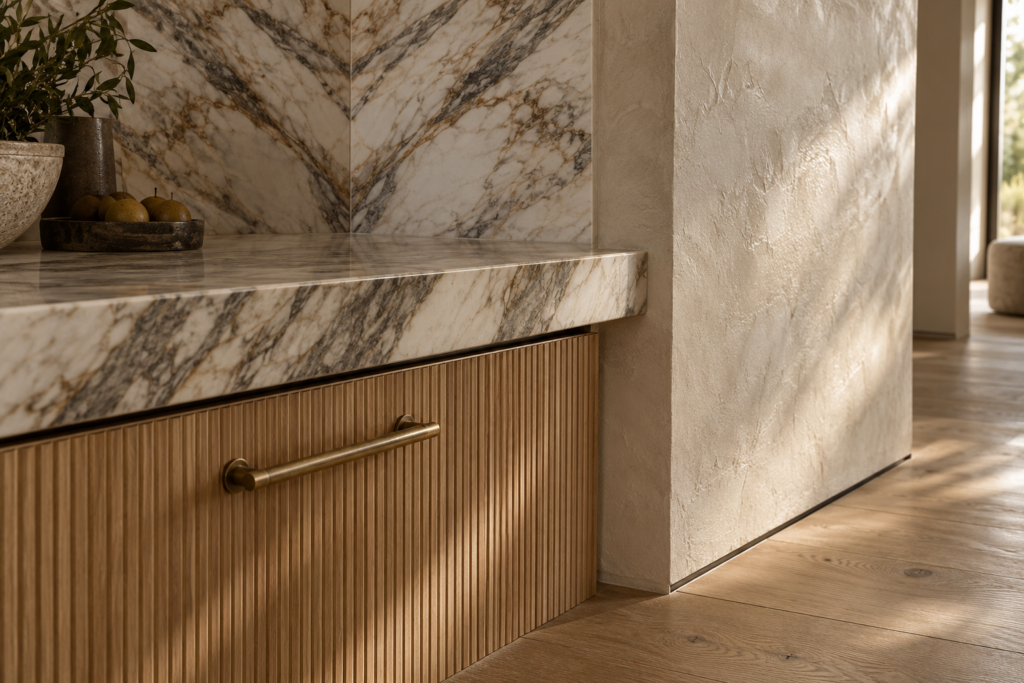
In genuinely high-end interiors, the largest share of a budget usually goes into surfaces and joinery rather than into furniture. This is counterintuitive until you notice that walls, floors, windows and built-in cabinetry make up almost everything you see.
Stone is a defining material, and how it is used matters more than which stone is chosen. Book-matching, where adjacent slabs are cut and opened like a book so the veining mirrors across a seam, is a signature of high-end work. So are thick mitred edges that make a countertop look like a solid block, waterfall ends, and full-height slab backsplashes rather than tiled ones. Marble, travertine, onyx and quartzite each behave differently, and part of specifying well is accepting that natural stone marks and patinates.
Wall finishes are where restraint becomes visibly expensive. Venetian plaster, limewash, tadelakt and hand-troweled finishes all produce a depth and light response that flat paint cannot. Panelled joinery, fluted or slatted timber, fabric-upholstered walls and hand-painted papers all do the same job of giving a wall texture and presence.
Joinery and millwork separate high-end houses from ordinary ones more reliably than any furniture purchase. Full-height doors, concealed hinges, shadow gaps where wall meets floor instead of skirting, built-in cabinetry scribed precisely to walls, and deep window reveals all read as quality even to people who could not name what they are seeing.
Metal should be considered as a finish with a lifespan. Unlacquered brass and bronze darken and develop character. Polished chrome and nickel stay bright and read as crisper and cooler. Mixing two metal finishes in a room is standard practice at this level, but three starts to look unresolved unless one is clearly dominant.
Textiles carry more of the perceived luxury than almost anything else, because they are what people touch. Weight and weave matter more than fibre alone. A heavy linen, a dense wool bouclé, a full-bodied velvet and a supple aniline leather all feel expensive in the hand. Curtains are the clearest example: fullness, meaning how many times the fabric width exceeds the track width, plus proper interlining, proper weights in the hem and a precise floor break, will make inexpensive fabric look considerably better than costly fabric hung badly.
Bespoke work is the last tier, and it is the genuine dividing line at the top of the market. Commissioned furniture, custom colour matching, upholstery made to a room’s exact dimensions, cabinetry built for a specific wall. The premium is significant and the result fits in a way nothing bought off a shelf can.
Getting the High-End Look on a Realistic Budget
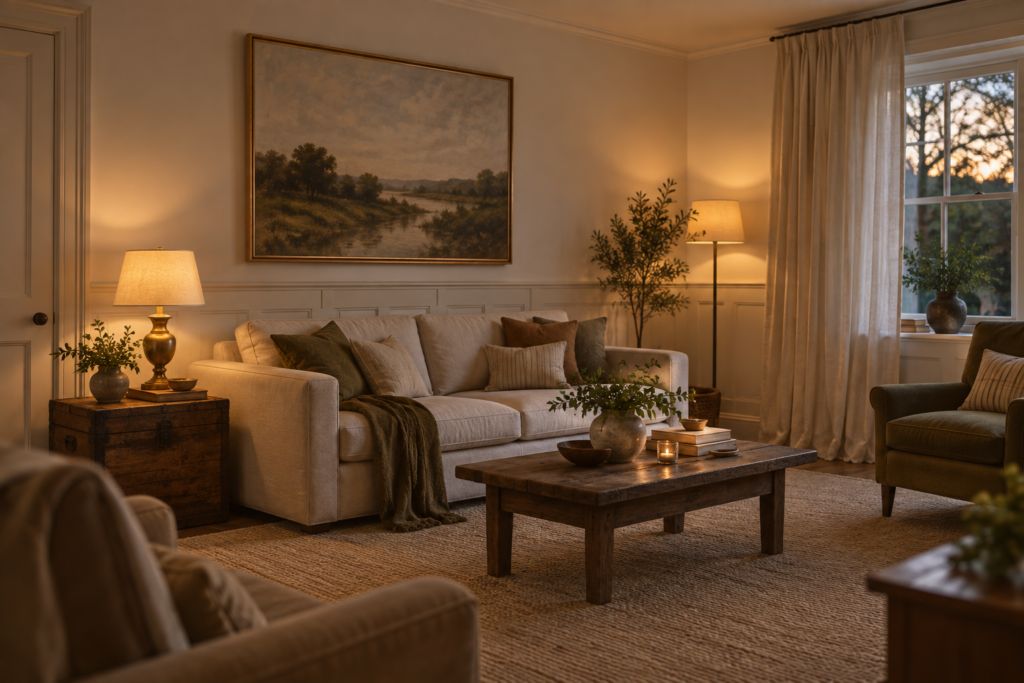
Most of what makes expensive rooms feel expensive is available cheaply, because it consists of decisions rather than purchases. The highest-impact moves cost very little.
Fix the proportions first. Hang curtains close to the ceiling rather than just above the window frame, extend the pole well past the frame on both sides, and let the fabric reach the floor with a slight break. Buy a rug one size larger than instinct suggests, so that at minimum the front legs of every seating piece sit on it. Hang art with its centre at roughly 145cm (57 inches) from the floor, treating a group as a single unit centred at the same height. These four changes cost almost nothing and transform a room.
Spend the whole lighting budget properly. Replace cool bulbs with warm ones throughout, at around 2700K. Add table and floor lamps until you have at least five sources in a living room at three different heights. Put everything you can on dimmers. If one purchase is possible, make it a single sculptural fixture in a place where it will be seen.
Upgrade what your hands touch. Door handles, cabinet hardware, light switches and tap fittings are small, cheap to change and disproportionately noticeable. Solid unlacquered brass hardware on ordinary cabinetry lifts a whole kitchen.
Use paint to buy architecture. Painting walls, trim, doors and sometimes the ceiling in the same colour, a technique usually called colour drenching, removes the choppiness of cheap mouldings and makes a plain room feel deliberate. Adding simple applied wall panelling, or replacing thin skirting with something deeper, brings architectural weight for the price of timber and a weekend.
Buy antique rather than new at the same price. This is the single best value in the entire field. Traditional wooden furniture currently sells secondhand for a fraction of new equivalents, and a solid antique chest, a hand-knotted rug with honest wear or a pair of vintage brass lamps will bring age and material quality that no new budget piece can match. Estate sales, regional auction houses and house clearances are the strongest sources, and mixed lots of ceramics, frames and lighting routinely sell for less than a single new cushion.
Choose one hero and let everything else be quiet. A budget spread evenly produces a room of mediocre things. The same budget concentrated into one genuinely good item, a rug, a light fixture, a piece of art or an antique chest, produces a room with a centre. Surround it with plain, well-proportioned, inexpensive pieces and the hero elevates them.
Edit hard. Removing half the objects in a room and grouping the remainder in threes with space between them costs nothing and is frequently the difference between cluttered and composed.
How do you make a new-build house feel high-end?
New builds usually fail on three specific things, and each has a direct fix. The problems are thin, undersized mouldings, flat unmodulated wall surfaces, and window openings that sit awkwardly in the wall. None require structural work to address.
Replace or build out the skirting and architraves with deeper profiles, and add a simple applied panelling to at least one wall in the main rooms. Change flat builder-grade paint for a chalky matte finish, or use limewash on a feature wall, which introduces the light variation plasterboard lacks. Hang curtains high and wide so the windows read as larger and better placed than they are. Swap the builder-grade lighting, internal door handles and switch plates, all of which are standardised and inexpensive to change. Then layer in genuinely old objects, since the one thing a new building cannot supply is age.
Floors are worth a mention because they are the largest surface. If the budget allows a single significant upgrade, moving from thin laminate to engineered oak in a wide plank with a matte oiled finish changes a house more than any furniture purchase.
Where Expensive Rooms Go Wrong
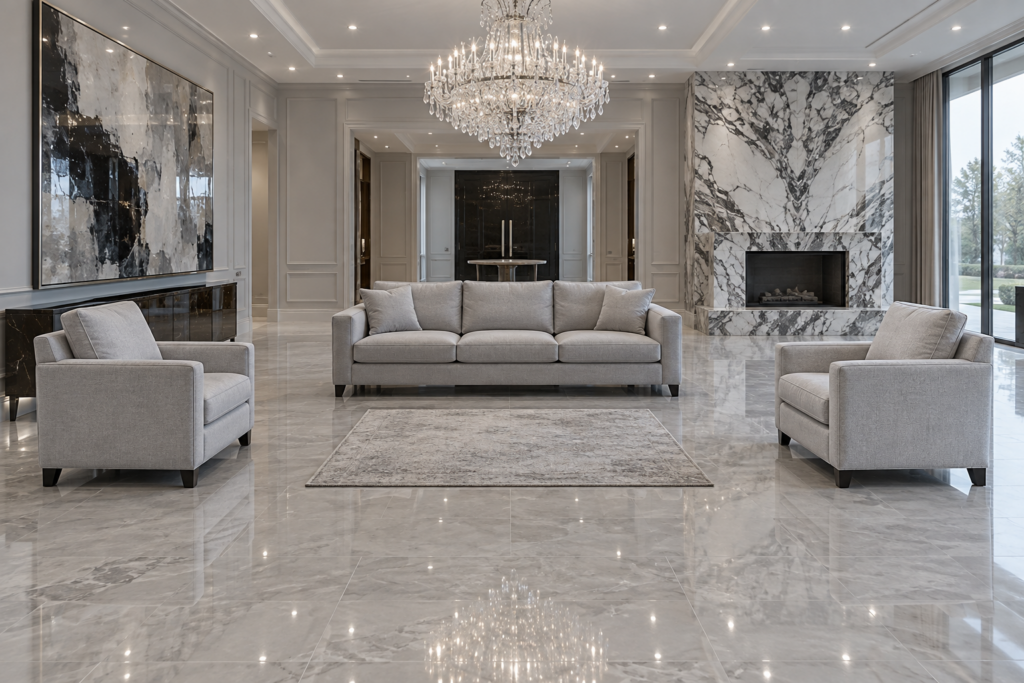
Failed high-end interiors fail predictably, and the causes are rarely about taste.
Everything bought at once, from one place. Matched suites and full-room packages produce spaces with no depth or history, whatever they cost. The fix is to introduce variation deliberately: one antique, one vintage piece, one thing inherited, different wood tones, different upholstery fabrics.
Grand without comfortable. Rooms that photograph beautifully and are unpleasant to sit in. Seat depth too shallow, upholstery too firm, no side table within reach of a chair, no lamp at reading height, nowhere to put a cup down. The best high-end designers are obsessive about exactly these details, and they are free to get right.
Scale confusion. Furniture too small for a large room, or oversized furniture jammed into a small one. Light fixtures that disappear in a double-height space. Art too small for the wall it sits on. Scale errors read as cheapness even when every individual item was costly.
Cold, flat lighting. The single most common destroyer of expensive rooms. High colour temperature bulbs, reliance on downlights, no dimmers, no lamps.
Too many focal points. A statement chandelier, a statement fireplace, a statement artwork, a statement rug and a statement sofa in one room leaves the eye nowhere to settle. Something has to win and the rest has to support it.
Visible imitation. Faux finishes that pretend to be something else are the fastest route to looking cheap in an expensive room. Printed marble effect, wood-look vinyl next to real timber, gold-coloured plastic. A plain, honest, inexpensive material almost always outperforms an imitation of a costly one.
No personality. The most common failure at the highest budgets. A room that could belong to anyone, assembled from the current consensus of what expensive looks like. Books that have been read, art chosen because somebody loved it, objects brought back from places, photographs of actual people. These are what separate a home from a very good showroom, and they are the one thing money cannot shortcut.
Frequently Asked Questions
What is quiet luxury in home decor?
Quiet luxury describes an approach that removes visible branding and obvious signals of expense, putting the entire budget into material quality, craftsmanship and proportion instead. In practice that means natural fibres, solid timber, real stone, hand-applied wall finishes, restrained neutral palettes and furniture chosen for construction rather than recognisability. Its appeal is that it ages extremely well, since nothing in the room is tied to a particular moment in fashion.
Which materials look most expensive in a home?
Natural stone with visible veining, solid hardwood with a matte oiled finish, unlacquered brass and bronze, heavy linen, wool bouclé, full-grain leather and hand-applied plaster all read as high quality, largely because they are difficult to imitate convincingly and because they improve rather than degrade with age. What consistently reads as inexpensive is anything printed to look like something else, high-gloss plastic laminate, thin synthetic fabric and gold-toned finishes that chip.
How much should I spend on a good sofa?
Rather than a figure, judge by construction, since prices vary enormously by market. Look for a kiln-dried hardwood frame with jointed rather than stapled corners, a proper spring system, high-density foam with a down or fibre wrap, removable and reversible cushions, a cover cut so patterns align across seams, and an available reupholstery option. A well-built frame can be recovered several times across decades, which changes the arithmetic considerably compared to a cheaper piece replaced every few years.
Can you mix high-end and affordable pieces in one room?
Yes, and almost every well-designed room does. The reliable method is to spend on the structural, daily-use items, meaning seating, beds, rugs and lighting, and to be relaxed about decorative accessories, side tables and smaller storage. Mixing also prevents the showroom effect that comes from buying everything at one price level. The one rule worth following is to keep the quality visible where hands touch: hardware, upholstery fabric and anything you sit on.
What is the difference between interior designers and decorators?
Interior designers generally work with the architecture itself, meaning layout, structural alterations, joinery, lighting design and specification of fixed materials, and often hold formal qualifications and work alongside architects and contractors. Decorators typically work within an existing shell, handling furniture, colour, textiles, window treatments and styling. Many practices do both, and the terms are used loosely in everyday conversation, but the distinction matters when you are hiring for a project involving building work.
Does expensive furniture hold its value?
Some of it does, though it is better treated as durability rather than investment. Recognised twentieth-century design classics produced by the original licensed manufacturers, good antique furniture and hand-knotted rugs tend to retain value reasonably well. Contemporary upholstery generally does not, since fabric and foam wear regardless of the label. The more useful framing is cost per year of use: a well-built piece that lasts thirty years and can be reupholstered often works out cheaper than several inexpensive replacements.
Where should I start if I want a more high-end feel but have a limited budget?
Start with the four free or near-free corrections: rehang the curtains high and wide to the floor, get a larger rug under the seating, rehang the art at the correct height, and change every bulb to a warm temperature while adding lamps at different heights. Then edit the surfaces down and group what remains. After that, save toward one genuinely good item rather than several adequate ones, and look secondhand for anything wooden, since age and solid material are exactly what a budget room lacks.