Traditional vs Transitional Decor: What’s the Difference?
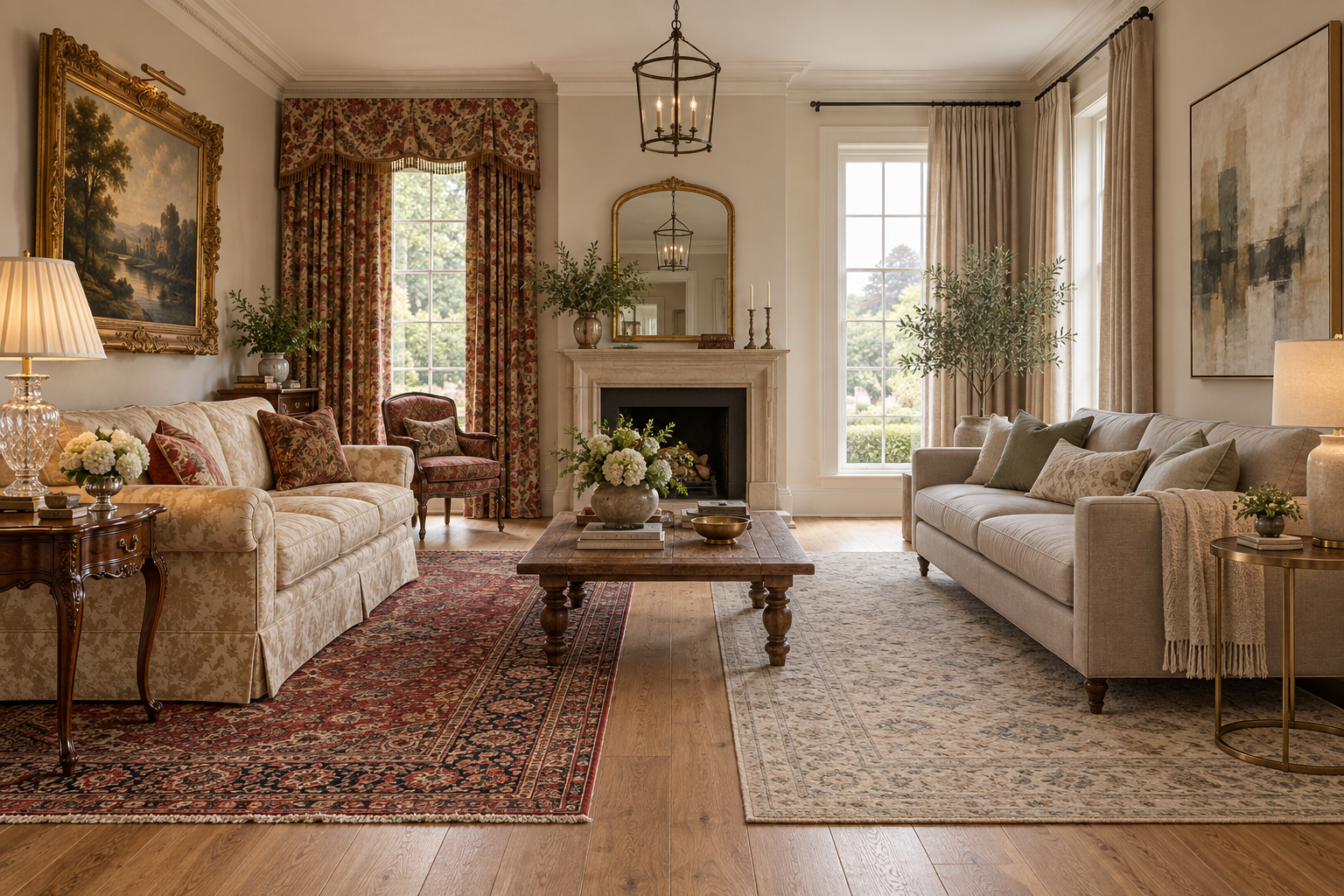
Walk into two houses on the same street and you might struggle to name what separates them. Both have wooden furniture. Both have soft neutral walls, curtains rather than blinds, a rug under the coffee table, a lamp on either side of the sofa. Nothing in either room is shouting. Yet one feels like a…
Walk into two houses on the same street and you might struggle to name what separates them. Both have wooden furniture. Both have soft neutral walls, curtains rather than blinds, a rug under the coffee table, a lamp on either side of the sofa. Nothing in either room is shouting. Yet one feels like a family home that has been added to over thirty years, and the other feels like it was photographed last spring.
The gap between them is usually the gap between traditional and transitional. These two styles get confused constantly, partly because transitional was built out of traditional, and partly because the word transitional gets used by furniture retailers to mean roughly anything that is neither antique nor ultra-modern. That commercial vagueness has made a genuinely useful distinction fuzzier than it needs to be.
The difference is real, and it is mostly about ornament, silhouette and how much visual information a room contains. Once you can see it, you can also see which one your own house is already leaning toward, which matters more than picking a favourite. Houses have opinions. Fighting them is expensive.
Traditional Decorating: What It Actually Is
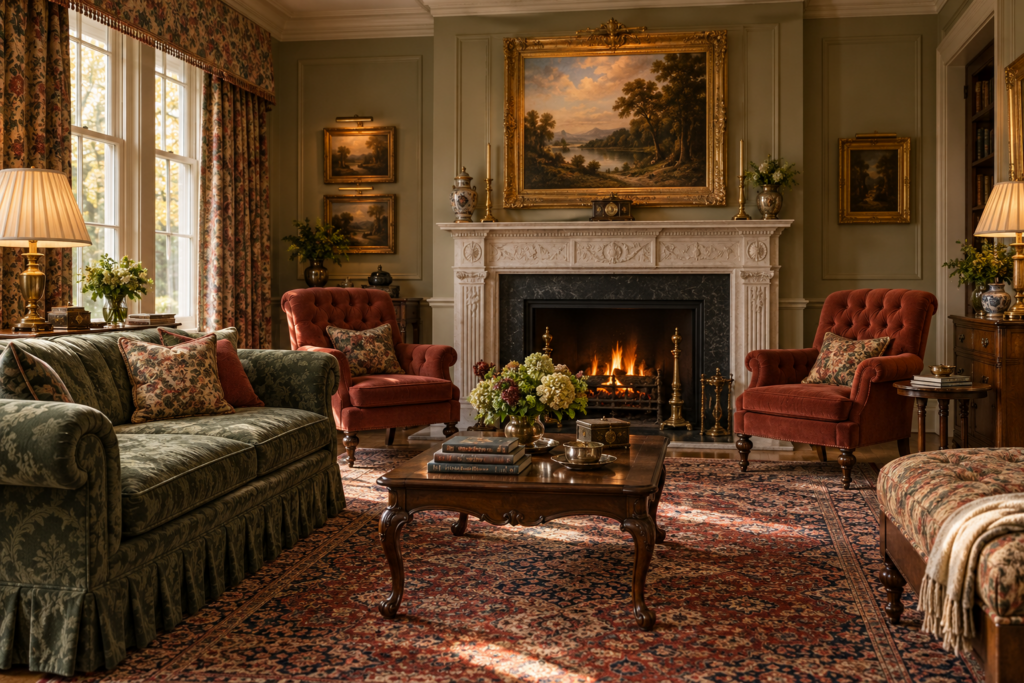
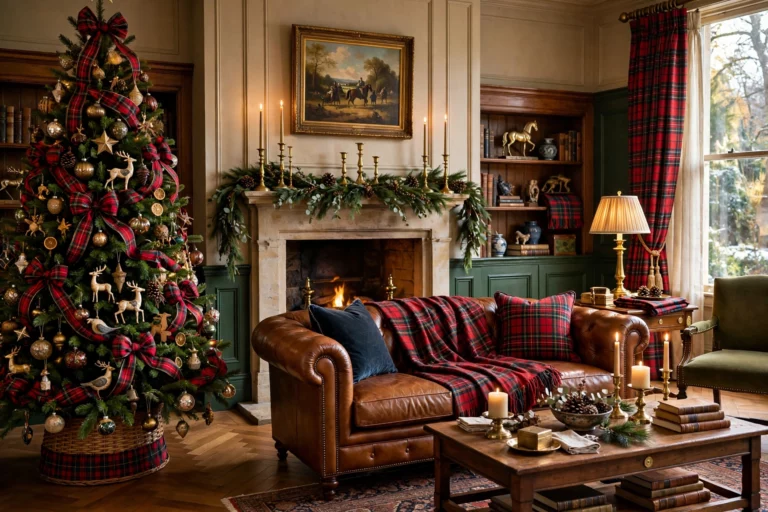
Traditional decorating draws directly on European design from roughly the 18th and 19th centuries, using symmetry, ornament and historical furniture forms. Expect carved wood, curved cabriole legs, skirted upholstery, rich pattern, layered window treatments, and rooms arranged in matched pairs. Nothing is stripped back. The detail is the point.
The vocabulary comes from named period styles: Georgian and Queen Anne in Britain, Chippendale and Federal in America, Louis XV and Louis XVI in France, with English country house layered on top as a softer, more lived-in variant. A traditional room is rarely a pure reproduction of any one of them. It borrows the language, the proportions and the ornament and uses them loosely.
The recognisable elements are consistent across the style. Furniture sits on the floor or close to it, often with a skirt hiding the base entirely, which is the visual opposite of the raised, leggy furniture of mid-century design. Wood is dark and warm, usually mahogany, cherry or walnut, and it is carved, moulded, turned or inlaid rather than left plain. Upholstery is rolled, tufted, buttoned and nailhead-trimmed.
Pattern carries a lot of the character. Damask, toile de Jouy, chintz florals, stripes, plaid and paisley all belong, and traditional rooms are comfortable running three or four of them at once. Colour is warm and often saturated: deep reds, forest greens, navy, gold, burgundy, cream. Cool grey is essentially absent from the historical palette.
Symmetry is the underlying organising principle, and it is the thing most people register without naming. Matched lamps flanking a sofa. A pair of armchairs facing each other across a fireplace. Art hung centred above a mantel. That mirroring is what makes traditional rooms feel calm even when they are dense with pattern and object.
The details go further than furniture. Traditional interiors lean on architectural millwork, meaning crown moulding, wainscoting, panelled doors, deep skirting boards and decorative ceiling medallions. Window treatments are layered, with a sheer or blind underneath, curtains over it, and often a pelmet or valance on top. Lighting runs to crystal chandeliers, brass sconces, candlestick-style table lamps and pleated fabric shades. Rugs are Persian, Oriental or Aubusson, usually patterned and usually old.
Done badly, traditional reads as fussy, heavy and dated, which is precisely the reaction that created the demand for something lighter. Done well, it has a settled authority almost no other style manages, because it is the only look that genuinely improves when the furniture is worn and the paintings are slightly crooked.
Transitional Decorating: What It Actually Is
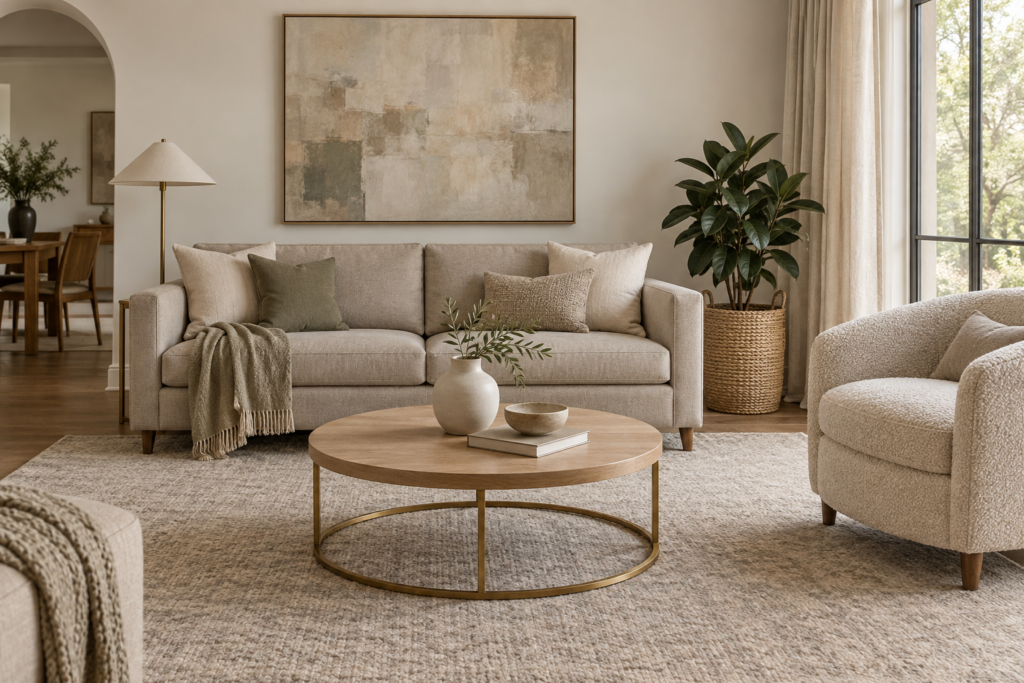
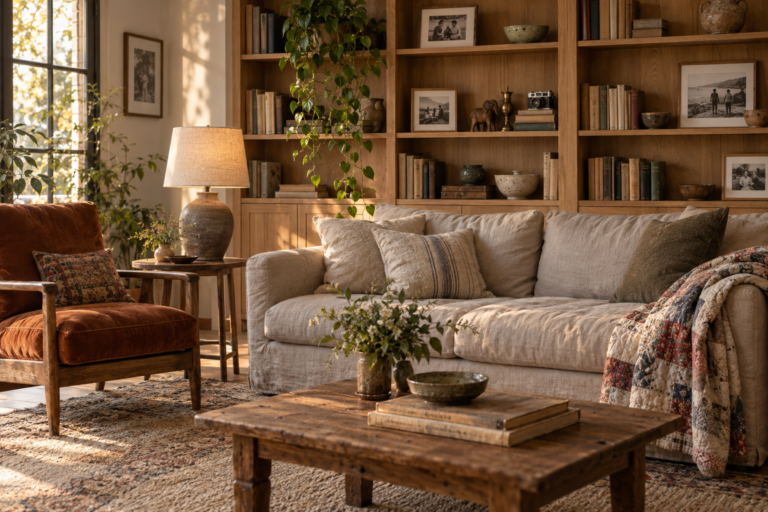
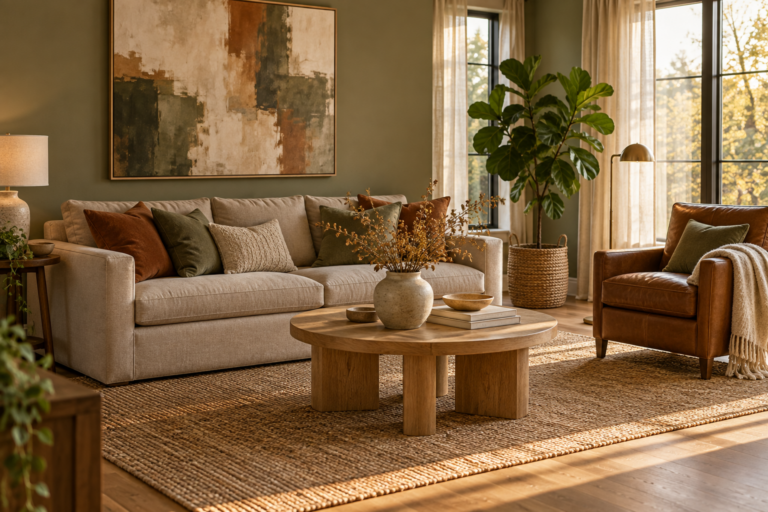
Transitional decorating keeps traditional silhouettes and proportions but strips away the ornament, then pairs them with a restrained modern palette and cleaner lines. A transitional sofa has the familiar comfort and shape of a traditional one with the carving, tufting, skirt and fringe removed. The result reads as calm, current and neutral without feeling cold.
The style emerged as a commercial category in the late 1980s and 1990s and expanded enormously through the 2000s, essentially because a lot of people wanted the warmth of traditional decorating without the visual weight. Retailers were happy to oblige, which is why the term is now attached to almost anything inoffensive.
The genuine version has consistent markers. Lines are straight or gently curved, never ornate. Upholstery arms are square, track or softly rolled with no skirt, and legs are exposed, simple and often turned or tapered. Wood tones run lighter and greyer than traditional: oak, ash, light walnut, painted finishes, sometimes a mix of wood and metal in one piece.
The palette does most of the heavy lifting. Transitional rooms run on neutrals, specifically warm whites, greige, taupe, soft beige, muted blue-greys and charcoal, with colour used sparingly as accent rather than as ground. Where a traditional room uses colour to create richness, a transitional room uses texture to do the same job, layering linen, wool, boucle, leather, rattan, jute and matte ceramic against each other.
Pattern is present but quiet. A subtle geometric on a cushion, a low-contrast rug, a woven texture that reads as pattern from close up and as solid from across the room. Large bold florals and heavy damasks sit outside the style.
Accessories are edited hard. Where traditional fills a mantel, transitional groups three objects on it and leaves the rest of the surface empty. Art tends toward large single abstract or photographic pieces rather than a dense gallery of small framed works. Window treatments simplify to floor-length plain panels hung high, usually with no valance at all.
Symmetry survives but loosens. A transitional room might still have a pair of lamps and a centred sofa, but it is comfortable breaking the mirror with one asymmetric element, an off-centre artwork or a single large plant on one side only.
Is transitional just a watered-down version of traditional?
That is the common accusation, and it is not quite fair. Transitional is a genuine editing exercise rather than a dilution: it keeps the parts of traditional decorating that make rooms comfortable, meaning generous furniture proportions, warm materials and a sense of layering, and removes the parts that make rooms feel period-specific, meaning ornament and historical reference.
The risk the criticism points at is real, though. Transitional done lazily has no point of view at all, which is how you end up with the grey-sofa-and-beige-wall interior that looks the same in a thousand listings. The difference between a transitional room with character and one without usually comes down to whether it contains anything with genuine age, texture or personal history. One antique chest, one worn leather chair or one inherited painting will anchor an otherwise anonymous room immediately.
The Differences That Actually Show Up in a Room
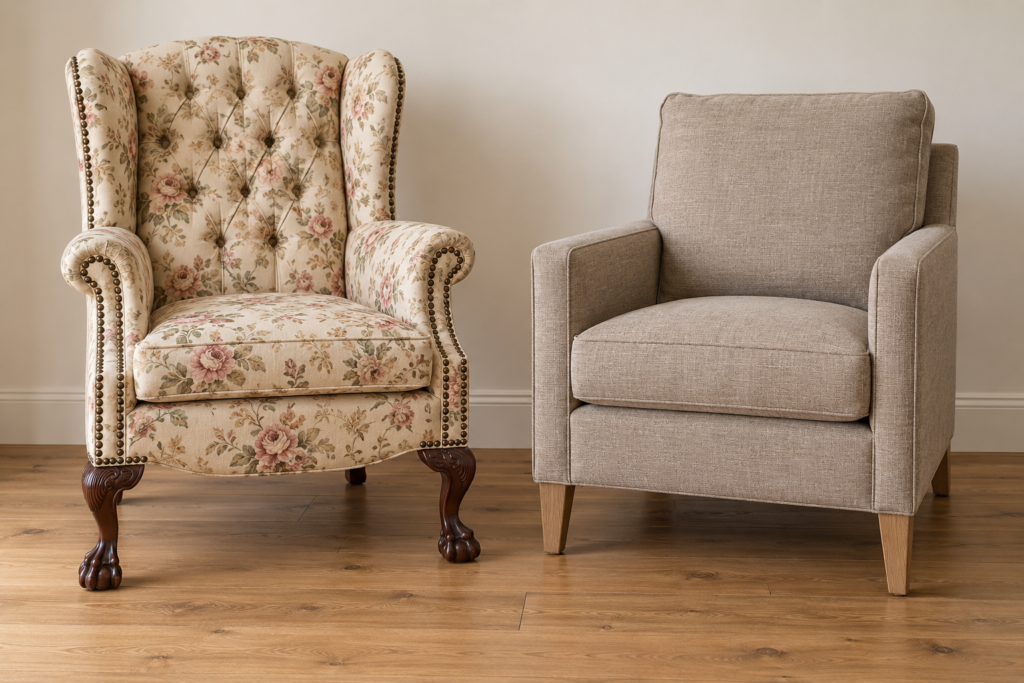
The fastest way to tell the styles apart is to look at three things in order: the base of the furniture, the amount of pattern on the walls and windows, and whether the surfaces are carved or plain. Those three checks will correctly place almost any room within a few seconds.
Here is how the two styles diverge across the elements that matter:
Furniture silhouette. Traditional uses curved, carved and skirted forms with cabriole legs, ball-and-claw feet and turned detail. Transitional uses straight or gently curved forms with plain exposed legs and no skirt.
Upholstery detail. Traditional has button tufting, nailhead trim, welting, fringe and pleated skirts. Transitional has clean seams, occasionally a simple welt, and nothing else.
Colour. Traditional runs warm and saturated, with deep reds, greens, navy, gold and cream. Transitional runs neutral, with warm whites, greige, taupe and charcoal, plus one muted accent colour at most.
Pattern. Traditional layers damask, toile, chintz, plaid and paisley freely. Transitional uses low-contrast texture and subtle geometry, usually on only one or two items in a room.
Wood. Traditional favours dark mahogany, cherry and walnut with visible carving and figure. Transitional favours lighter oak and ash, painted finishes and plain surfaces.
Metals. Traditional uses polished brass, bronze and crystal. Transitional uses brushed brass, matte black, nickel and chrome, often mixing two finishes in one room.
Window treatments. Traditional layers sheers, curtains and a valance or pelmet. Transitional hangs simple floor-length panels, high and wide, with no top treatment.
Accessories. Traditional displays collections, porcelain, silver, framed family photographs and many small framed works. Transitional edits down to a few larger objects with negative space around them.
Symmetry. Traditional is strictly symmetrical. Transitional is mostly symmetrical with deliberate exceptions.
Architecture. Traditional rewards heavy millwork, panelling and ceiling detail. Transitional works with simpler mouldings and plain walls.
The test that settles almost every argument: look at one piece of furniture and ask whether removing its decoration would change what it fundamentally is. A carved mahogany chest with brass escutcheons and bracket feet becomes a different object if you sand it plain. A transitional chest is already that plain object, and its quality lives in proportion, material and joinery rather than ornament.
What’s the difference between transitional and modern farmhouse?
They overlap in palette and often get mistaken for each other, but they come from different places. Transitional descends from formal traditional furniture and keeps that refinement in its proportions and materials, leaning toward tailored upholstery, polished wood and a slightly dressed-up feel. Modern farmhouse descends from rural vernacular and keeps a rougher, more casual character.
In practice the tells are specific. Modern farmhouse uses shiplap, exposed beams, barn doors, apron-front sinks, galvanised metal, distressed painted finishes and a high-contrast black-and-white scheme. Transitional uses none of those. Transitional wood is usually smooth and finished, while farmhouse wood is often reclaimed, distressed or left rough sawn. If a room’s charm depends on things looking weathered, it is farmhouse. If it depends on things looking tailored, it is transitional.
How to Tell Which One Your Home Is Asking For
Before choosing based on preference, look at what the building already does. The single most reliable predictor of which style will look right is the amount of architectural detail in the room, because decorating against that detail is a fight nobody wins cheaply.
Rooms with heavy millwork, deep skirting boards, panelled doors, picture rails, ornate cornicing, original fireplaces with carved surrounds, sash windows with thick glazing bars and high ceilings are already halfway to traditional. Furnish them minimally and the architecture reads as noise with nothing to talk to. Period houses in particular tend to look thin and unresolved when they are decorated in a strictly contemporary way, because the walls keep insisting on something the furniture refuses to acknowledge.
Rooms with plain walls, simple square-edged skirting, flush doors, standard ceiling heights, large modern window openings and no fireplace suit transitional far better. There is no ornament competing for attention, so clean silhouettes and texture can carry the room without anything looking accidentally bare.
A few other factors matter in the decision:
How you actually live. Traditional rooms absorb children, pets and general chaos surprisingly well, because patterned fabrics hide wear and slightly worn furniture is period-appropriate. Transitional rooms show everything, since a plain pale linen sofa records every incident.
How often you want to change things. Transitional schemes are easier to refresh, because swapping cushions, art and a rug genuinely changes the feel. Traditional schemes are more committed, since the furniture itself is the style.
What you already own. If you have inherited good antique furniture, transitional will usually leave it looking stranded unless you commit to two or three specific pieces and stage them carefully. If you own mostly newer upholstery, a full traditional scheme means replacing nearly everything.
Where you live. Regional architecture and climate matter. A dark, rich traditional scheme works beautifully in a cold-climate house with small windows and long winters. A sunlit house with large openings and pale floors will often look heavy in a full traditional palette and lighter and more correct in a transitional one.
Can you mix traditional and transitional in one house?
Yes, and most well-decorated houses do. The reliable method is to keep one style dominant at roughly seventy to eighty percent and use the other as deliberate contrast, rather than splitting the difference evenly in every room, which is what produces spaces that feel indecisive.
Room-by-room variation works too, as long as something carries through the whole house. Formal spaces like a dining room, entrance hall or front sitting room can run traditional, while kitchens, family rooms and bedrooms run transitional. Tie them together with a consistent wall colour, consistent flooring, or a repeated metal finish throughout.
Within a single room, the strongest version of the mix is an antique or genuinely ornate piece used against an otherwise clean background. A carved gilt mirror above a plain console. A Persian rug under a straight-lined sofa. One tufted wingback among simple chairs. The contrast makes both things look more intentional than either would alone.
Shifting a Traditional Room Toward Transitional Without Replacing Everything
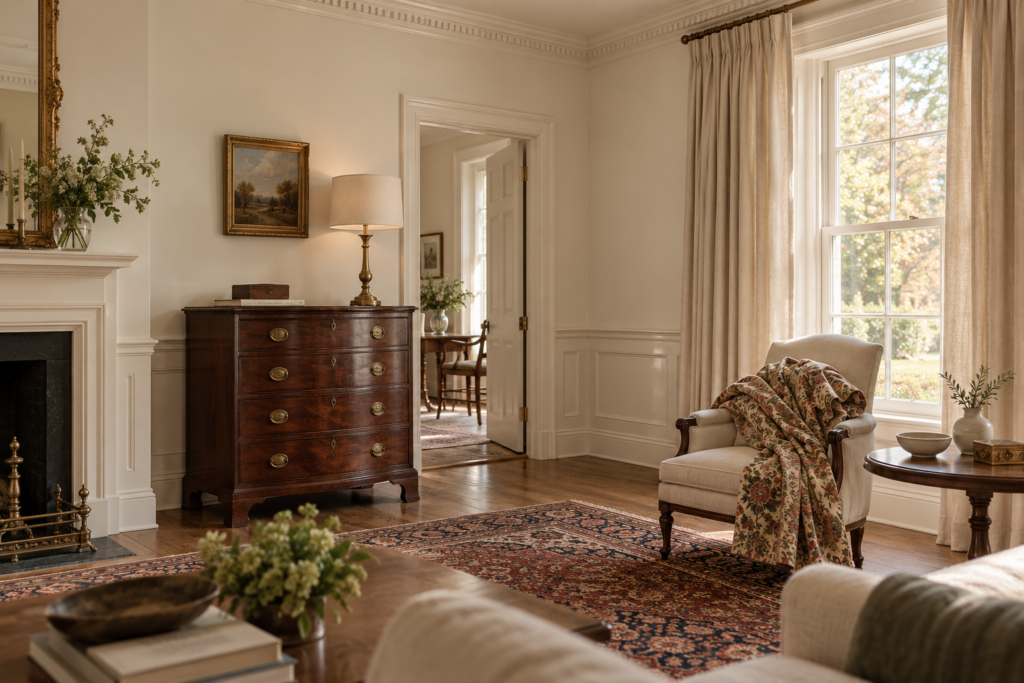
Most people asking this question already live with traditional furniture and want something lighter without a full replacement budget. That is entirely achievable, because the shift is largely about subtraction and background rather than new furniture.
Work in this order, because the early steps change the most for the least money:
Paint the walls first. Moving from a saturated colour to a warm neutral does more than anything else on this list. Choose a white or greige with a warm undertone rather than a cool grey, because cool tones make traditional mahogany look purple and tired. Paint the millwork too, often in the same colour in a higher sheen, which lightens ornate mouldings without removing them.
Simplify the windows. Take down valances, pelmets and swags. Hang plain floor-length panels in linen or cotton, mounted close to the ceiling and extending well past the window frame. This single change modernises a room faster than any furniture swap.
Change the lampshades. Swap pleated silk shades for plain drum shades in linen or paper. The lamp bases can stay, and often should, since an ornate base under a simple shade is exactly the traditional-transitional hybrid that works.
Edit the surfaces. Clear everything off every surface, then put back roughly a third of it in grouped arrangements with space between. Most of the fussiness people attribute to traditional furniture is actually accumulated object density.
Rethink the art. Replace a dense arrangement of small framed prints with one or two larger pieces. Keep a genuinely good piece of traditional art if you have one and hang it alone, which makes it read as a deliberate choice rather than part of a set.
Update the rug. A patterned Persian rug can stay if the rest of the room simplifies around it, and often should, since it adds the age transitional rooms frequently lack. If it is too busy, a flatweave or a low-contrast wool rug in a solid warm neutral resets the floor immediately.
Reduce the wood. Traditional rooms often contain four or five dark wood pieces. Keep the two best, move or store the rest, and replace them with upholstered, painted or lighter-wood alternatives. Painting one dark piece in a soft neutral is a low-cost way to break up a wall of mahogany.
Change the upholstery last. If a skirted sofa is the sticking point, reupholstering it in a plain textured neutral without the skirt and without the fringe is usually cheaper than replacing it, particularly if the frame is solid.
Going the other direction, from transitional toward traditional, follows the reverse logic and costs more, because you are adding rather than removing. The highest-impact additions are architectural: better mouldings, a panelled or wainscoted wall, a proper fireplace surround. After that, introduce one antique wood piece, layer a patterned rug, add a pair of matched lamps for symmetry, and bring in pattern through cushions and curtains before committing to patterned upholstery.
Where These Rooms Go Wrong
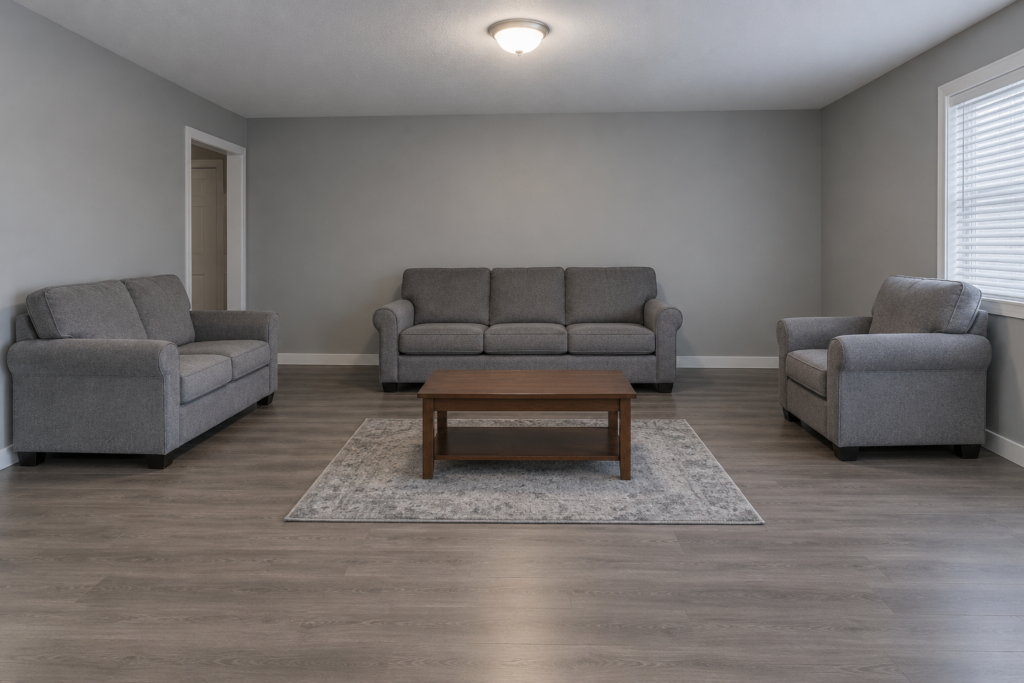
Both styles fail in predictable ways, and the failures are almost never about taste. They are about a small number of technical mistakes repeated across thousands of rooms.
The transitional room with no anchor. Everything is beige, everything is new, everything matches the set it was bought in, and the room has no point of interest anywhere. The fix is to add a single element with weight: a dark antique chest, a large piece of art, a genuinely old rug, a painted feature wall. Something must be the loudest thing.
The grey undertone problem. Cool grey neutrals against warm wood furniture make the wood look dull and slightly purple. This is the most common reason a transitional scheme feels off without an obvious cause. Test paint against your actual furniture in daylight, and favour warm-toned neutrals if you own any brown wood at all.
The furniture set. Buying a matched suite of sofa, loveseat and chair in one fabric flattens a room instantly. Both styles need variation, meaning different fabrics, different chair styles and different wood tones in controlled amounts.
The traditional room that never got edited. Traditional decorating tolerates density, but it still requires arrangement. Objects spread evenly across every surface, framed photographs on every ledge and small tables in every corner produce fussiness rather than richness. Group things, leave gaps, give the eye rest.
Undersized rugs. Rugs too small for the seating arrangement sink both styles equally. In a living room, all seating pieces should have at least their front legs on the rug. In a dining room, the rug should extend at least 60cm (24 inches) past the table edge on every side.
Flat lighting. A single overhead fixture kills a traditional room’s depth and makes a transitional room look like an empty rental. Both need light at three heights: overhead, table lamps at seated eye level, and something low or floor-level. Warm bulbs throughout, on dimmers where possible.
Mismatched formality. A formal skirted sofa beside a casual rattan chair and an industrial metal table is not eclectic, it is unresolved. Match the level of dressiness even when mixing styles.
Nothing personal in it. This is a transitional problem far more than a traditional one, because traditional rooms tend to accumulate family objects naturally. A room assembled entirely from current retail stock is technically correct and entirely forgettable. Inherited pieces, travel finds, real books and actual photographs are what make a room read as somebody’s rather than nobody’s.
Frequently Asked Questions
Which style is more expensive to decorate?
Traditional usually costs more to do properly, because the look depends on carved wood furniture, layered window treatments, architectural millwork and genuine antique rugs, all of which are expensive new. Transitional can be done affordably because plain silhouettes are what most contemporary retailers make, and texture, which carries the style, comes cheaply through fabric. The exception is that traditional can be done very cheaply secondhand, since brown furniture and antique dining sets currently sell for a fraction of their replacement cost.
Is traditional decorating out of style?
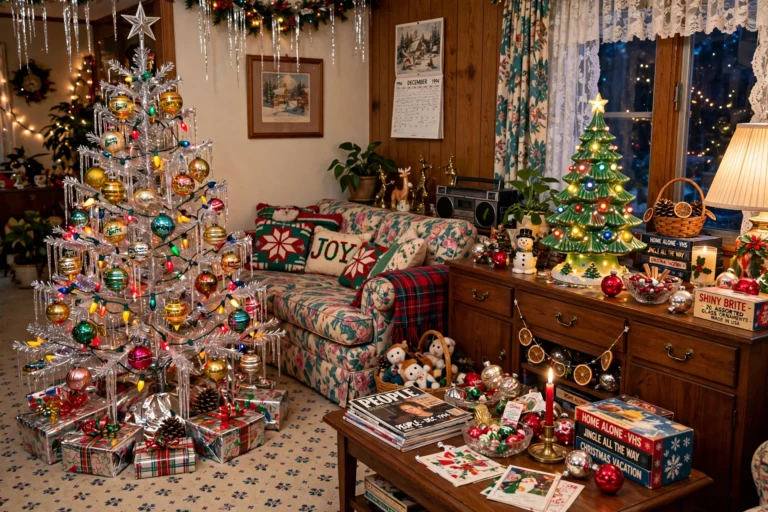
It moves in and out of retail fashion but never disappears, largely because it is tied to architecture rather than trend. Houses with period detail keep asking for it, and the current direction of interior design has been warming up and reintroducing pattern, colour and antique furniture after a long neutral period. What does look dated is a specific 1990s version of traditional, meaning heavy swagged valances, dense floral wallpaper with matching borders, and full matched furniture suites.
Which style is better for resale?
Transitional is generally the safer choice for a property you plan to sell soon, because neutral palettes and simple finishes appeal to the widest pool of buyers and photograph well in listings. That said, buyers price the building far more than the styling, and paint and furniture are easily changed. The choices that genuinely affect resale are permanent ones: heavily ornate fixed joinery, unusual tiling and bold bathroom fittings carry more risk than anything you can move out with.
Does transitional decor have to be grey and beige?
No, and the assumption that it does is why so many transitional rooms look identical. The style requires a restrained palette, not a colourless one. Soft sage, muted terracotta, warm clay, dusty blue, olive and deep charcoal all work as either wall colour or a dominant upholstery colour while keeping the style intact. The rule is intensity, not hue: keep colours muted and slightly greyed rather than fully saturated, and use them consistently.
What flooring works for each style?
Traditional favours dark or mid-toned hardwood, preferably in narrower boards, along with patterned tile, natural stone and wall-to-wall carpet in formal rooms. Transitional favours mid-toned oak in wider planks with a matte finish, large-format tile in warm neutrals, and simple stone. Both look best with real or convincing wood underfoot. The choice that fights both is very pale grey-washed timber, which reads as a specific recent trend and tends to date quickly.
Can I use antiques in a transitional room?
Yes, and they are usually what saves it. A transitional scheme with two or three genuine antiques is the version of the style that has character, because age supplies the depth that new furniture cannot. The method is to give each antique space and let it be seen as an object: one carved chest against a plain wall, one gilt mirror, one worn leather chair. What does not work is a full room of antiques arranged casually, which simply becomes a traditional room.
How do I know if my room is already transitional?
Check the three markers. Look at whether the furniture legs are visible and plain, whether the walls and windows are free of pattern and layered treatments, and whether the surfaces are mostly smooth rather than carved. If all three are true and the palette is neutral, the room is transitional whether or not it was planned that way. If the furniture has skirts, carving or tufting and there is pattern on more than one large surface, it is traditional, or it is a mix that needs one side to become dominant.