Ralph Lauren–Style Classic Christmas: Tartan, Velvet & Heirloom Charm
Most Christmas decor does not fail because of one bad purchase. It fails because it chases the year instead of transcending it — the trendy palette that looks dated by February, the novelty ornaments that embarrass you by next December. Meanwhile, there is a style of Christmas that has looked right for forty years and…
Most Christmas decor does not fail because of one bad purchase. It fails because it chases the year instead of transcending it — the trendy palette that looks dated by February, the novelty ornaments that embarrass you by next December. Meanwhile, there is a style of Christmas that has looked right for forty years and will look right for forty more: the heritage Christmas. Tartan ribbon. Velvet. Brass. A tree that looks collected over decades rather than purchased in an afternoon.
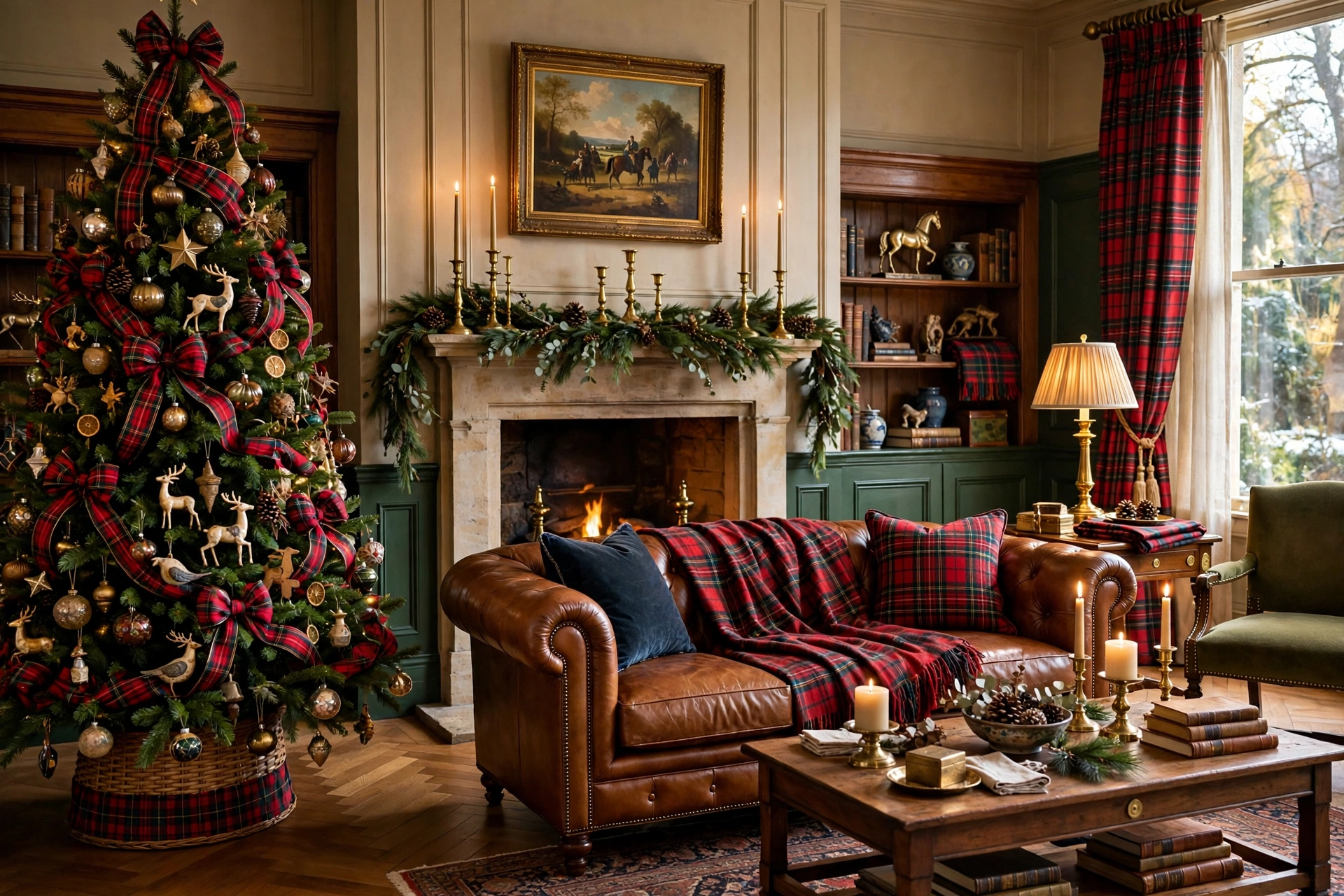
You know it as the Ralph Lauren Christmas — the aesthetic the brand perfected in its holiday campaigns and store windows: equestrian touches, hunting-lodge greens, rich plaids, polished brass, and an overall feeling of old-money ease. It is traditional without being stuffy, luxurious without being flashy, and deeply, comfortingly, unmistakably familiar.
This guide breaks the look down the way a designer would: what “Ralph Lauren Christmas” actually means as a set of design decisions, the heritage palette and how to use it, tartan done right (which plaids, where, how much), the signature materials (velvet ribbon, brass, natural greenery), the heirloom-ornament tree, the candlelit table, and how to get the whole look on a realistic budget. No trends, no irony — just the timeless version, done properly.
What “Ralph Lauren Christmas” Actually Means
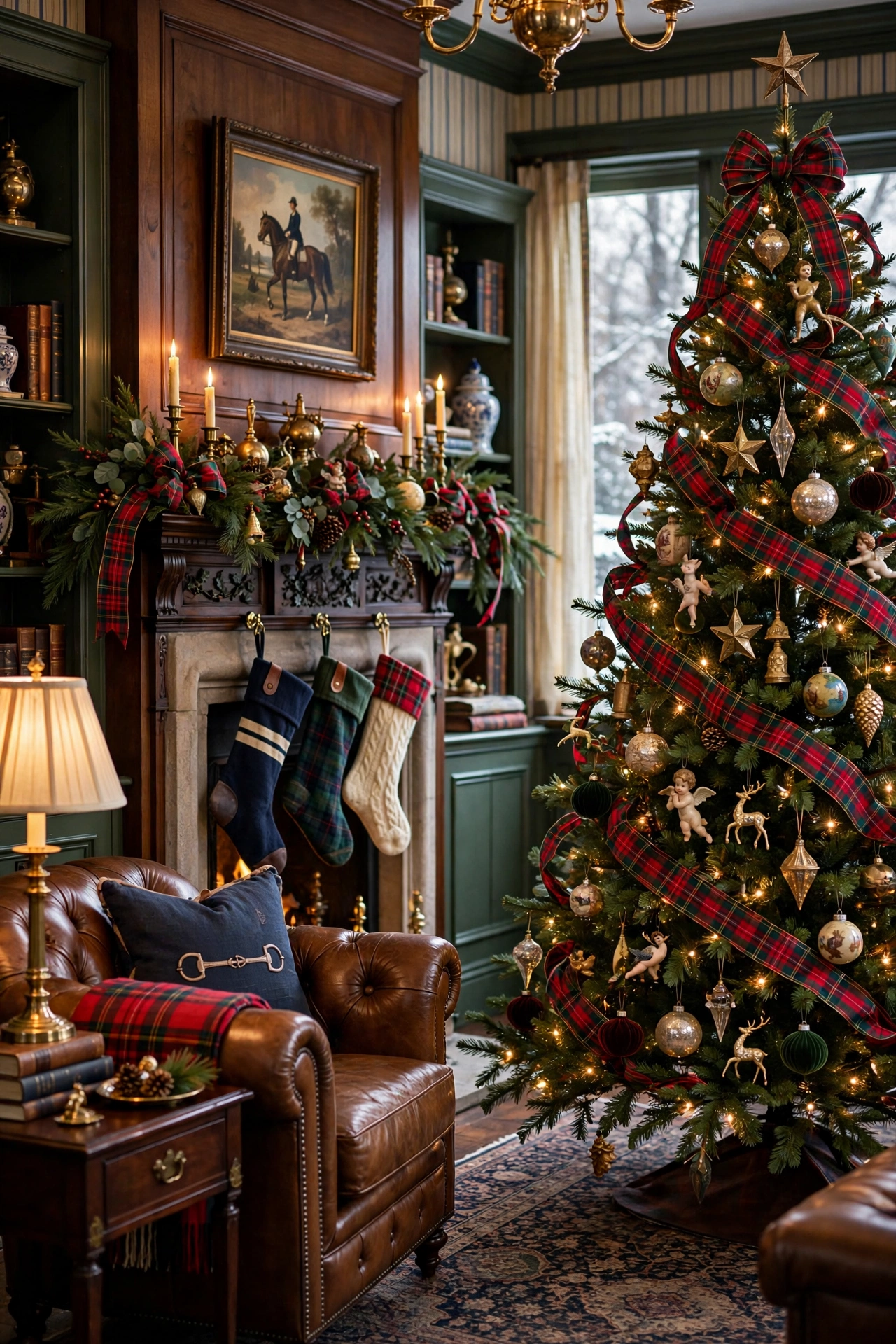
The direct answer: it is a heritage-luxury aesthetic built from five pillars — a traditional red-green-gold palette, tartan and plaid textiles, natural evergreen greenery, polished brass and leather accents, and decor that looks collected over time rather than bought at once. Every styling decision in this guide traces back to one of those five.
The look comes from a specific fantasy: the American country house, the English hunting lodge, the ski chalet — places where Christmas has supposedly been done the same beautiful way for generations. Ralph Lauren’s genius was codifying that fantasy into a repeatable visual language. The components are not expensive individually; the luxury is in the coherence and the patina, real or artfully suggested.
It is worth distinguishing this from generic “traditional Christmas.” Traditional Christmas can mean anything from a 90s tinsel explosion to a farmhouse buffalo-check scheme. The Ralph Lauren version is narrower and more disciplined: richer colors, better materials, no novelty, no irony, and an insistence on natural textures — wool, velvet, brass, leather, real greenery — over plastic and glitter. Homes and Gardens’ guide to classic holiday styling describes the same discipline from a different angle: rich greens, deep reds, shimmering golds, and natural materials layered with intention.
The Heritage Palette: Deep, Warm, and Disciplined
The direct answer: the palette is forest green, deep oxblood red, antique gold, and warm neutrals (cream, camel, natural wood) — four colors, no exceptions. The discipline is the luxury; adding a fifth color is what turns heritage into hodgepodge.
- Forest/hunter green: the foundation. Real evergreen garland, a natural tree, green velvet ribbon, boxwood wreaths. This green is darker and more natural than emerald — think pine forest, not jewel box.
- Oxblood/burgundy red: the accent. Deeper and more muted than cherry red — oxblood ribbon, burgundy ornaments, a plaid with red ground. Bright red reads as generic Christmas; oxblood reads as heritage.
- Antique gold: the metallic. Brass candlesticks, gold-framed art, antique-gold ornaments. Polished but never flashy — aged brass over shiny gold.
- Warm neutrals: cream, camel, natural linen, wood tones. The tartan throw needs a camel sofa or cream wall behind it; the palette breathes through its neutrals.
Notice what is absent: silver, white-and-blue winter schemes, pastels, neon, and black (the Ralph Lauren Christmas is warm through and through). If you are drawn to the cooler, more jewel-toned end of green-and-gold, our luxury home decor guide explores that adjacent territory — same richness, different temperature.
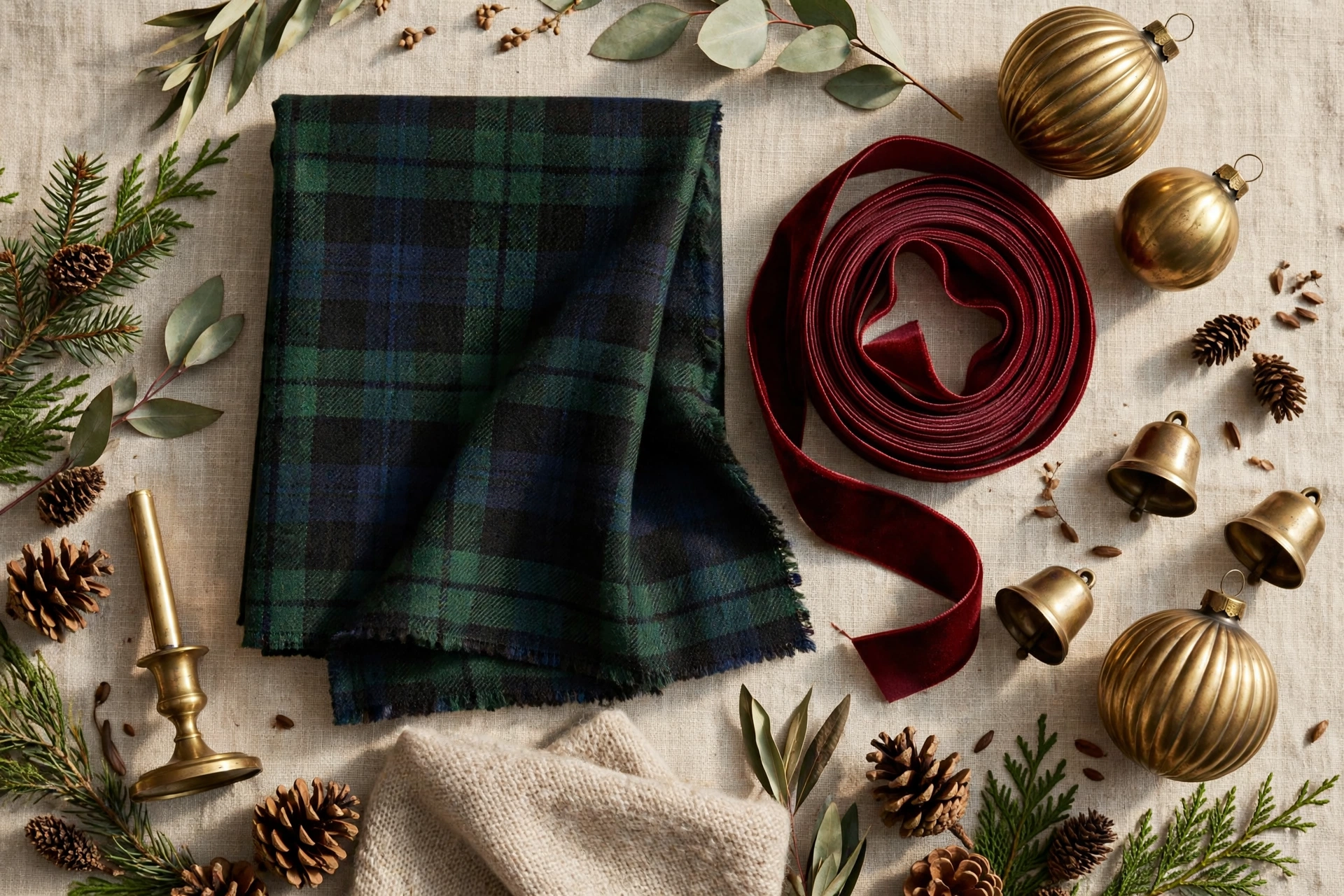
Tartan Done Right: Which Plaids, Where, and How Much
The direct answer: use two tartans maximum — one large-scale statement plaid (Royal Stewart or similar red tartan) and one dark neutral plaid (Black Watch) — and deploy them as textiles (throws, ribbon, pillows), never as wall-to-wall pattern. Tartan is an accent in this look, not a theme.
The Two Tartans Worth Knowing
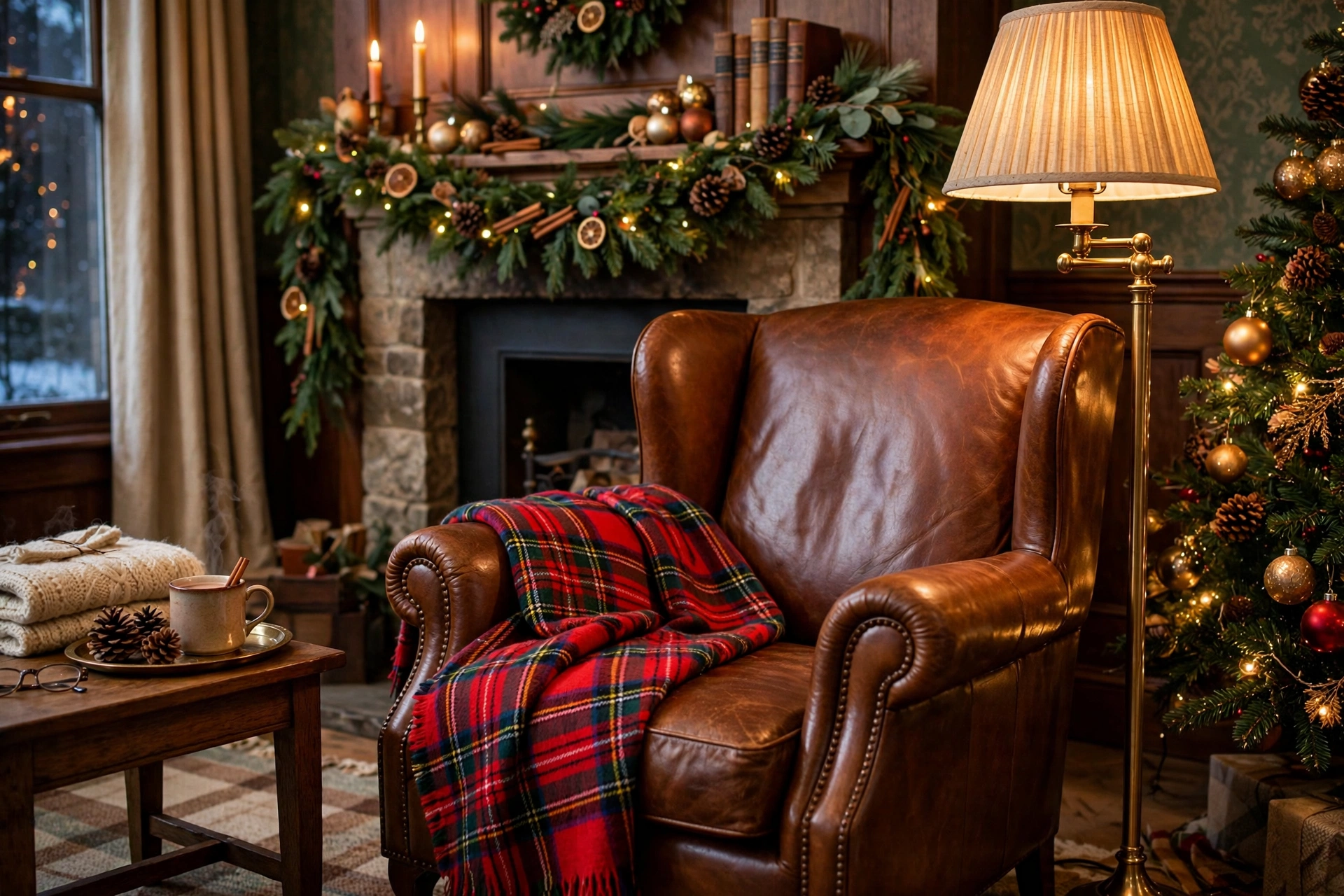
- Royal Stewart: the red-ground tartan everyone pictures — red with green, blue, yellow, and white overchecks. This is the statement plaid: a throw draped over the sofa arm, wide ribbon on the tree, or a table runner. One large application per room.
- Black Watch: the dark green-navy-black tartan. The quiet plaid: pillow covers, a tree skirt, or napkins. It reads as texture from a distance and reveals its pattern up close — the sophisticated choice.
Buy actual wool or wool-blend tartan, not printed polyester — the difference in drape and depth is immediately visible, and wool throws ($40-80) last decades. Thrift stores are full of genuine wool tartan throws for $10-20; check the label for wool content and look for fringed ends, which signal quality.
Where Tartan Goes (and Where It Does Not)
Tartan belongs on: throws, tree ribbon, a tree skirt, pillow covers, stockings, and gift wrap accents. Tartan does not belong on: walls, upholstery, more than one large piece per room, or mixed with other bold patterns. The rule is one tartan moment per sightline — the throw on the sofa means the pillows stay solid velvet; the tartan tree ribbon means the mantel garland stays plain greenery. Restraint with pattern is what separates heritage from Highland gift shop.
Velvet Ribbon: The Signature Material
The direct answer: if tartan is the pattern of this look, velvet is its texture. Wide velvet ribbon — 2.5 to 4 inches, in oxblood, forest green, or gold — appears on the tree, the wreaths, the garlands, and the gifts, and it is the single material that most instantly signals “heritage Christmas.”
Velvet ribbon works here for a specific reason: it absorbs light rather than reflecting it, which gives the whole scheme its characteristic depth and softness. Satin ribbon would add shine the look does not want; burlap would add rusticity it does not want. Velvet is the middle path — rich but quiet.
Deploy it in four places:
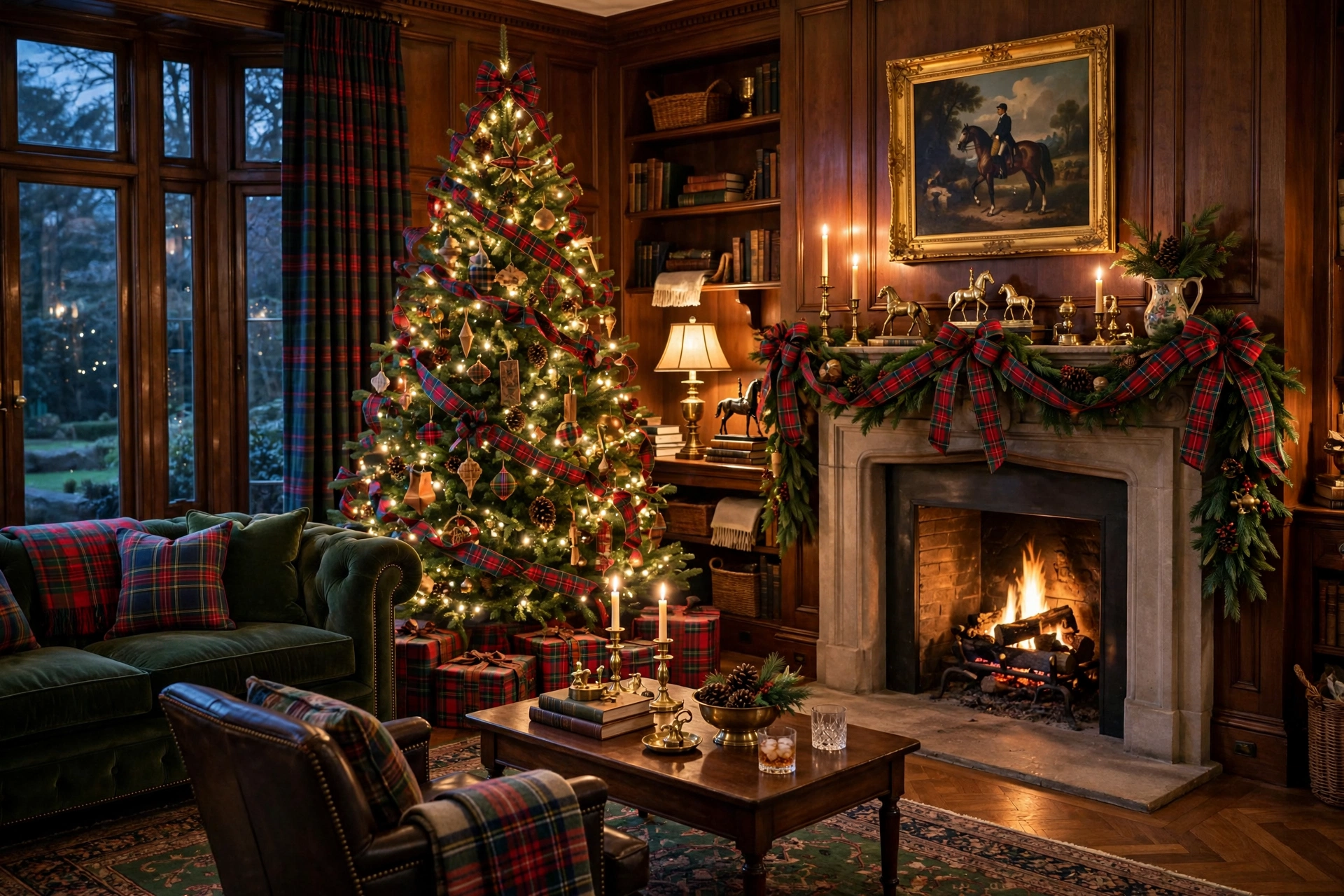
- The tree: 4-inch velvet ribbon woven vertically in 3-4 cascades, tucked deep into the branches. For a 7-foot tree, plan 6-8 yards. Oxblood velvet on a green tree is the iconic combination.
- Wreaths: a large velvet bow (8-10 inches) wired to the bottom of each wreath, with 18-inch tails. One wreath, one bow, no competing elements.
- Garland: velvet bows wired at each swag point along the mantel or staircase garland, 24-30 inches apart.
- Gifts: all gifts wrapped in solid paper (kraft, cream, or deep green) with velvet ribbon and a sprig of greenery tucked under the bow. The uniformity of the gift pile is part of the look — no novelty paper.
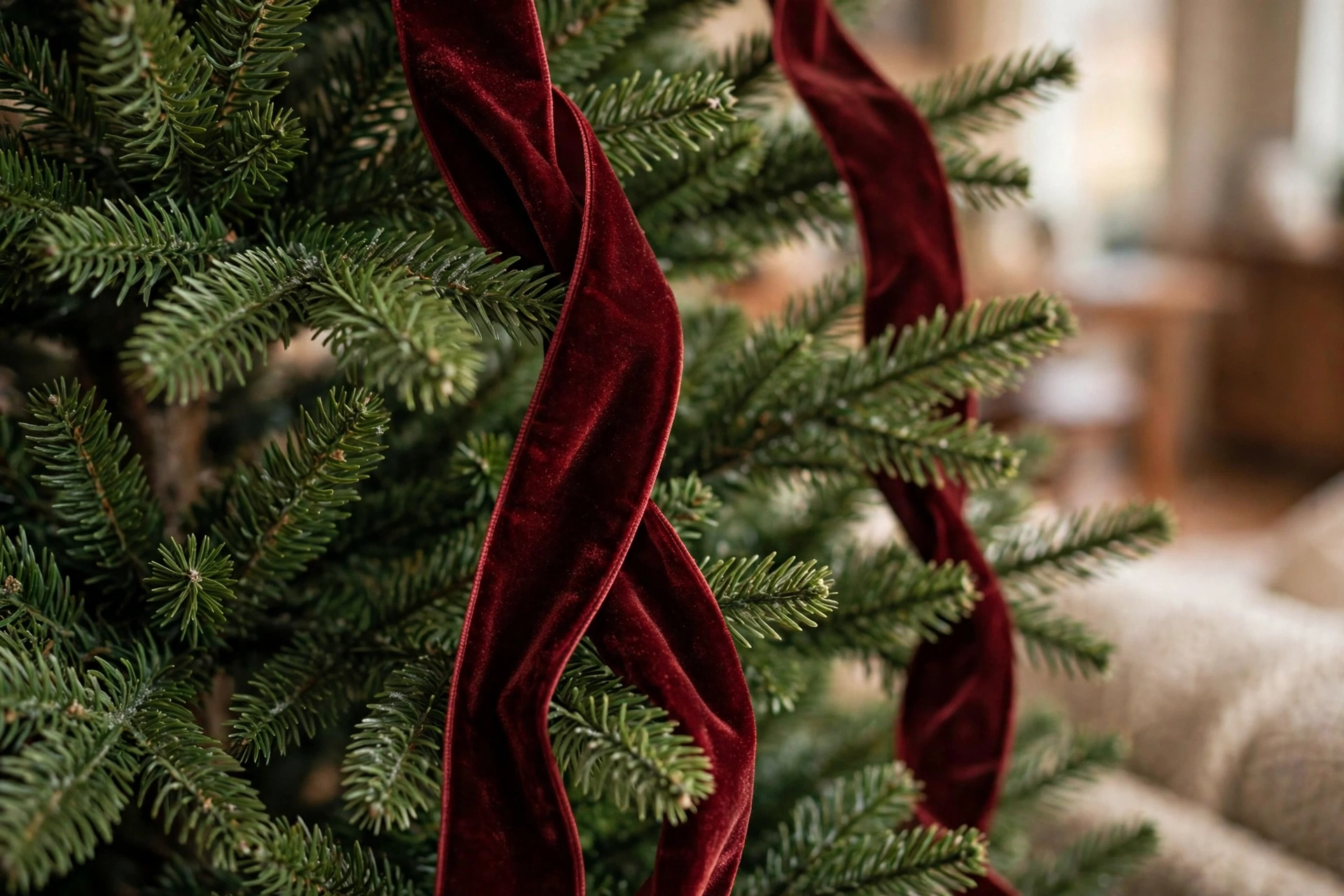
The Heirloom Tree: Collected, Not Decorated
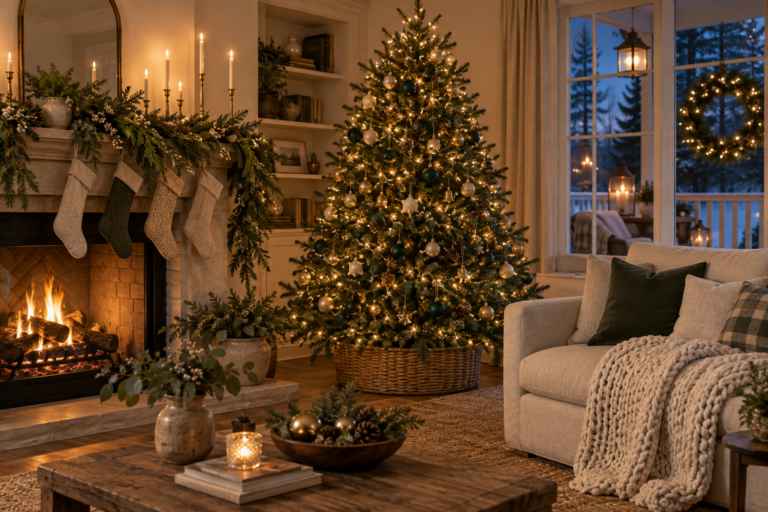
The direct answer: the Ralph Lauren tree looks accumulated over decades because it mixes ornament types, eras, and finishes within the strict palette — glass balls, figural ornaments, natural elements, and a few genuinely old pieces. Uniform ornament sets are the enemy; variety within discipline is the goal.
Build the tree in this order:
- Lights: warm-white, 100 per foot of height, woven deep. This look never uses multicolor lights.
- Velvet ribbon cascades as described above — ribbon goes on before ornaments so ornaments can overlap it naturally.
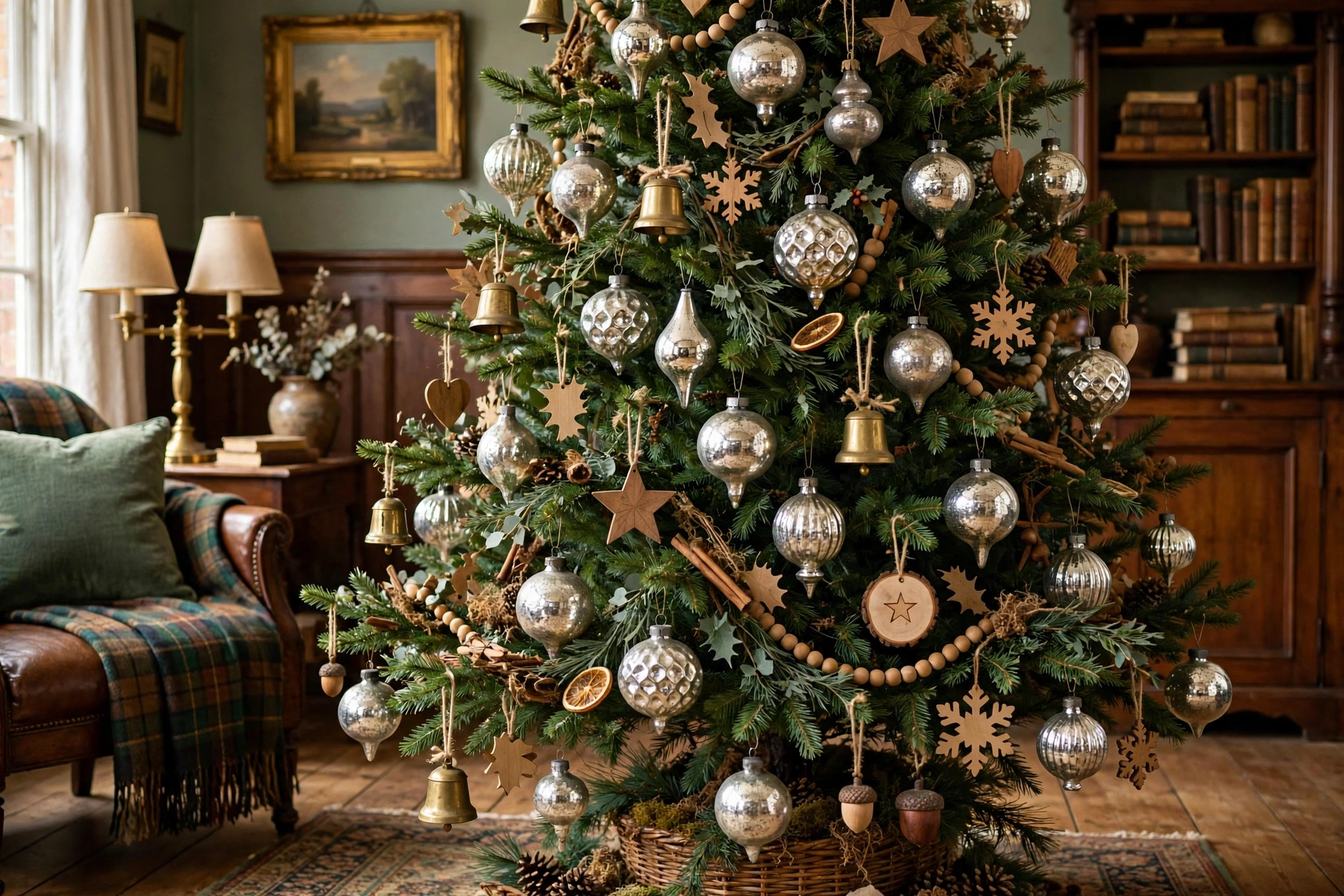
- Glass balls in the palette: 25-35 ornaments mixing oxblood, forest green, and antique gold, in varied sizes (2-4 inches) and finishes (shiny, matte, mercury glass). Mercury glass — with its silvery, aged patina — is the heritage finish par excellence.
- Figural and natural ornaments: 10-15 pieces with character — brass bells, wooden animals, pinecone clusters, dried orange slices, small framed miniatures. These are the “collected” layer that makes the tree feel personal.
- Heirloom placement: the oldest, most meaningful ornaments go at eye level on the front of the tree — the prime real estate. Everything else supports them.
- Topper: a large velvet bow or a classic gold star. Nothing novelty, nothing lit independently of the tree.
The collected look takes time to build honestly, but you can accelerate it: estate sales and antique malls sell boxes of vintage glass ornaments for $15-30, and mercury-glass reproductions are widely available. The trick is mixing — ten vintage ornaments among twenty new ones in the same palette reads as a collection; ten vintage ornaments alone on a bare tree reads as a start. For the broader philosophy of building a home that looks gathered over time, our traditional vs. transitional decor guide maps how heritage pieces coexist with newer ones.
The Sporting Touches: Brass, Leather, and the Hunt Motif
The direct answer: the equestrian and sporting details — brass horse bits, leather straps, hunting-horn motifs, pheasant feathers — are what make this look specifically Ralph Lauren rather than generically traditional. Use three to five such touches per main room, and keep them to accessories, never furniture.
- Brass: candlesticks, bells, picture frames, a brass bowl of ornaments on the coffee table. Aged brass over polished — patina is the point.
- Leather: a leather strap around a wreath instead of ribbon, leather-bound books stacked as a riser for a candle arrangement, a leather tray corralling the bar cart’s holiday bottles.
- Hunt and equestrian motifs: a brass horse-bit snaffle hung on the tree as an ornament, pheasant feathers tucked into garland and arrangements, a hunting-horn-shaped ornament or two. These read as heritage shorthand — use sparingly, one or two per room.
- Natural trophies: pinecones (the acceptable, non-controversial kind), antler sheds used as a candle holder or curtain tieback, dried seed heads in arrangements. Keep it botanical rather than taxidermy — the line is real.
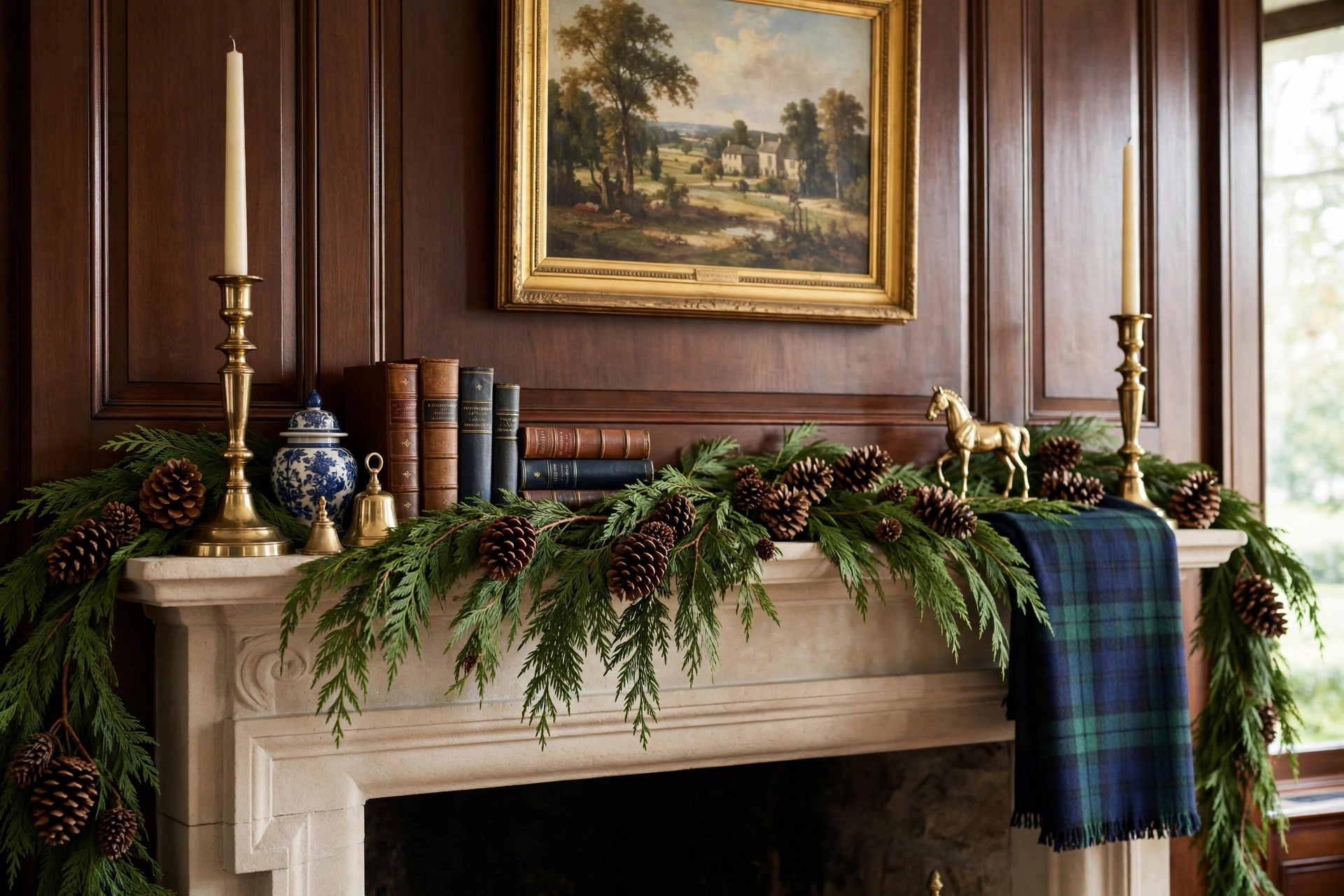
A note on taste: the sporting aesthetic borrows from hunting culture, and the decor should stay firmly on the brass-and-feathers side of that line. No realistic animal mounts as Christmas decor, no camo patterns, nothing that reads as a trophy room. The fantasy is the country house library, not the game larder.
Natural Greenery: Cedar, Pine, and Boxwood
The direct answer: this look uses real or realistic greenery exclusively — cedar garland for its drape, pine for its fullness, boxwood for its structure — and lots of it. Greenery is the green foundation of the palette, and skimping here undermines everything built on top.
Which Greenery Where
- Cedar: the garland garland — flat, draping sprays that cascade beautifully over mantels and down staircases. A 9-foot cedar garland covers a 6-foot mantel with proper end drape.
- Noble fir or pine: the full garland for wreaths and tree-adjacent arrangements. Denser and more three-dimensional than cedar.
- Boxwood: the structured green — small boxwood wreaths on interior doors, boxwood topiaries flanking the fireplace or entry. Boxwood reads as formal and English.
- Magnolia: the accent — a few magnolia leaves with their brown velvet undersides tucked into arrangements add the two-tone depth designers love.
Real vs. faux: real greenery wins on scent and authenticity, and a fresh garland costs $25-40 — comparable to good faux. The tradeoff is lifespan (3-4 weeks indoors, misted every few days, kept away from heat vents) versus reusability. My rule: real for the mantel and entry where scent matters, high-quality faux for the staircase and secondary spots where longevity matters. If you go faux, buy the best you can afford — cheap garland with visible plastic stems destroys the heritage illusion instantly. Squeeze the branches in the store: if they spring back and look varied, they will pass; if they look like green pipe cleaners, keep walking.
The Table: Candlelight and Good Glass
The direct answer: the Ralph Lauren Christmas table is built on candlelight — the more, the better — with a low greenery runner, classic glassware, and zero novelty. It should look like the same table the family has set for thirty years, because the best versions are.
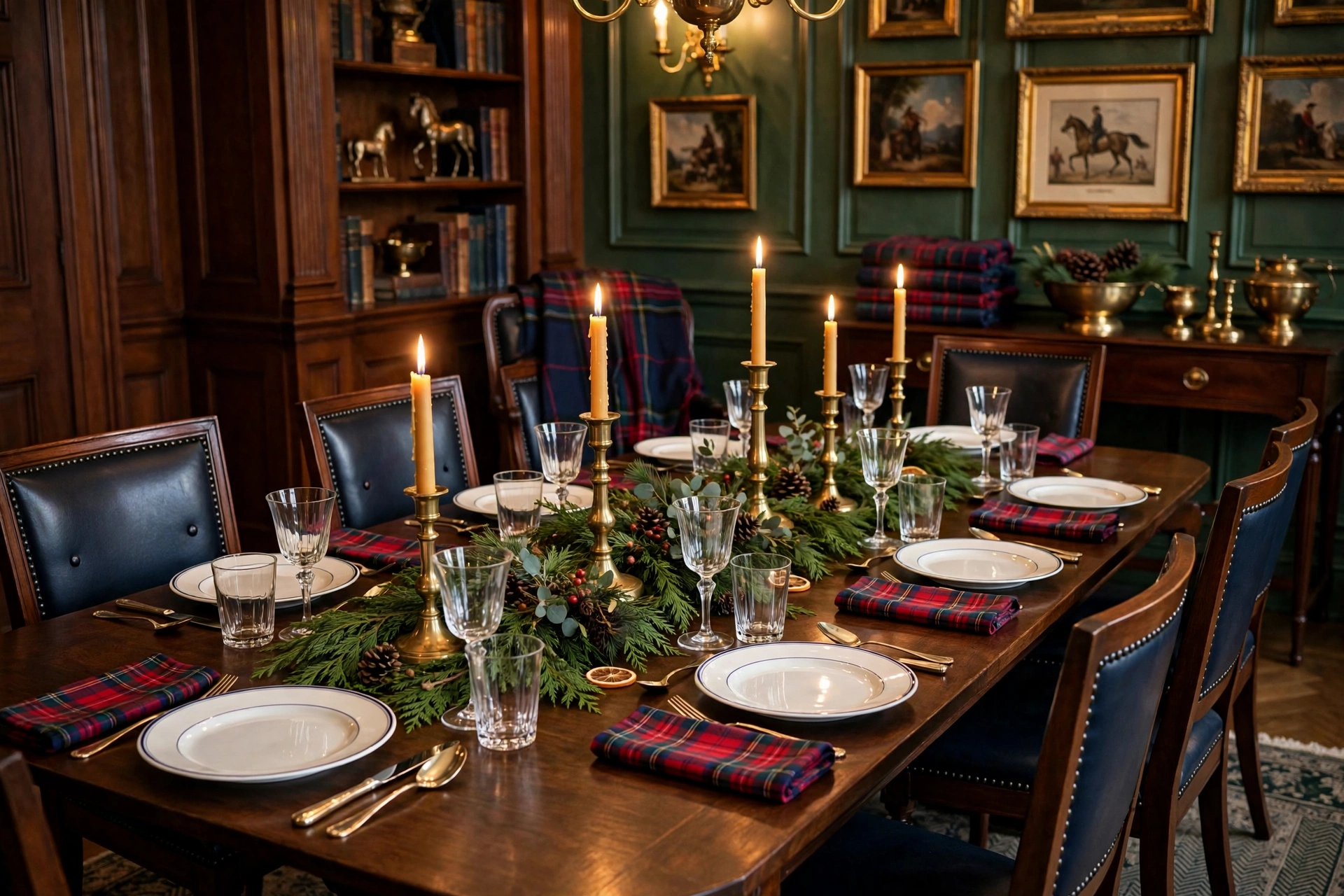
- The runner: a cedar or pine garland runner down the center of the table, studded with brass candlesticks in graduated heights and a few pinecones. Keep it under 10 inches tall — this is a dining table, not a display shelf.
- Candles: ivory tapers in brass holders, unscented, in abundance — 8-12 tapers for a six-person table. Tapers over pillars: tapers read as formal, pillars read as spa. Light them 15 minutes before guests sit down.
- Glassware: the best glasses you own, whatever they are. Cut crystal if you have it, simple elegant stems if not. One water glass and one wine glass per setting — no clutter.
- Plates and linens: white or cream plates (the food provides the color), a tartan or deep green runner, and napkins — Black Watch tartan napkins are the heritage move — folded simply with a sprig of greenery on each.
- The bar cart: if you have one, style it for the season: brass tray, decanters, a small wreath hung on the cart’s side, and a bowl of clementines. The bar cart is the Ralph Lauren Christmas in miniature.
Getting the Look on a Realistic Budget
The direct answer: the heritage look is one of the cheapest to fake well, because its core materials — greenery, plaid, brass, velvet ribbon — are all thrift-store staples. A convincing main-room scheme costs $80-150, with the brass and wool pieces appreciating into permanent collection items.
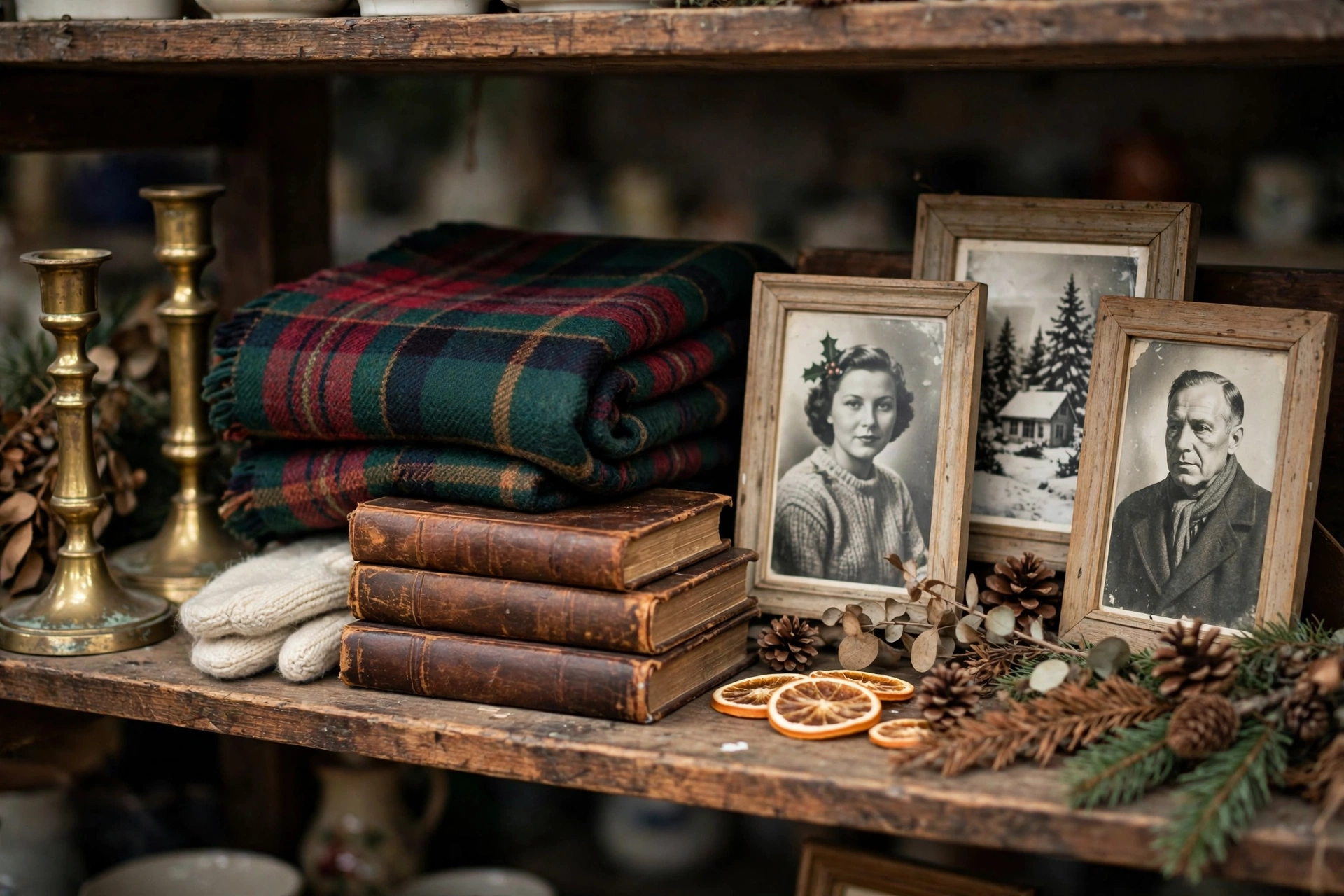
- Thrift first: brass candlesticks ($2-6 each), wool tartan throws ($10-20), leather-bound books ($1-3 each), cut-glass bowls for ornament displays. Estate sales in older neighborhoods are the richest source — you are literally buying someone’s actual heritage collection.
- Ribbon is the splurge: $8-14 per spool of good velvet ribbon is the one place to buy new and buy well. Cheap velvet ruins the illusion; everything else can be secondhand.
- Greenery over ornaments: $40 of fresh cedar garland does more for this look than $40 of ornaments. The palette’s green foundation should be botanical first, decorative second.
- Spray paint as time machine: antique-gold spray paint ($6) turns thrifted frames, old candlesticks, and pinecones into heritage pieces. Two thin coats, light sanding first.
- Build over years: this look rewards patience more than any other in this guide. Buy three brass pieces this year, the tartan throw next year, vintage ornaments the year after. In five years you own it outright — which is, fittingly, exactly how the look is supposed to be acquired.
The Heritage Christmas Through the House: Room by Room
The direct answer: the look scales through the house by varying intensity — full expression in the living room, edited echoes in the entry and dining room, and a whisper in the bedrooms. Every room shares the palette; no room repeats the same composition.
Entryway: The Formal Greeting
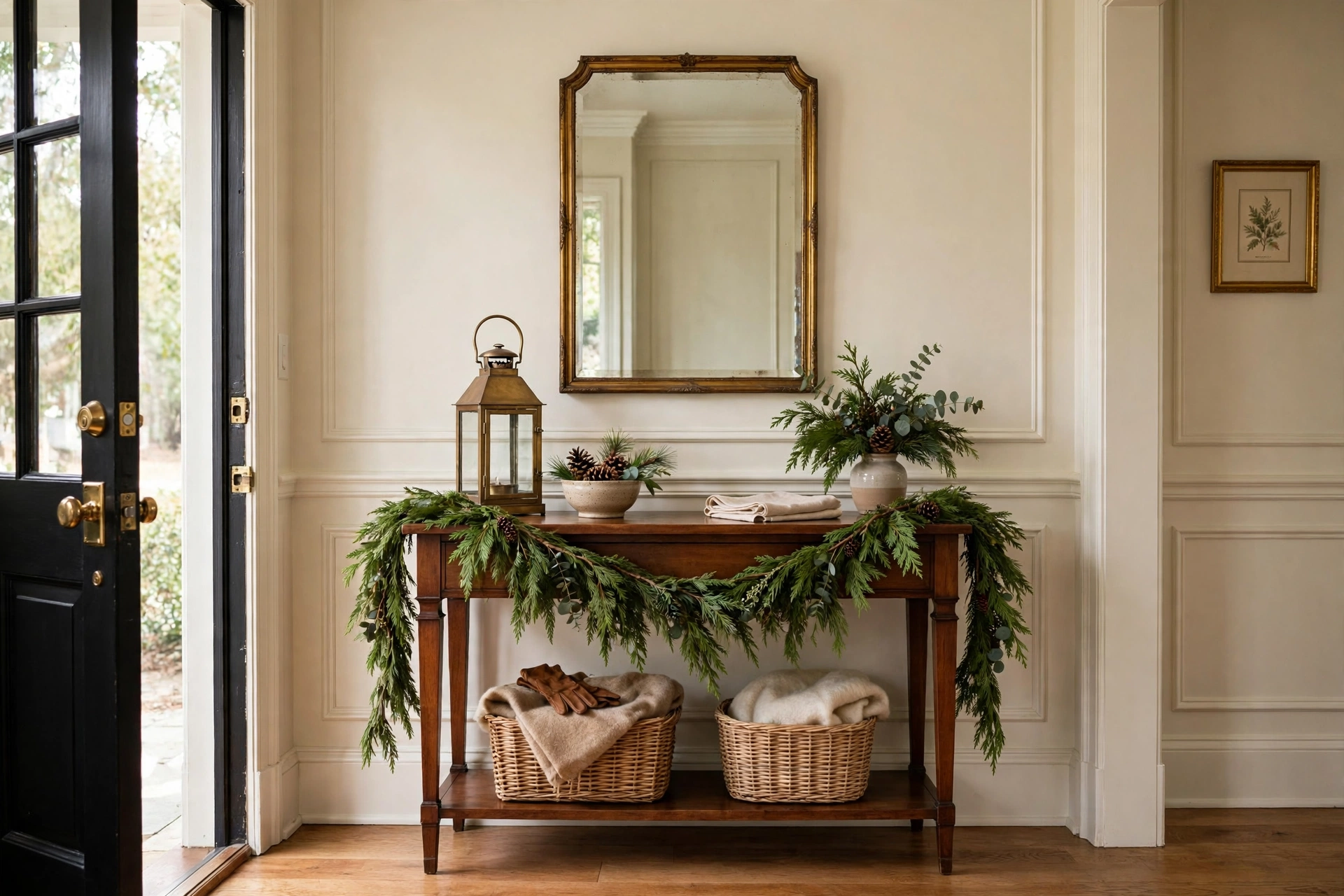
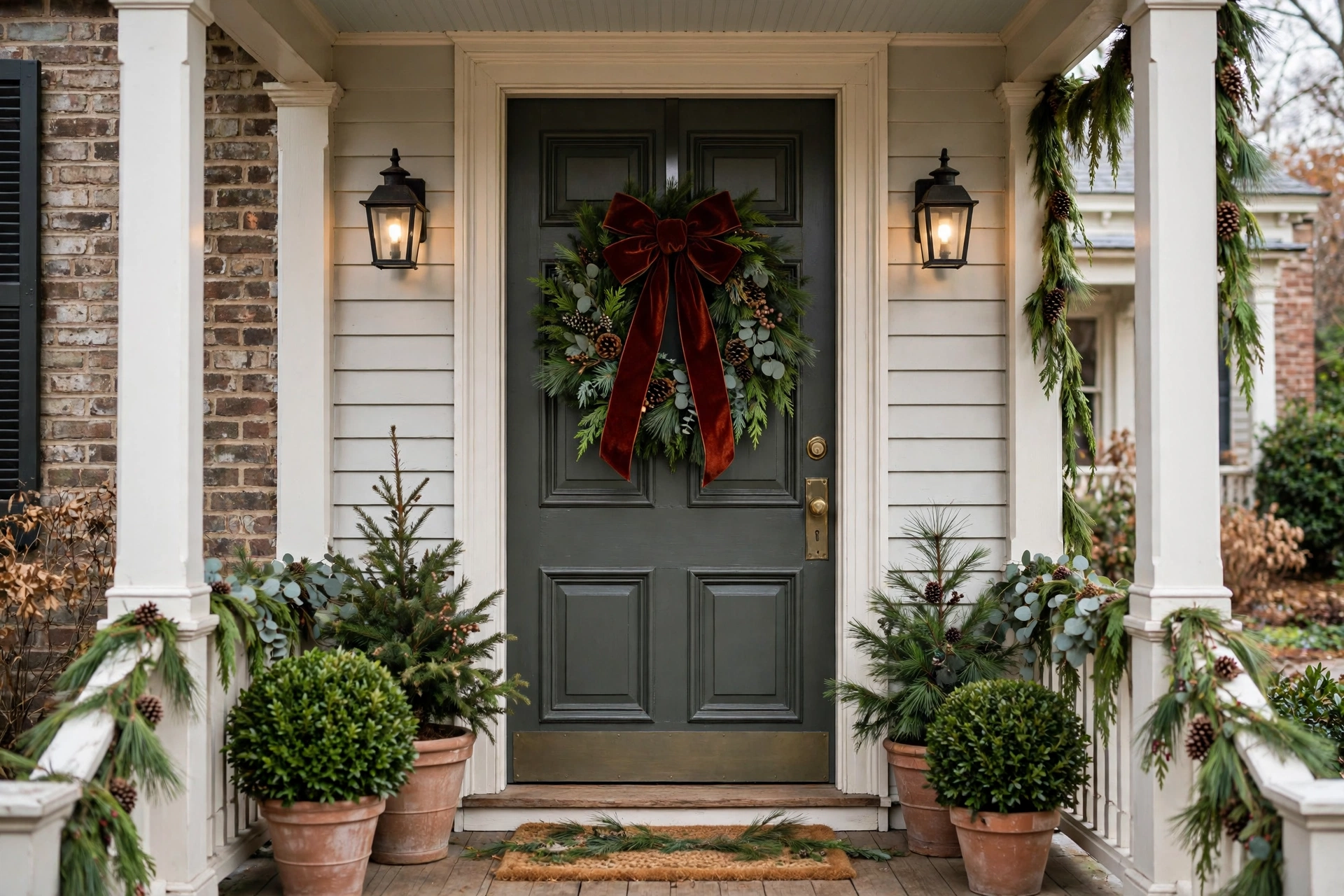
The entry is where the heritage look makes its first impression, and formality is the point. A pine wreath with an oversized oxblood velvet bow on the front door, a brass lantern with a real or flameless candle beside it, and cedar garland along any railing or console. Inside, a mirror or framed print above the console table gets a small boxwood wreath hung on its frame — the wreath-on-art trick is pure country-house. Keep the entry symmetrical: matching lanterns, matching wreaths, matched pairs. Symmetry reads as established and confident.
Dining Room: The Candlelit Stage
Covered in the table section above, but the room around the table matters too: a tartan runner on the sideboard, brass candlesticks of graduated heights along it, and a large wreath or framed art above. If the dining room has a chandelier, wire small velvet bows to its arms — the overhead detail makes the room feel dressed from every angle. Keep the chandelier bows at least 6 inches from bulbs and use cool-running LEDs.
Bedrooms and Working Rooms: The Whisper
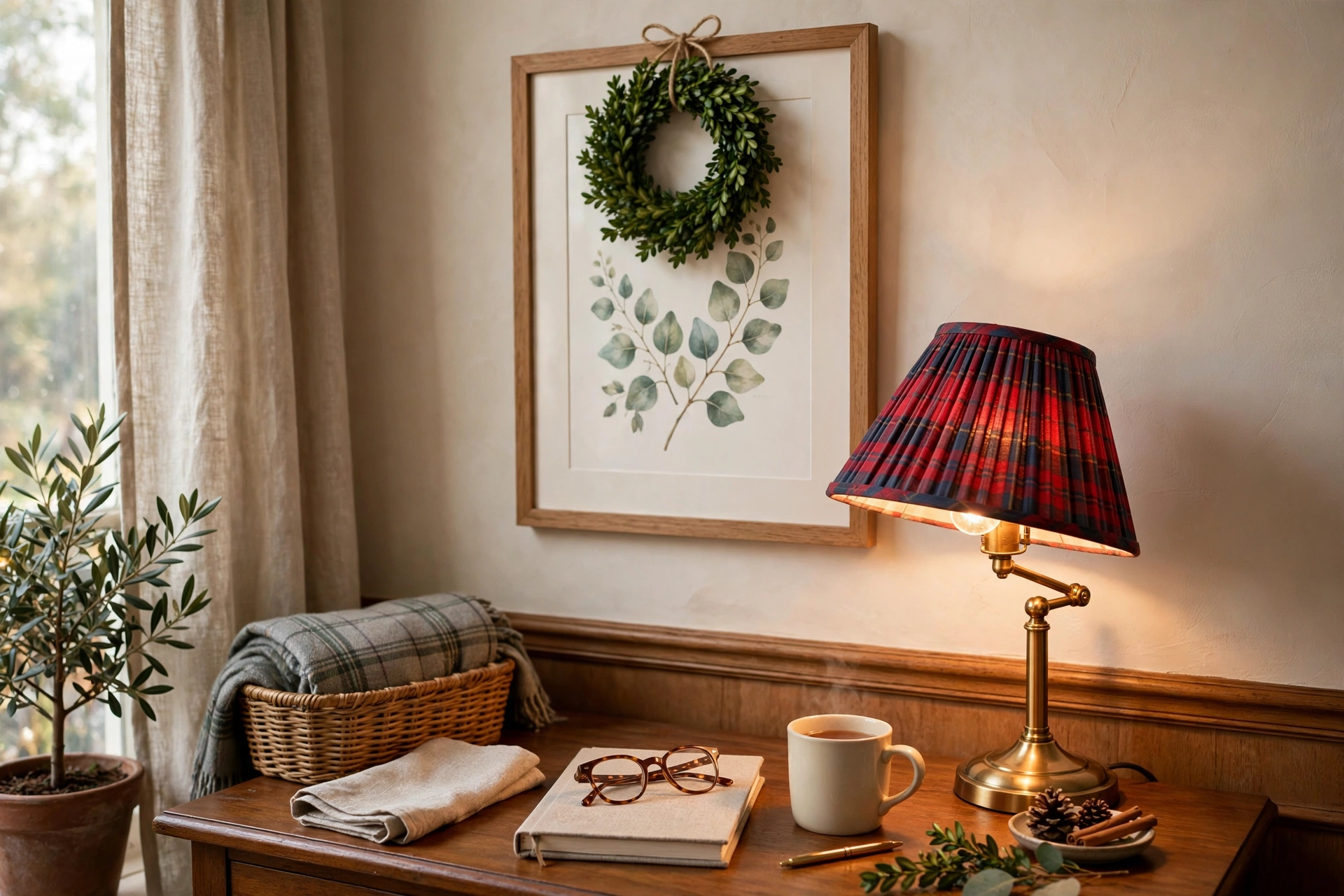
Private rooms get the palette at quarter volume: a tartan throw folded across the foot of the bed, a small wreath above the headboard, a brass candlestick on the nightstand. In a home office, a boxwood wreath on a framed print and a sprig of pine in a brass vase is the entire scheme — enough to feel the season during a December workday without turning the workspace into a display. The discipline of restraint in private rooms is what makes the public rooms feel special by contrast.
Caring for the Collection Through the Season
The direct answer: heritage decor is built from natural materials that need light maintenance — mist the greenery, polish the brass once, keep velvet dry, and check candle levels. Thirty minutes a week keeps the whole scheme looking opening-day fresh through New Year’s.
- Real greenery: mist garlands and wreaths every 2-3 days with water, keep away from heat vents and fireplaces (heat is what kills fresh greenery fastest), and expect 3-4 weeks of good looks indoors. When cedar starts shedding significantly, it is done — replace or remove rather than letting it go crispy.
- Brass: polish once at setup with a gentle brass cleaner; the patina will hold through the season. Handle polished pieces with clean dry hands — fingerprints etch over time.
- Velvet ribbon: keep dry and away from direct fireplace heat, which can scorch the pile. If a bow gets crushed, hold it over steam from a kettle for 30 seconds and reshape — velvet pile revives beautifully.
- Tartan wool: shake throws outdoors weekly to release dust and pine needles; spot-clean only. Wool is naturally soil-resistant, which is one reason it suits this look.
- Candles: trim wicks to a quarter inch before each lighting for clean, soot-free flames — soot is the enemy of cream walls and light upholstery. Burn tapers for no more than 3-4 hours at a stretch to avoid tunneling and dripping.
- Tree water: a real tree in this scheme needs a quart or more of water daily for the first two weeks. A dry tree drops needles onto your velvet tree skirt, which is a cleaning job you do not want.
Schedule it: Sunday evening, ten minutes with the mister and the candle trimmer, five minutes checking the tree water, and a walk-through looking for anything wilted, dripping, or dusty. Heritage style is high-maintenance the way a good suit is high-maintenance — the care is part of the pleasure, and the result looks effortless precisely because it is not.
The Heirloom Mindset: Starting Your Own Collection
The direct answer: you do not inherit a heritage Christmas — you build one, one deliberate purchase per year. The mindset shift is from “decorating for this December” to “acquiring for every December,” and it changes what you buy and what you skip.
Each year, add two or three permanent pieces and skip everything disposable. Year one: the velvet ribbon and a real garland habit. Year two: three brass candlesticks and a wool tartan throw. Year three: a box of vintage glass ornaments from an estate sale and a good wreath form. Year four: the leather-bound books for styling, the cut-glass bowl for the ornament display. By year five, you are not shopping for Christmas anymore — you are assembling it, and the assembly takes an afternoon because every piece already belongs.
Buy the best version of the small things. A $14 spool of real velvet ribbon outperforms a $4 spool of polyester “velvet” so completely that the cheap one is wasted money. A $6 thrifted brass candlestick outperforms a $12 new gold-tone one. The heritage look is one of the few aesthetics where the thrift store reliably beats the big-box store — age is the feature, not the flaw.
And document as you go. Photograph the tree and mantel each year, keep the ornament boxes labeled, note where the good brass came from. In twenty years, someone will be hanging your ornaments and telling the story of where each one came from. That is the entire point of this style — Christmas as a collection, a collection as a history, a history as a home.
Frequently Asked Questions
1. What is the Ralph Lauren Christmas style?
A heritage-luxury holiday aesthetic built on five pillars: a traditional forest green, oxblood red, and antique gold palette; tartan and plaid textiles; natural evergreen greenery; brass, leather, and equestrian accents; and decor that looks collected over decades. It is traditional without being stuffy — old-money ease rather than showroom perfection.
2. What plaid is used in classic Ralph Lauren Christmas decor?
Two tartans: Royal Stewart (the red-ground statement plaid) for throws, tree ribbon, and table runners, and Black Watch (the dark green-navy plaid) for pillows, napkins, and tree skirts. Use a maximum of two tartans, one large application per room, and buy wool or wool-blend — the drape and depth of real wool is immediately visible.
3. How do I make my Christmas tree look collected instead of store-bought?
Mix ornament types, eras, and finishes within a strict palette: glass balls in varied sizes and finishes, figural pieces with character, natural elements (pinecones, dried oranges), and a few genuinely vintage finds. Place heirloom pieces at eye level, avoid uniform ornament sets, and let the variety read as decades of accumulation.
4. What colors are in a classic heritage Christmas palette?
Forest green, oxblood/burgundy red, antique gold, and warm neutrals (cream, camel, natural wood) — four colors, no exceptions. Bright cherry red, silver, pastels, and black all break the spell. The discipline of the four-color palette is what makes the look read as luxurious rather than merely traditional.
5. Is the Ralph Lauren Christmas look expensive to achieve?
Not necessarily — it is one of the cheapest heritage styles to build because its materials are thrift-store staples. Brass candlesticks, wool tartan throws, and leather-bound books are abundant secondhand. Budget $80-150 for a main-room scheme, splurge only on good velvet ribbon, and build the collection over several years — which is how the look is supposed to be acquired anyway.
6. Can I mix the Ralph Lauren look with modern furniture?
Yes — the contrast is part of the appeal. Heritage textiles and brass look striking against clean-lined modern furniture; the mix reads as collected and personal rather than themed. Keep the modern pieces in warm neutrals (camel, cream, natural wood) so they harmonize with the palette, and let the Christmas decor provide all the pattern and patina.
7. What kind of greenery is best for a classic Christmas?
Cedar for draping garlands, noble fir or pine for full wreaths, boxwood for structured formal accents, and magnolia leaves for two-tone depth. Use real greenery where scent matters (mantel, entry) and high-quality faux where longevity matters (staircase). Never mix obviously plastic greenery with real — the contrast exposes both.
8. How is this different from farmhouse Christmas decor?
Farmhouse Christmas leans rustic and casual — buffalo check, galvanized metal, distressed wood, “merry and bright” signage. The Ralph Lauren heritage look is polished and formal — real tartan (not buffalo check), brass (not galvanized steel), velvet (not burlap), and no word signs. Same traditional roots, completely different register.
9. What should I avoid in a heritage Christmas scheme?
Novelty ornaments, multicolor lights, silver mixed with gold, word-art signs, inflatable yard decor, and any plastic that looks like plastic. The look’s authority comes from natural materials and restraint — each non-heritage element does disproportionate damage because the whole scheme depends on coherence.
10. How do I store heirloom ornaments safely?
Wrap each ornament individually in acid-free tissue, store in divided boxes (not loose bins), keep in climate-controlled space — attics and garages destroy old glass and adhesives with temperature swings. Photograph the tree each year before takedown so you can recreate ornament placement, and keep a small inventory list of the most valuable pieces for insurance purposes.
The Ralph Lauren Christmas endures because it was never about a season — it was about a sensibility. Coherence over novelty, materials over motifs, patina over perfection. Start this year with the velvet ribbon and a real garland, add the brass and tartan as you find them, and let the look accumulate the way it is meant to: slowly, deliberately, and built to outlast every trend that comes for it. Your future self, hanging these same ornaments in twenty years, will thank you.