Living Room Decor Ideas: A Complete Style Guide
Most living rooms don’t fail because of one bad purchase. They fail because the pieces were chosen one at a time, with no plan connecting them. A sofa bought on sale, a rug inherited from a previous apartment, a lamp picked up because it was nearby. Each item may be perfectly nice, yet the room…
Most living rooms don’t fail because of one bad purchase. They fail because the pieces were chosen one at a time, with no plan connecting them. A sofa bought on sale, a rug inherited from a previous apartment, a lamp picked up because it was nearby. Each item may be perfectly nice, yet the room never quite comes together.
The good news is that a room that feels finished follows a fairly predictable order of decisions. Layout comes before color. Color comes before accessories. Lighting gets planned rather than improvised. Once you understand that sequence, decorating stops feeling like guesswork, whether you’re working with a sprawling open-plan lounge, a narrow terraced-house front room, or a small formal sitting room you barely use.
This guide walks through that sequence in the order a designer would approach it, with practical measurements, style breakdowns, and the small details that separate a room that looks styled from one that actually feels good to live in.
Living Room vs. Sitting Room: Why the Difference Shapes Your Decor
A living room is the main everyday gathering space in a home, built around comfort, entertainment and flexible use. A sitting room is typically a smaller, quieter room meant for conversation, reading or receiving guests. The distinction matters because it changes your furniture priorities, your focal point and how durable your materials need to be.
In many modern homes the two terms are used interchangeably, and in British English “sitting room” often simply means the lounge. But where a house has both, the rooms do different jobs, and decorating them identically is a missed opportunity.
The living room usually carries the heaviest load. It hosts movie nights, kids’ homework, a dog on the sofa, a laptop on a Sunday afternoon. That means performance fabrics, a rug that hides a spill, generous seating depth, and a layout that accommodates a television without letting it dominate. Storage is essential here, because clutter gathers fastest in the room everyone uses.
A sitting room can afford to be more deliberate. Without a TV to plan around, the focal point can be a fireplace, a window, a bookcase or a pair of facing chairs. Seating tends to be more upright and conversational. You can use more delicate materials, like velvet, silk-blend cushions or a pale wool rug, because the room sees less traffic. This is also the space where a bolder paint color or a darker, moodier scheme often works best, since it isn’t the room you need to feel bright and energetic at 8 a.m.
How do you make a sitting room feel cozy?
A sitting room feels cozy when the seating is pulled close together, the lighting sits low and warm, and there is plenty of soft texture. Group chairs and a small sofa around one focal point, use table lamps instead of ceiling lights, and add a thick rug, throws and cushions in natural fabrics like wool and linen.
Scale plays a big role too. A small sitting room with oversized furniture feels cramped, while one with undersized pieces floating against the walls feels cold. Aim for a tight conversation circle, roughly the distance at which two people can talk without raising their voices, and let the rest of the room breathe around it. Warm-toned wood, a paint color with a slightly muddy or earthy undertone, and a few personal objects such as books you’ve actually read or a piece of pottery from a trip will do more for coziness than any number of decorative accessories bought to fill shelves.
Start With the Layout: Furniture Placement That Makes the Room Work
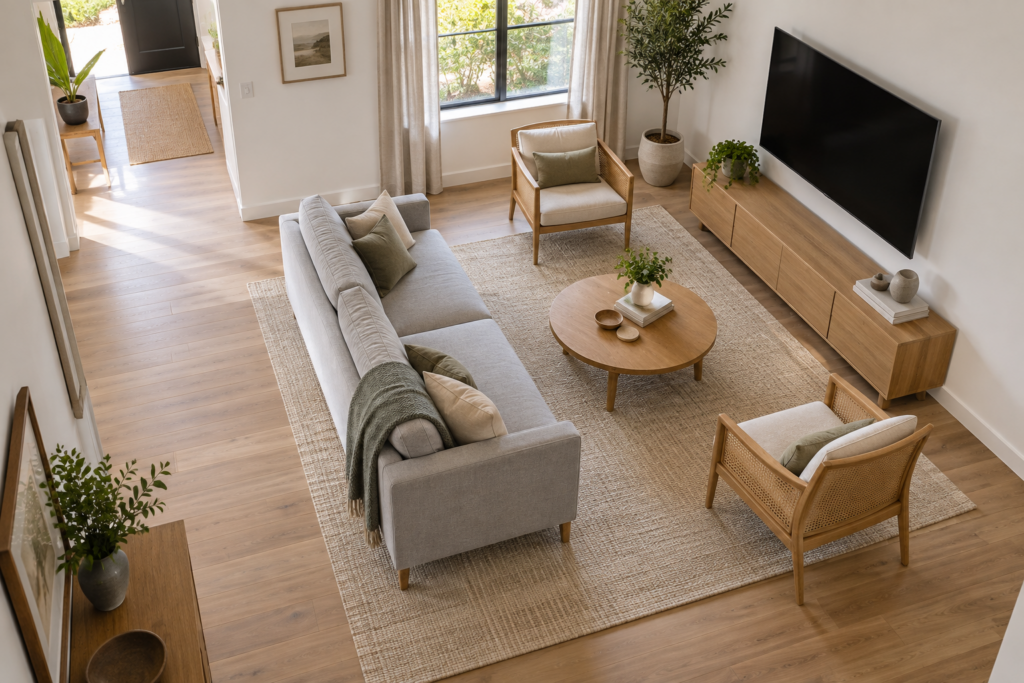
Before you choose a paint color or buy a single cushion, work out where people will sit, walk and look. Layout is the foundation that everything else sits on, and it’s the hardest thing to fix later.
Begin by identifying the room’s focal point. In most living rooms it will be one of three things: a fireplace, a large window with a view, or the television. If you have a fireplace and a TV on different walls, you’ll need to compromise, often by mounting the TV above the fireplace (if the height allows comfortable viewing) or by angling seating so both are visible from the main sofa.
Next, map your traffic paths. People need to walk through the room without squeezing past knees or stepping around a coffee table. A clear walkway of roughly 30 to 36 inches (about 75 to 90 cm) is comfortable for main routes. Secondary paths, like the gap between a sofa and a side chair, can be tighter.
A few spacing guidelines that designers rely on:
- Leave about 16 to 18 inches (40 to 45 cm) between the sofa and the coffee table, close enough to reach a drink, far enough to stretch your legs.
- Keep conversational seating within about 8 to 10 feet (2.5 to 3 metres) of each other so people don’t have to raise their voices.
- Choose a coffee table that is roughly two-thirds the length of your sofa.
- Side tables should sit close to the height of the sofa arm, give or take a couple of inches.
One of the most common layout mistakes is pushing every piece of furniture against the walls. It feels like it creates space, but it often produces a dead zone in the middle of the room and makes conversation awkward. Even pulling a sofa a few inches off the wall creates depth. In larger rooms, floating the sofa in the middle with a console table behind it defines a seating zone and makes the room feel more intentional.
How do you arrange furniture in a small living room?
In a small living room, choose one main seating piece, keep furniture raised on visible legs, and pull items slightly away from walls rather than pushing everything to the edges. Use a round or oval coffee table to ease traffic flow, and replace a second sofa with one or two armchairs to keep sightlines open.
Beyond that, think about furniture that does two jobs. A storage ottoman can serve as a coffee table, footrest and extra seat. A nest of tables takes up the footprint of one. A wall-mounted shelf above a narrow console gives display space without eating floor area. Avoid bulky, rolled-arm sofas with deep skirts, which visually weigh a small room down; track-arm or slim-armed designs with exposed legs let the floor show underneath, and more visible floor always reads as more space.
If the room is long and narrow, divide it into two zones, perhaps a seating area at one end and a reading chair or small desk at the other, instead of stretching one arrangement down its length. A rug under each zone helps anchor them.
Where should the sofa go in a living room?
The sofa usually belongs facing or perpendicular to the room’s focal point, positioned so it doesn’t block the main walkway or turn its back to the entrance. In open-plan spaces, placing the sofa’s back toward the kitchen or dining area creates a natural divider that defines the living zone without walls.
If you can, avoid putting the sofa directly under a window where it blocks radiators, curtains and light, unless the window is the only practical wall. Test your layout before committing: painter’s tape on the floor marking the footprint of each piece will show you in minutes whether a layout actually flows.
Choosing a Color Palette and Wall Treatment
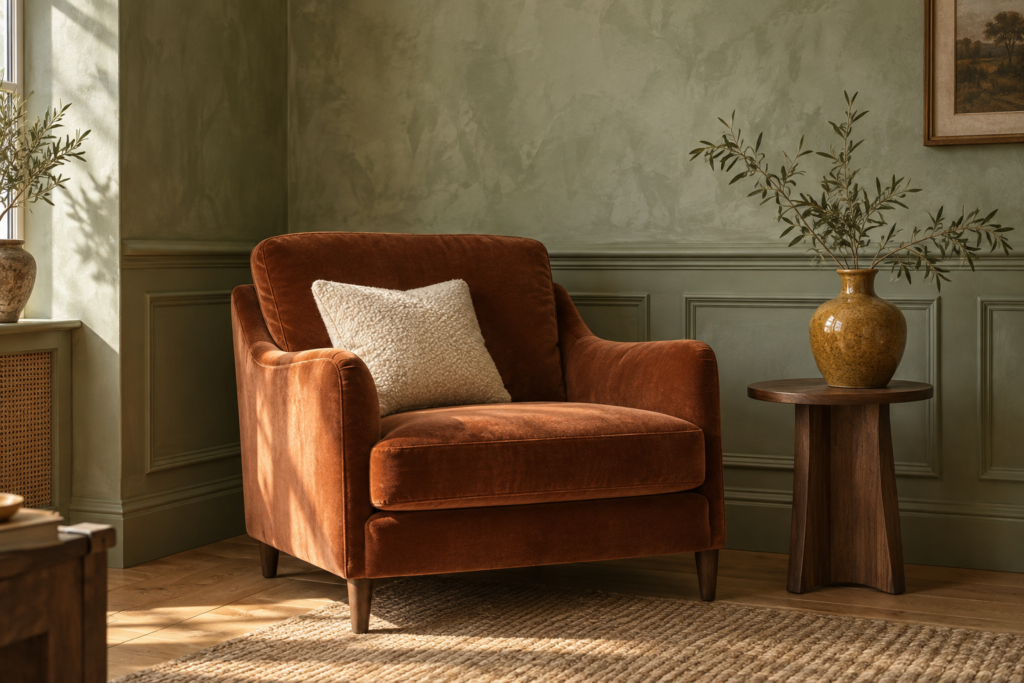
Your color palette is what makes a room feel unified. Even a room full of mismatched furniture can look deliberate when the colors relate to each other.
The simplest framework to start with is the 60-30-10 rule. Roughly 60 percent of the room is a dominant color, usually the walls and possibly a large rug or sofa. About 30 percent is a secondary color, carried through larger furniture, curtains or an accent wall. The final 10 percent is an accent color that shows up in cushions, artwork, a vase or a lamp base. It isn’t a strict formula, but it prevents the two most common problems: a room with no contrast at all, or one where five competing colors fight for attention.
Light is the factor most people underestimate. A paint color that looks warm and soft in a south-facing room can turn flat and grey in a north-facing one, because northern light is cooler and more consistent. In north-facing rooms, colors with warm undertones (creamy whites, earthy greens, terracotta, warm greige) tend to hold up better. South-facing rooms can handle cooler blues and crisp whites without feeling chilly. Always paint large sample swatches, at least the size of a sheet of paper, on two or three different walls and look at them in morning, afternoon and evening light before deciding.
Current living room palettes have moved away from the stark grey-and-white schemes of the last decade toward warmer, more grounded tones. Earthy greens like sage and olive, soft clay and plaster pinks, warm off-whites, deep chocolate browns and ochre accents are all popular because they pair naturally with wood, linen and plants. That said, the right palette is the one that suits your light and the furniture you already own, not whatever is fashionable this year.
Walls don’t have to be just paint, either. Some options worth considering:
- Limewash or plaster-effect paint gives soft, cloudy movement that adds depth without pattern.
- Wainscoting, panelling or picture-frame moulding adds architectural character to plain new-build rooms, especially when painted the same color as the walls above for a tonal look.
- Wallpaper on one wall or inside built-in alcoves brings pattern without overwhelming the space.
- Color drenching, painting walls, trim and sometimes the ceiling in one color, makes small rooms feel cocooning and oddly larger because the edges blur.
Don’t forget the ceiling. A pure bright white ceiling over warm walls can look jarring. Choosing a ceiling white with a little of the wall color mixed in, or a very pale tint, makes the whole room feel more cohesive.
Layered Lighting for a Room That Works Day and Night
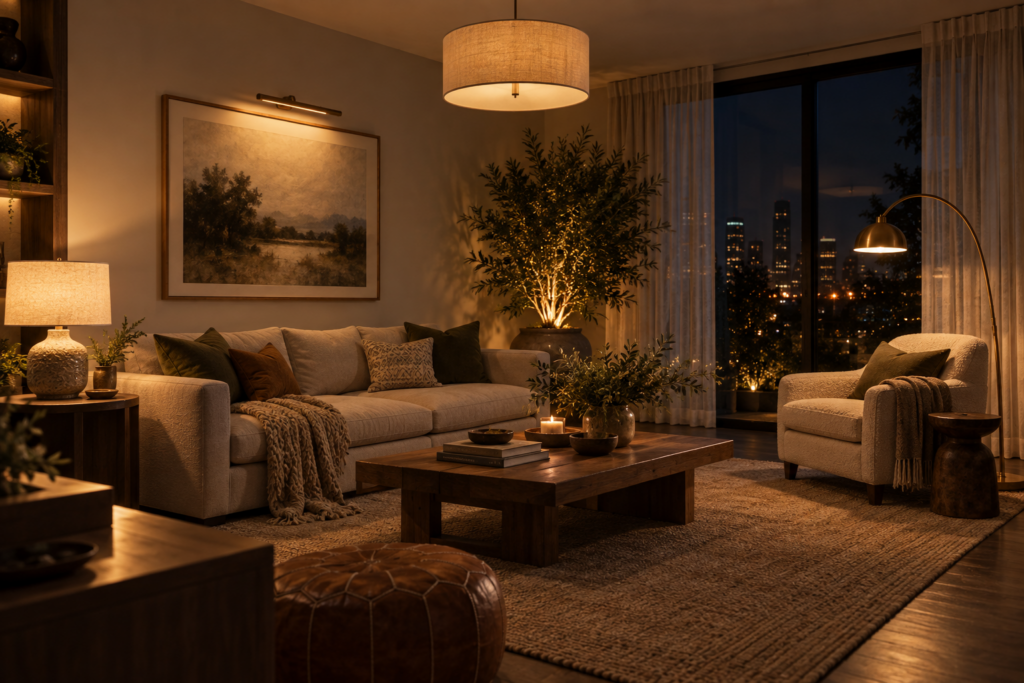
If there is one change that transforms a living room more than any other, it’s lighting. A single overhead fixture flattens a space, casts harsh shadows and makes even beautiful furniture look uninviting. Good living room lighting is built in layers, each doing a different job.
Ambient lighting provides overall illumination. This is your ceiling pendant, flush mount, recessed downlights or wall-washing fixtures. It should be on a dimmer wherever possible, because the right brightness for tidying up is very different from the right brightness for watching a film.
Task lighting serves specific activities. A floor lamp with an adjustable arm beside a reading chair, a desk lamp in a work corner, or a swing-arm wall light next to the sofa. Position reading lights so the light falls over your shoulder onto the page, not into your eyes.
Accent lighting adds atmosphere and draws attention to features. Picture lights above artwork, small uplighters behind plants, LED strips inside shelving or glass cabinets, and candles all belong in this layer.
A useful rule of thumb is to aim for light sources at several different heights, low (table lamps, uplighters), middle (floor lamps, wall sconces) and high (ceiling fixtures), placed around the room so light comes from more than one direction. In an average living room, that often means three to five separate sources, not counting the ceiling light.
Bulb color temperature matters as much as the fixtures. For living and sitting rooms, warm white bulbs in the range of about 2700K to 3000K create a relaxed, flattering glow. Cooler “daylight” bulbs, which you’ll see labelled 4000K and above, suit kitchens and workspaces but tend to make living spaces feel clinical, especially in the evening. Try not to mix very different color temperatures in the same room, as the contrast is noticeable.
Natural light is part of the scheme too. Hang curtain rods higher and wider than the window frame, close to the ceiling and extending several inches beyond each side, so curtains can be pulled fully clear of the glass during the day. This lets in more light and makes windows and ceilings look larger. Sheer or linen curtains layered with heavier blackout or thermal ones give you flexibility between bright mornings and cozy winter evenings.
Rugs, Textiles and the Finishing Touches
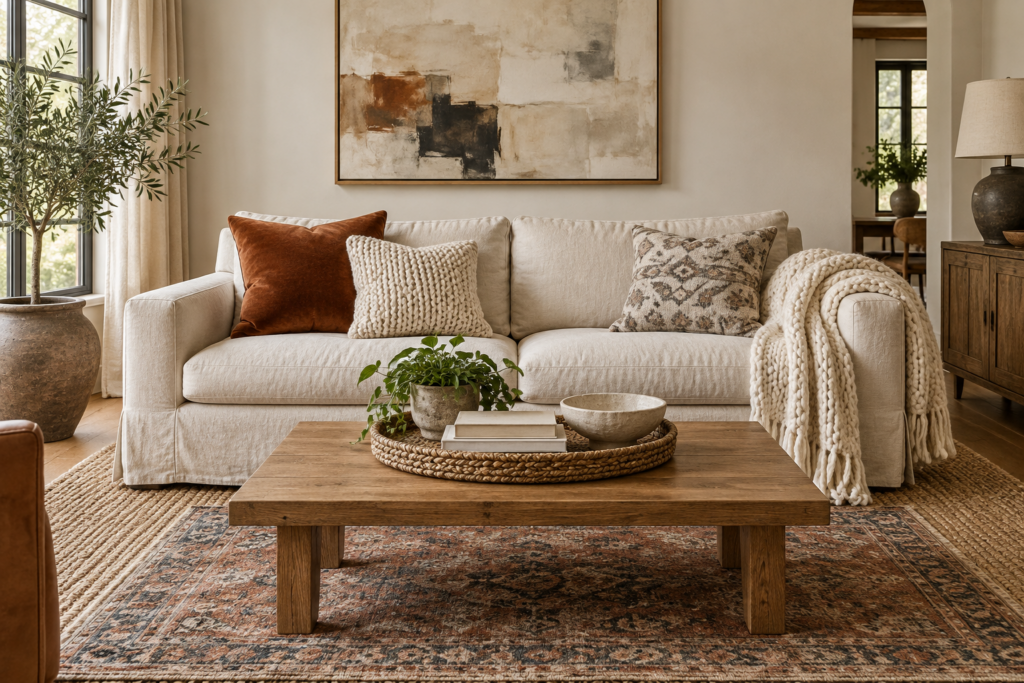
Once the layout, color and lighting are set, textiles and accessories are what give the room personality and warmth. This is also where most rooms go wrong in the opposite direction, either too sparse to feel lived-in or so full of objects that nothing stands out.
What size rug should go in a living room?
A living room rug should be large enough that at least the front legs of the sofa and every chair in the seating group rest on it. In most average rooms that means a rug of around 8×10 feet (240×300 cm) or larger. A rug that floats in the middle, touching no furniture, makes the room look disconnected and smaller.
In a very large room, a rug big enough for all furniture legs to sit fully on it creates a luxurious, cohesive zone. Leave a border of bare floor, typically around 12 to 18 inches (30 to 45 cm), between the rug edges and the walls so the room doesn’t look carpeted wall-to-wall. For material, wool is durable and naturally stain-resistant, jute and sisal bring texture but can be scratchy underfoot and harder to clean, and flatweave or low-pile synthetics are practical in homes with kids and pets. Layering a smaller patterned or vintage-style rug over a large neutral jute rug is an affordable way to get size and character at once.
Texture is what keeps a neutral room from looking flat. Mix at least three or four different surfaces: nubby bouclé, smooth leather, chunky knit, crisp linen, soft velvet, rough-hewn wood, glazed ceramic, woven rattan. When the colors are restrained, texture does the visual work.
Cushions look best in odd, loosely coordinated groupings rather than rigidly matched pairs. A reliable formula is to combine one solid, one textured and one patterned cushion, varying sizes slightly, and to repeat at least one color from elsewhere in the room so they feel connected. Feather or feather-blend inserts, sized an inch or two larger than the cover, give that full, slightly plump look instead of a limp one.
How high should you hang art above a sofa?
Hang art above a sofa so the bottom of the frame sits about 8 to 10 inches (20 to 25 cm) above the top of the sofa back. On an open wall with no furniture beneath it, place the center of the artwork at roughly 57 to 60 inches (145 to 150 cm) from the floor, which is close to average eye level.
The width matters as much as the height. A single piece or grouping above a sofa generally looks best at about two-thirds the width of the sofa. Anything much smaller looks lost; anything wider than the sofa can feel top-heavy. For a gallery wall, lay the frames out on the floor or trace them on paper taped to the wall first, keeping the spacing between frames consistent, usually 2 to 3 inches.
Shelves and coffee tables benefit from the same restraint. On a coffee table, group objects on a tray to keep things tidy: a stack of books, something organic like a small plant or branches in a vase, and one sculptural or personal object. On open shelving, mix books placed both vertically and horizontally with a few objects, and leave some empty space on every shelf. Rooms feel curated when the eye has somewhere to rest.
Plants are the finishing layer nearly every living room benefits from. A large floor plant such as a fiddle-leaf fig, rubber plant or olive tree adds height and softens corners, while trailing pothos on a high shelf and a snake plant in a low-light corner are forgiving choices for beginners. Seasonally, swapping cushion covers and throws, heavier wool and velvet in autumn and winter, lighter cotton and linen in spring and summer, refreshes the room without redecorating.
Finding Your Style: Popular Living Room Decor Styles Explained
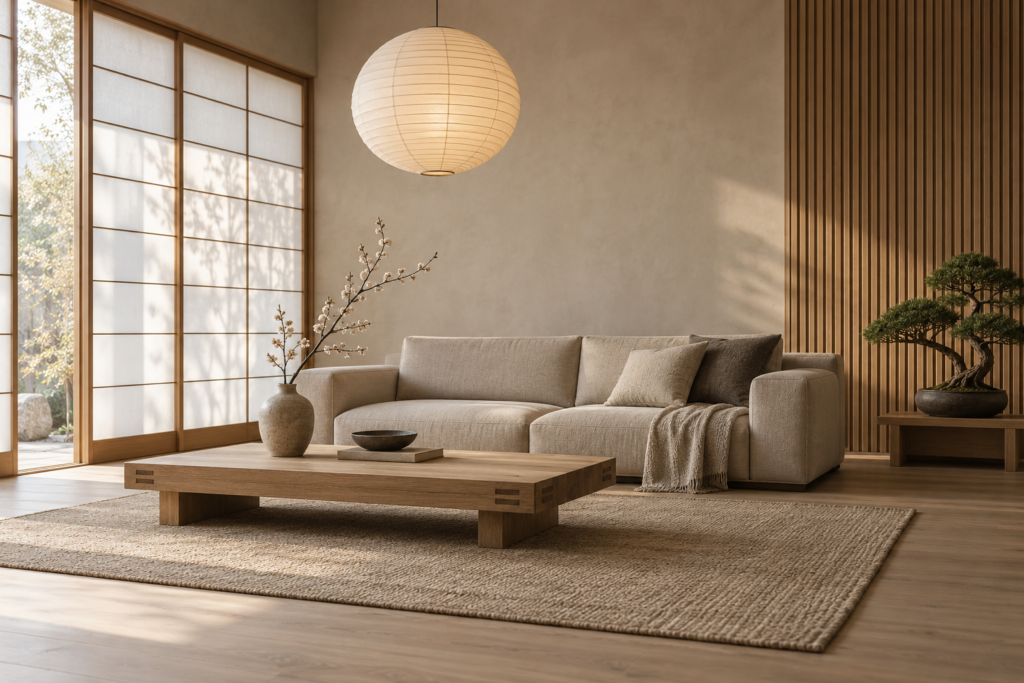
Knowing the name of a style isn’t the point. The point is recognizing what you’re naturally drawn to so you can make consistent choices. Most beautiful rooms are a blend of two styles, with one leading and the other adding contrast.
Modern and contemporary. Clean lines, minimal ornament and a restrained palette. Think low-profile sofas, glass or stone surfaces, sculptural lighting and very little clutter. Modern rooms can feel cold without warm textures, so a wool rug and wood accents help.
Scandinavian. Light, airy and practical. Pale wood floors and furniture, white or soft neutral walls, simple shapes, and plenty of cozy textiles like sheepskin and knitted throws. It works especially well in small rooms and homes with limited natural light.
Japandi. A blend of Scandinavian comfort and Japanese minimalism. Low furniture, natural materials such as ash, oak, bamboo and paper, muted earthy colors, and a strong emphasis on craftsmanship and calm. Fewer objects, but each one chosen carefully.
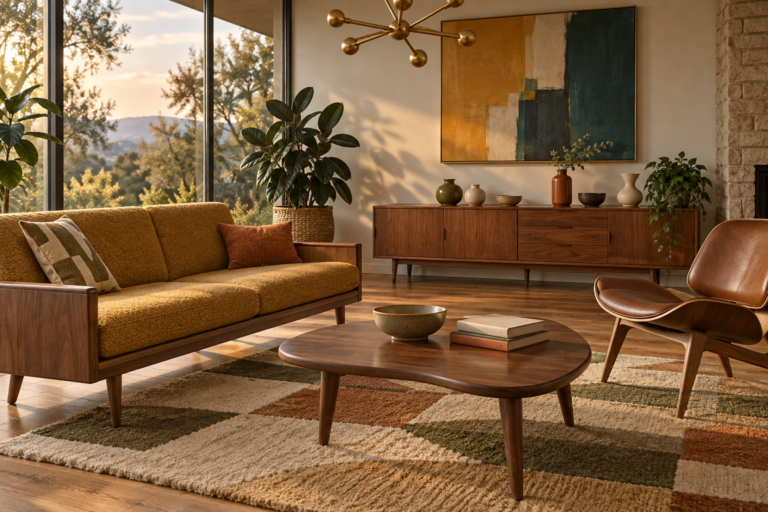
Mid-century modern. Inspired by design from roughly the 1950s and 60s. Tapered wooden legs, walnut and teak finishes, organic curves, and punchy accents like mustard, teal and burnt orange. Iconic shapes like the lounge chair with ottoman and the sunburst mirror are hallmarks.
Modern farmhouse. Rustic elements balanced with clean updates. Shiplap or panelled walls, reclaimed wood, black metal hardware, slipcovered sofas and neutral linens. It reads warm and family-friendly, but can tip into cliché if every accessory has a rustic finish.
Traditional and classic. Symmetry, rich wood tones, rolled-arm sofas, wingback chairs, patterned rugs and layered curtains with valances or pelmets. Traditional sitting rooms in particular suit this style, with a fireplace flanked by matching armchairs.
Bohemian. Relaxed, collected and colorful. Layered patterned rugs, rattan and wicker, floor cushions, macramé, abundant plants and objects gathered from travel. The key to boho that works is a consistent underlying color story, otherwise the layering turns chaotic.
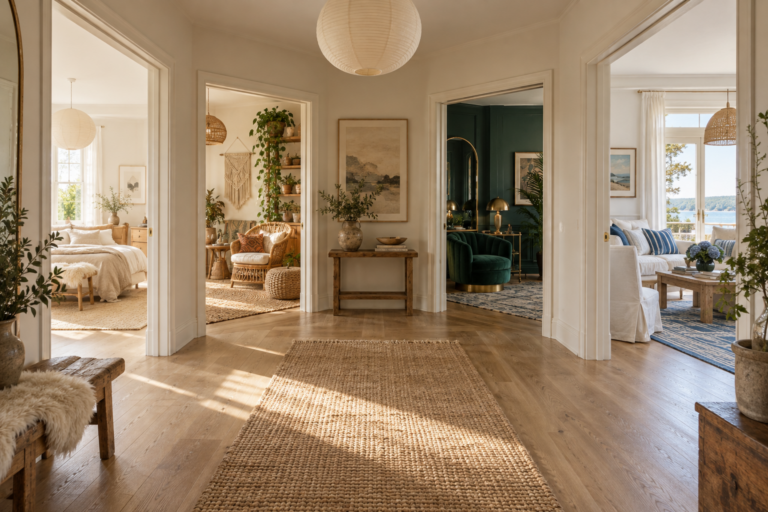
Coastal. Breezy and light, with whites, sandy beiges and soft blues, weathered wood, linen slipcovers and natural fibres like jute and seagrass. Modern coastal avoids anchors and seashell motifs in favor of texture and tone.
Transitional. A middle ground between traditional and contemporary. Classic silhouettes in simplified forms, neutral palettes and a mix of materials. It’s the most common style in real homes precisely because it adapts easily to furniture you already own.
How do you mix decor styles without the room looking messy?
To mix decor styles successfully, choose one style to lead and let the second make up no more than a third of the room. Tie the two together with a shared color palette, a repeated material such as wood or brass, and consistent scale, so different pieces feel related instead of randomly assembled.
For example, a Scandinavian base with mid-century accents might use pale oak and white walls throughout, then introduce a walnut sideboard, a tapered-leg armchair and one mustard cushion. A traditional room can be modernized with a contemporary abstract painting and a sleek floor lamp while the rolled-arm sofa and patterned rug stay put. The contrast is what makes the room interesting. The shared threads are what make it feel intentional.
If you’re not sure what your style is, look at the rooms you’ve saved or photographed over time and note what keeps recurring: materials, colors, the shape of furniture legs, how full or empty the surfaces are. Those patterns are a far better guide than any quiz.
Frequently Asked Questions
What is the first step in decorating a living room?
The first step is planning the layout around how you actually use the room. Measure the space, identify the focal point and main walkways, and decide where seating will go before buying anything. Choosing furniture and color becomes much easier once the layout is settled.
How can I make my living room look expensive on a budget?
Hang curtains high and wide, replace harsh overhead lighting with warm table and floor lamps, and invest in one large rug that fits the seating properly. Paint, new cushion covers and editing down clutter also make a dramatic difference for very little money, as does swapping cheap hardware or lampshades for better-quality versions.
What colors make a small living room look bigger?
Light, warm neutrals such as soft whites, pale greige and gentle earthy tones reflect light and make walls recede. Painting walls and trim in the same shade reduces visual breaks, which also helps. A darker color drenched across every surface can make a small room feel larger too, because it blurs the room’s edges.
Should the living room rug match the sofa?
The rug shouldn’t match the sofa exactly, but it should relate to it. Pick a rug that shares at least one color with the sofa, cushions or curtains, or one that contrasts in tone so the sofa stands out. A pale sofa on a slightly darker, textured rug usually looks more grounded than two identical shades.
How many throw pillows should go on a sofa?
A standard three-seat sofa typically looks balanced with three to five cushions, while a loveseat suits two or three. Odd numbers feel relaxed and modern, and even numbers arranged symmetrically suit traditional rooms. Leave enough space that people can still sit comfortably without moving cushions onto the floor.
How do you decorate a living room with a TV?
Mount or place the TV at seated eye level and anchor it with a media console, built-in shelving or a gallery-style wall so it doesn’t become a lone black rectangle. Frame-style TVs that display artwork, cabinets with doors, or darker paint behind the screen all help it blend into the decor instead of dominating it.
Can you put a sectional sofa in a small living room?
Yes, a compact or apartment-sized sectional can work well in a small room, especially one tucked into a corner, since it provides more seating per square foot than a sofa and separate chairs. Choose a low back, slim arms and raised legs, and make sure it leaves at least one clear walkway.
How often should you update your living room decor?
Major pieces like sofas and rugs usually last many years, so full redecorating isn’t needed often. Most people refresh their living room seasonally with textiles, plants and accessories, and repaint every several years or when the walls look tired. Updating small elements regularly keeps the room feeling current without constant spending.