Christmas Decorating Ideas for Small Apartments (No Tree? No Problem)
Most apartments do not fail at Christmas because of one bad purchase. They fail because every decorating idea seems designed for a suburban living room with twelve-foot ceilings and a fireplace the size of a studio kitchen. If your “entryway” is three feet of hallway and your tree options range from “blocks the front door”…
Most apartments do not fail at Christmas because of one bad purchase. They fail because every decorating idea seems designed for a suburban living room with twelve-foot ceilings and a fireplace the size of a studio kitchen. If your “entryway” is three feet of hallway and your tree options range from “blocks the front door” to “blocks the only window,” the holiday season can feel like something other people get to have.
I have decorated a 480-square-foot apartment for Christmas more times than I can count, and here is what I learned: small spaces do not need smaller Christmas spirit. They need a different strategy. Instead of one big tree anchoring the room, you build the holiday feeling out of vertical surfaces, windows, tabletops, and light. The result can feel more magical than a full-size tree, because the decor wraps around you instead of standing in one corner.
This guide walks through the whole playbook in designer order: start with the wall tree (the single highest-impact move), dress your windows, run garlands vertically instead of horizontally, use tabletop trees that punch above their size, hang everything renter-friendly so your deposit survives, and finish with lighting tricks that make a tiny room glow. No full-size tree required, no landlord conflicts, and nothing that needs a storage unit in January.
Why Small Apartments Are Actually Great for Christmas Decorating
The direct answer: a small apartment needs less decor to feel fully festive, and every piece you add has more visual impact per square foot. A single strand of fairy lights that would disappear in a big house can transform a studio.
Think about the math. A 500-square-foot apartment has roughly the wall and window area of one large living room, but you see all of it at once. When you sit on your couch, your whole decorated home is in your field of vision. Designers call this the “jewel box effect” — small rooms reward bold, concentrated decorating because there is no dead space to fill.
There are practical advantages too. A few specifics:
- Lower cost: decorating 400-600 square feet fully can cost $40-80 with budget finds, versus $200+ for a full house.
- Faster setup: most small-apartment schemes in this guide take 2-3 hours total, not a full weekend.
- Easier storage: everything here packs flat or fits in one under-bed box.
- More light per square foot: two or three light strands make a studio glow; a big house needs a dozen.
The strategy throughout this guide is simple: decorate surfaces you already have (walls, windows, shelves, tables) instead of adding floor-hogging pieces. If you want the bigger-picture version of this approach, our complete guide to Christmas home decorating ideas covers whole-house schemes you can scale down.
The Wall Tree: Your New Best Friend
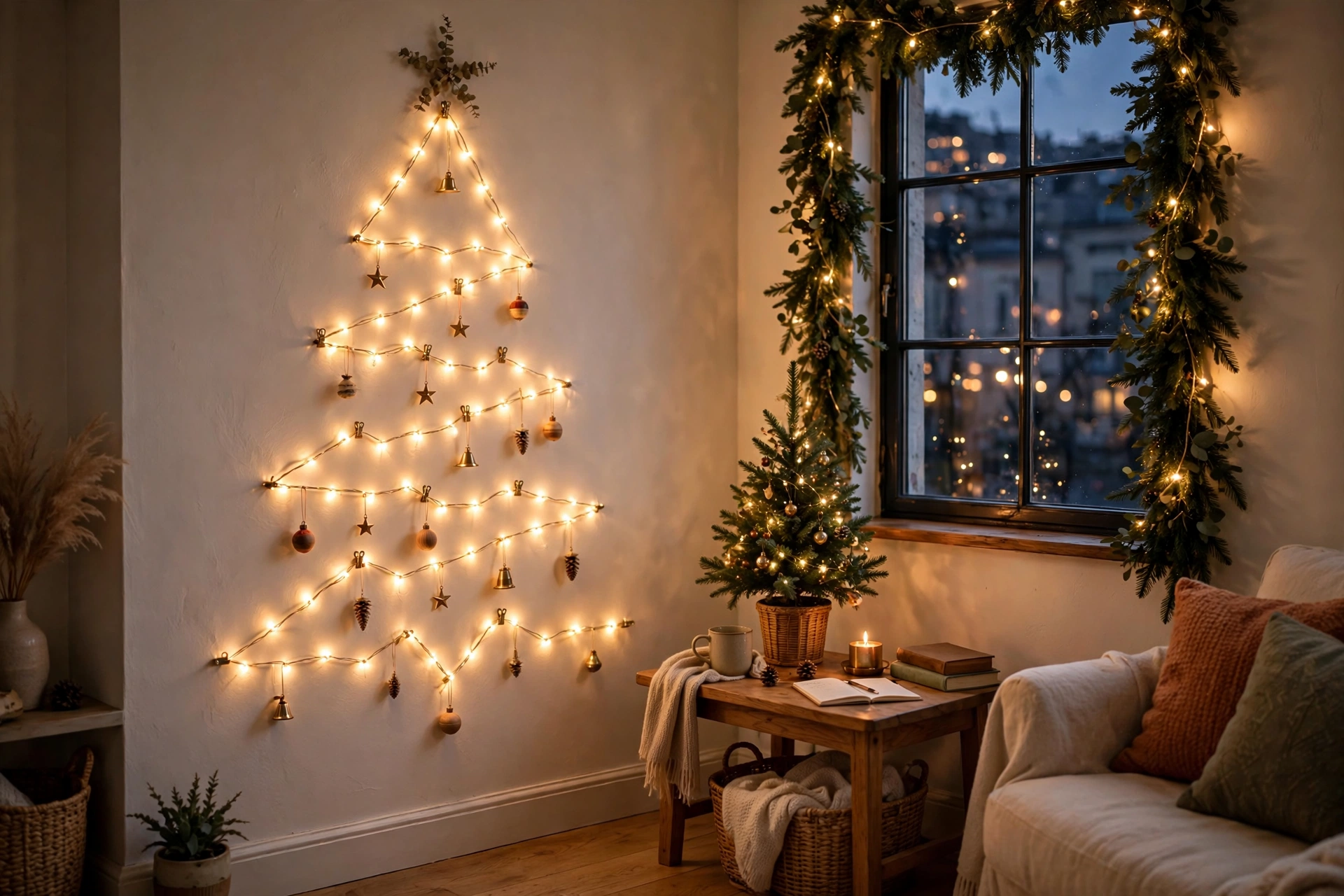
The direct answer: a wall-mounted tree gives you the silhouette, the lights, and the ornament display of a Christmas tree while using zero floor space. It is the single best move a small apartment can make at Christmas.
A wall tree is exactly what it sounds like: a tree shape built on your wall from lights, branches, felt, or ribbon, decorated with ornaments. It reads as “Christmas tree” to everyone who sees it, photographs beautifully, and comes down in minutes. Here are the three versions that work best, from easiest to most involved.
Felt Wall Trees (Kid and Pet Friendly)
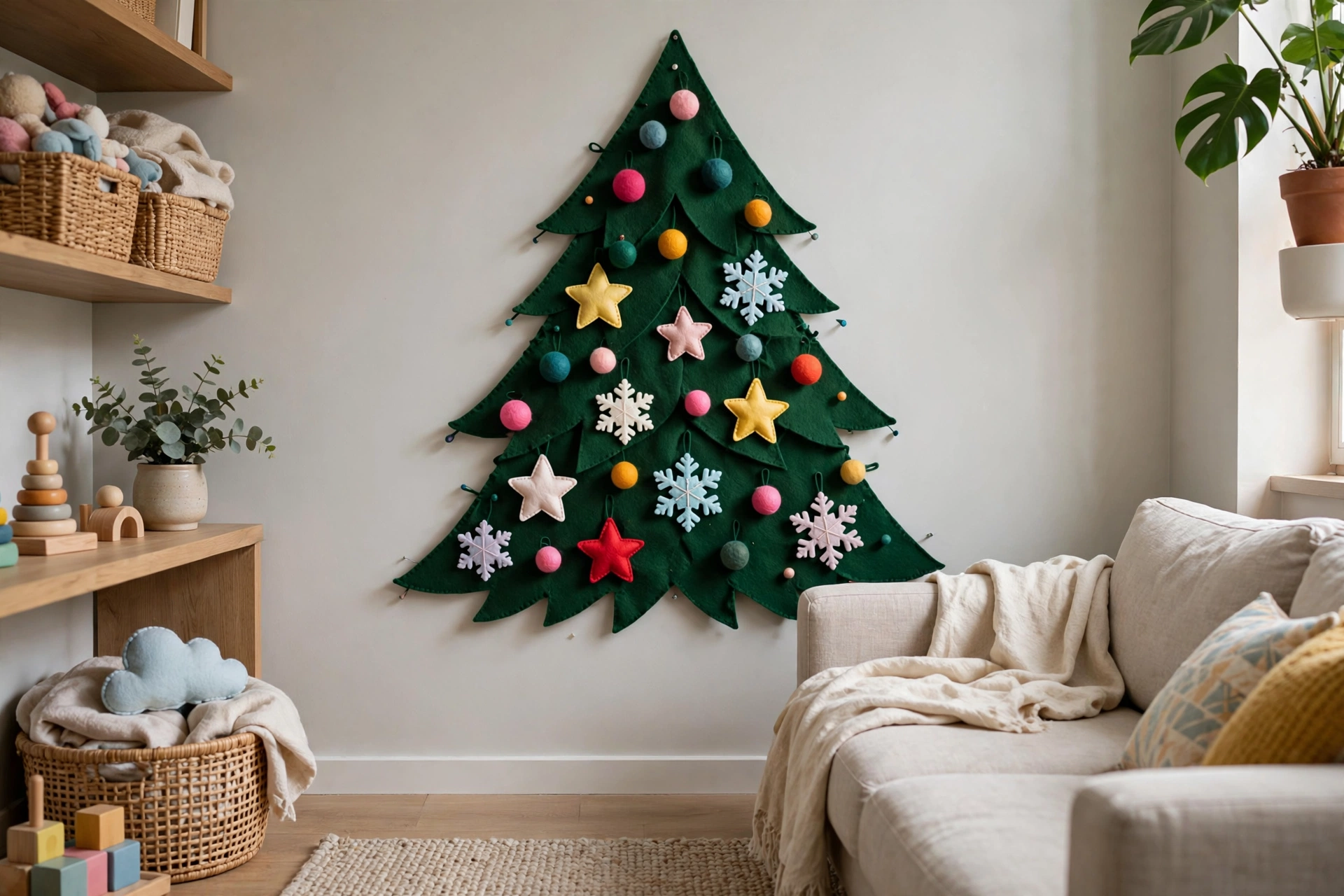
Felt trees are fabric tree shapes, usually 3-4 feet tall, that stick to the wall with included adhesive tabs or a few small hooks. The ornaments attach with Velcro or sewn-on loops, so kids can rearrange them endlessly without breaking anything.
What to look for: a tree at least 36 inches tall (smaller ones read as a wall decal, not a tree), ornaments with secure Velcro backing, and a green that matches your taste — deep forest green looks classic, while sage or cream felt looks modern. Hang it at a height where the “trunk” sits about 30-36 inches off the floor so it reads as tree-sized, and place a small basket of wrapped gifts or a tree collar underneath to ground it. Total cost runs $15-30, and the whole thing folds into a drawer in January.
Light-Strung Wall Trees (Maximum Glow)
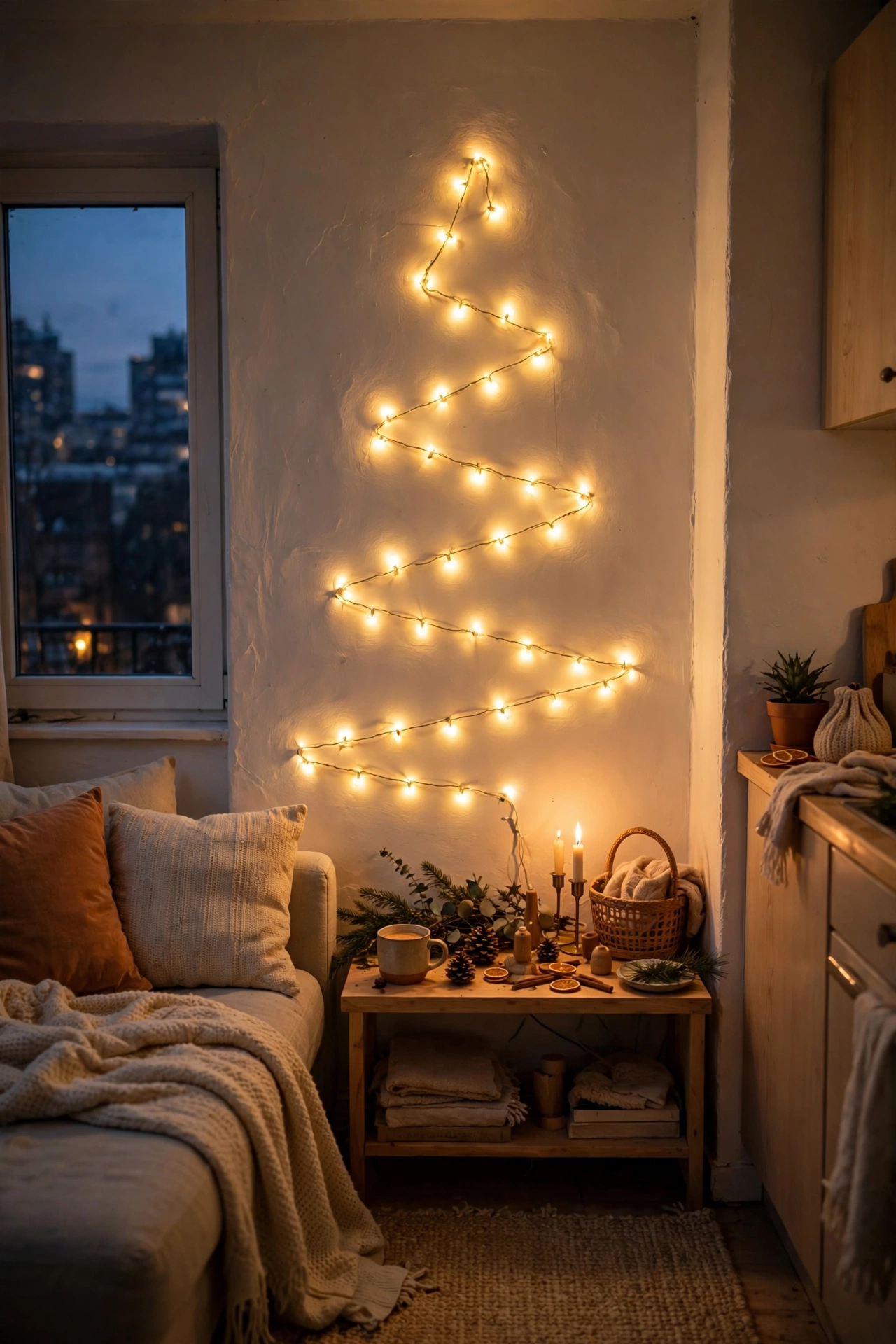
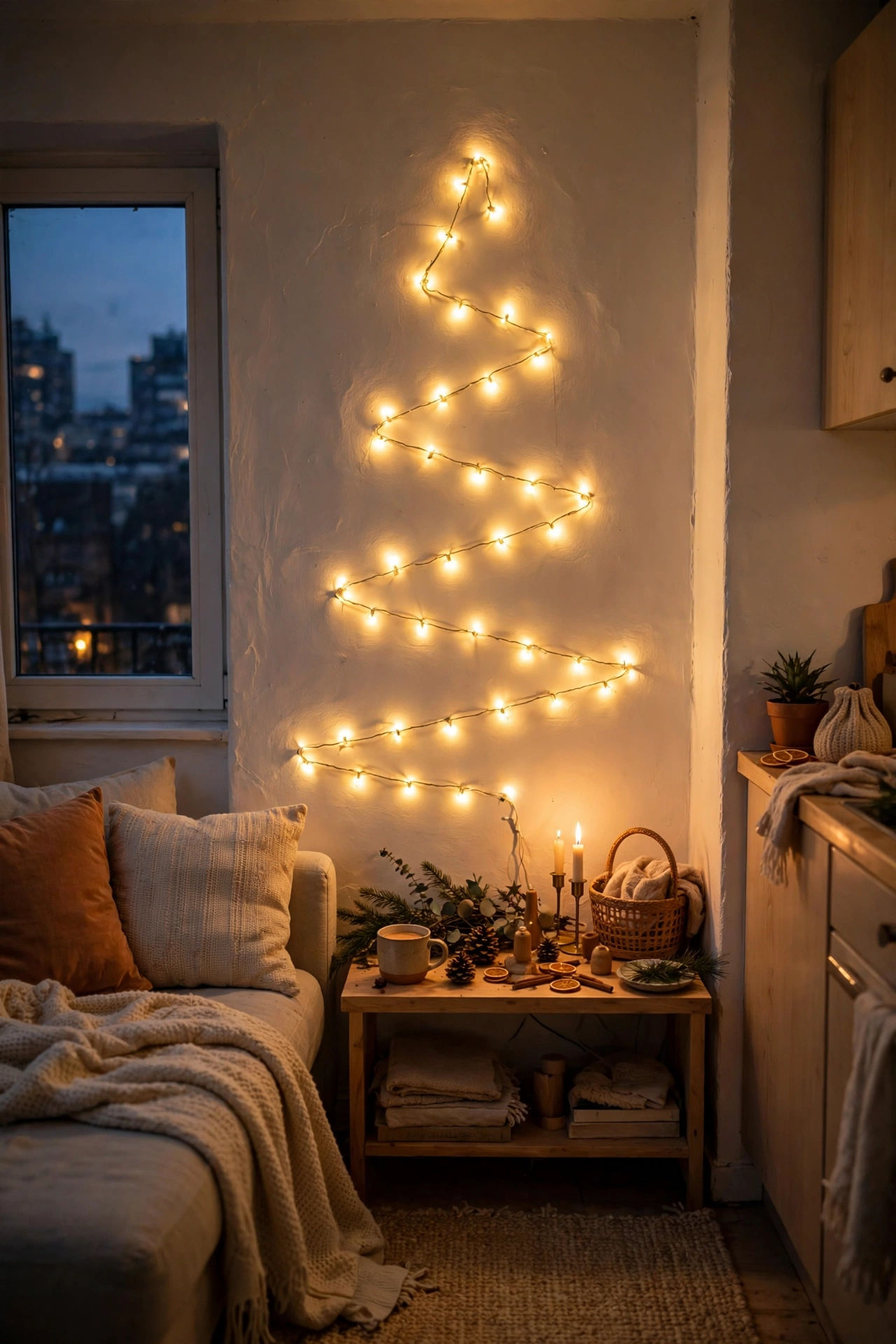
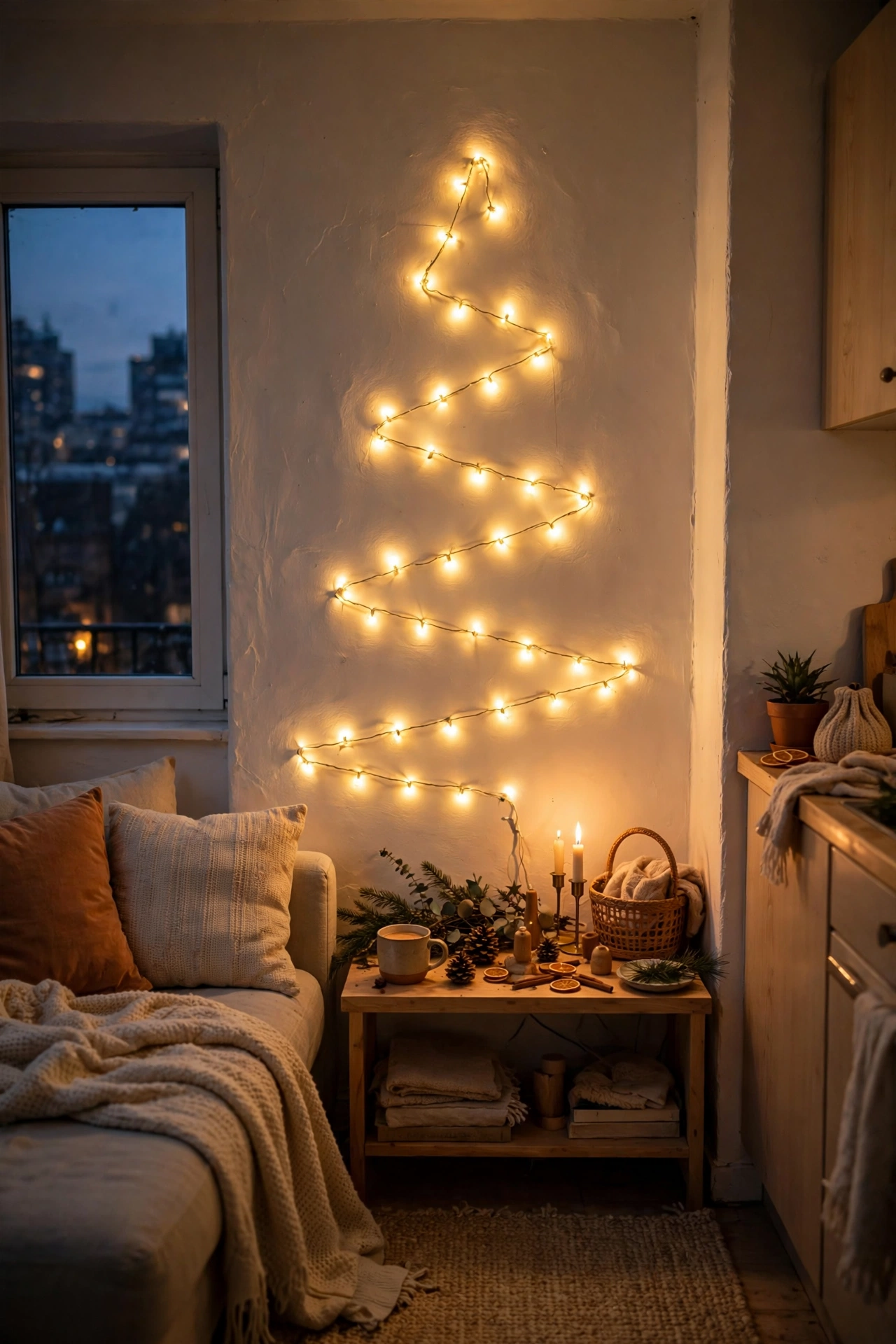
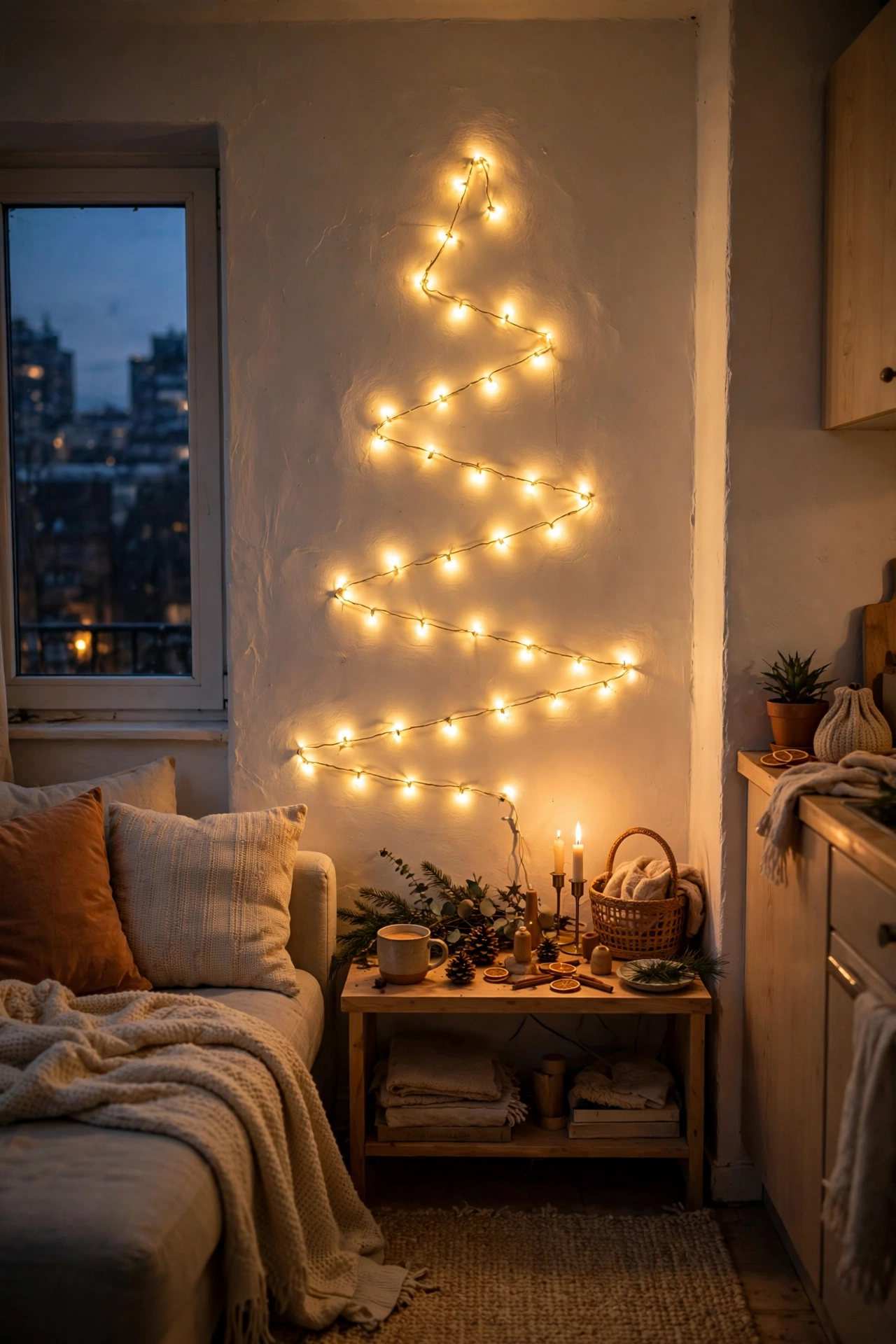
This is my favorite version. You outline a tree shape on the wall with a string of LED fairy lights, zigzagging back and forth to form the branches, then hang lightweight ornaments from small clear hooks along the “branches.” At night, with the room lights low, it is genuinely stunning.
Here is the method, step by step:
- Mark your tree outline with painter’s tape first: a triangle about 4 feet wide at the base and 5-6 feet tall. Stand back and check the proportions before committing.
- Start at the top with a 33-foot (10-meter) strand of warm-white LED fairy lights on thin copper wire. Copper-wire lights are key — they are nearly invisible by day and bend into any shape.
- Zigzag downward, making each row 4-6 inches longer than the one above, and secure the wire at each turning point with a small clear adhesive hook (rated for at least 0.5 lb).
- Hang 12-20 lightweight ornaments — shatterproof plastic or paper — from the hooks along the rows.
- Top it with a star or bow hung from one final hook.
Use battery-operated lights with a timer (6 hours on, 18 off) so you never have to reach behind furniture to switch them off. One strand costs $8-12, and the whole project takes about 45 minutes.
Branch-and-Dowel Minimalist Trees
For a Scandinavian-leaning look, mount 5-7 horizontal wooden dowels or real branches on the wall in decreasing lengths — longest at the bottom (about 36 inches), shortest at the top (about 8 inches) — spaced 8-10 inches apart. Hang ornaments, dried orange slices, and pine sprigs from each dowel with twine.
This version doubles as wall decor that works beyond the holidays if you swap the ornaments for air plants or art prints in January. Use dowels at least 0.5 inch thick so they do not bow under ornament weight, and anchor the two longest dowels into studs or with toggle bolts if your ornaments are glass.
Windows: Your Free Display Case
The direct answer: windows are the most underused decorating surface in a small apartment. They are visible from inside and outside, they need no floor space, and a single dressed window can carry the whole room’s holiday feeling.
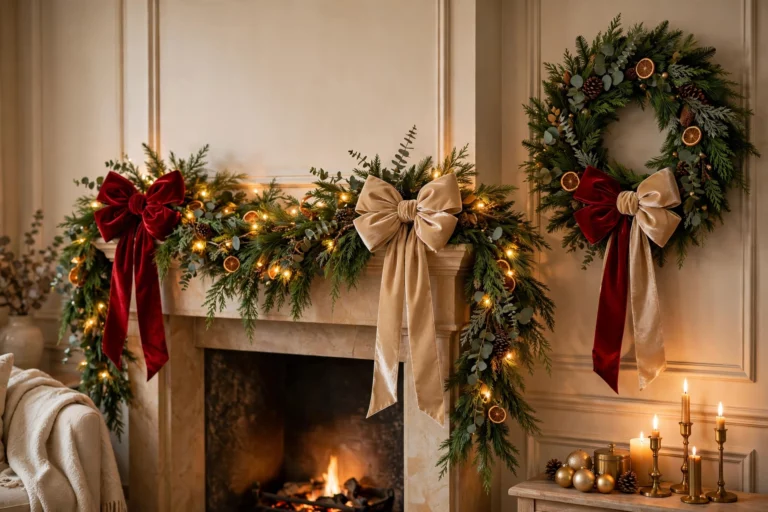
Start with the frame. A 6-foot pre-lit artificial garland draped along the top of the window frame, swagged slightly in the middle and secured with two adhesive hooks, takes five minutes and instantly says Christmas. Choose a garland at least 2.5 inches thick so it reads as lush from across the room, and look for one with mixed foliage (pine, cedar, eucalyptus tips) rather than a single flat needle type — the variety catches light and looks real.
Wreaths on Suction Cups
A 16-20 inch wreath hung in the center of a window on a heavy-duty suction cup (rated for 5+ lbs) is a classic for a reason: it is symmetrical, it is visible from the street, and it takes up literally no interior space. Wipe the glass with rubbing alcohol before attaching the cup, press out all the air, and check the seal after 24 hours — temperature swings can loosen cheap cups. For double-hung windows, hang the wreath on the inside of the outer pane or on the wall above the frame instead.
Window Clings and Light Curtains
Static-cling snowflakes and holiday decals cost $5-10 for a sheet of 30-50, apply with water in minutes, and peel off without residue — the definition of renter-friendly. Cluster them in one corner of the glass rather than spreading them evenly; an asymmetric cluster looks designed, while an even grid looks like a craft project.
For evening impact, hang a light curtain (a 10×10-foot net of 100-200 LEDs) across the window behind your regular curtains. When lit, the whole window glows. When off, the fine wires nearly disappear. Keep the color temperature consistent with your other lights — all warm white (2700-3000K) or all cool — because mixed temperatures are the fastest way to make decor look accidental.
Vertical Garlands: Go Up, Not Out
The direct answer: in a small apartment, garland should travel vertically — down door frames, along shelf edges, around mirrors — because vertical lines draw the eye up and make ceilings feel higher while using no floor space.
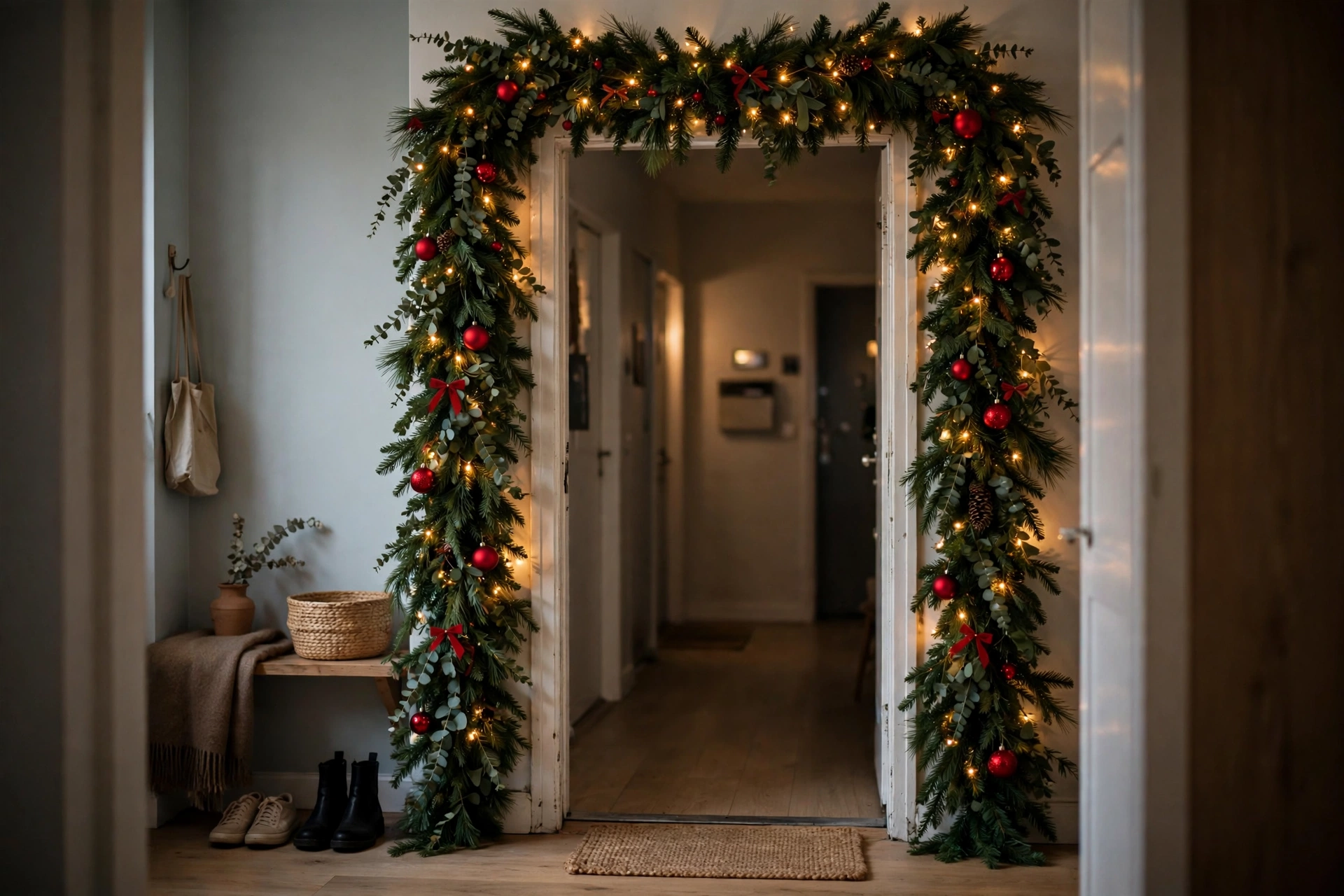
The doorway frame is the highest-value garland spot in a small home. Wrap a 9-foot garland up one side of your main interior doorway, across the top, and down the other side, securing it with adhesive hooks every 18 inches. Weave in one 20-foot strand of fairy lights and 6-8 lightweight ornaments, and tuck in a few real or faux eucalyptus stems for scent and texture. Walk through it a few times before finalizing — the garland should clear your head by at least 6 inches.
Shelf Edges and Mirror Frames
Run a slim garland (1.5-2 inches thick) along the front edge of open shelves, letting it drape 4-6 inches over the edge. This works on bookshelves, kitchen open shelving, and media consoles. Secure with small adhesive clips every 12 inches. On mirrors, frame two sides instead of all four — a garland on the left and top of a mirror doubles the greenery visually through reflection, which is free decor.
The Staircase Substitute: Banisters You Do Not Have
No staircase? No problem. The banister look translates to any long horizontal line: the top of a bookshelf, a curtain rod, a room divider, even the back of a couch. Drape garland along it with a 6-inch swag between anchor points, add ribbon bows every 24 inches, and you get the classic staircase effect in 8 feet of space. Apartment Therapy’s roundup of Christmas tree alternatives for small spaces is full of this kind of lateral thinking if you want more ideas in the same spirit.
Tabletop and Shelf Trees That Punch Above Their Size
The direct answer: a 2-3 foot tree on a table reads as a “real” Christmas tree when it is styled with intention — full ornament coverage, a proper topper, and a base that hides the mechanics. Height plus density beats raw size every time.
The sweet spot for apartments is a 24-36 inch tree. At that height it fits on a side table, console, bar cart, or kitchen counter, and it holds 30-50 ornaments, which is plenty for a rich look. Place it where you will see it most — next to the couch, not in a corner you never face.
- Bottle-brush trees: the vintage-look workhorses. Buy them in graduated heights (6, 9, 12, 18 inches) and cluster 5-7 on a tray with faux snow for an instant village scene. $3-8 each.
- Small potted evergreens: a 2-foot Norfolk Island pine or dwarf Alberta spruce in a decorative pot is a living tree you keep year-round as a houseplant. Water sparingly and keep away from heat vents.
- Ceramic light-up trees: the nostalgic 1970s ceramic trees with colored peg lights are back in a big way and suit the 90s-nostalgia mood. A 12-15 inch one on a shelf is pure charm.
- Rosemary or topiary trees: a rosemary plant trimmed into a cone shape smells like Christmas and goes back to the kitchen in January.
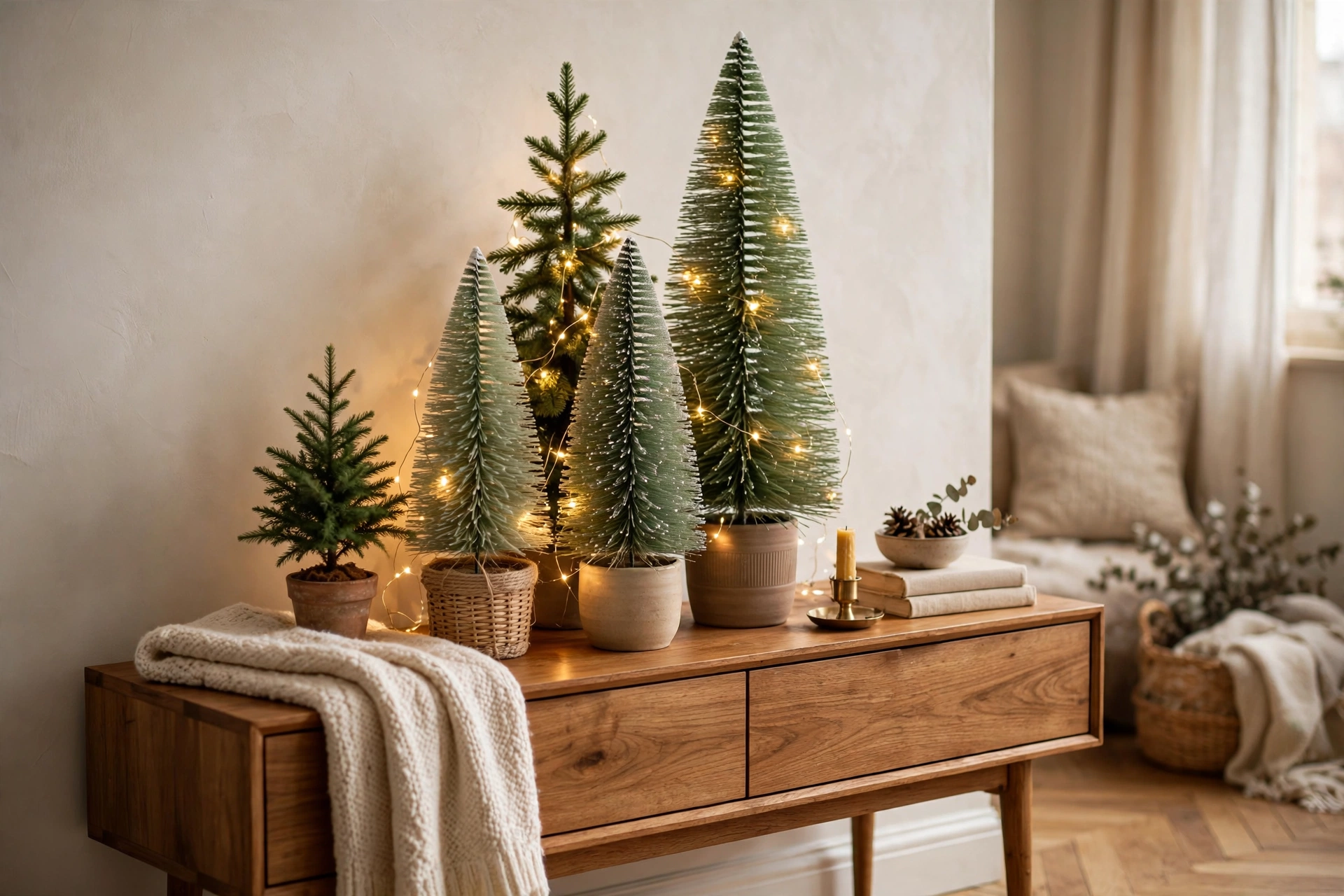
Styling rules for small trees: use ornaments scaled to the tree (1-1.5 inch ornaments for a 2-foot tree, not full-size 3-inch ones), wrap the base in a tree collar or fabric instead of a skirt (collars take less visual space), and put the tree on a stack of books or a cake stand to add 6-8 inches of free height. For more small-space styling principles that work year-round, see our small-space home decor ideas.
Renter-Friendly Hanging Methods That Protect Your Deposit
The direct answer: you can hang a fully decorated small-apartment Christmas scheme with zero holes using adhesive hooks, tension rods, and over-door hardware. The trick is matching the hanger’s weight rating to the actual load and prepping surfaces properly.
Adhesive hooks are the backbone of renter Christmas decor, but most failures come from user error, not the product. The rules that actually matter:
- Clean first: wipe the spot with rubbing alcohol and let it dry completely. Dust and kitchen grease are the top reasons hooks fall.
- Wait the full cure time: most brands need 1 hour before hanging; heavy-duty ones need 24. Hang your garland the day after you stick the hooks.
- Respect the rating — then halve it: a hook rated for 3 lbs holds a 1.5-lb garland section reliably through a heated, dry December. Heat and humidity weaken adhesive.
- Remove correctly: pull the tab straight down along the wall, slowly, never outward. Rushed removal is what takes paint off.

No Mantel? No Problem: The Stocking Wall
Hang stockings directly on the wall in a staggered row — the tallest hook at 60 inches, stepping down 4 inches per stocking — above a console table, bench, or even the couch. Use one hook per stocking, and stuff the toes with tissue paper so they hold their shape. A strip of garland run horizontally above the stockings at 66-70 inches ties the whole arrangement together and reads as a “mantel line” even though no mantel exists.
Tension Rods and Over-Door Hardware
A spring tension rod ($8-12) wedged inside a window frame or closet doorway holds a curtain of lights, hanging ornaments, or a swag of greenery with no hardware at all. Over-door wreath hangers work on interior doors too — hang a small wreath on the bedroom door, the bathroom door, and the closet door for a whole-apartment thread of decor that costs one wreath times three. Just check the hanger’s clearance: most need a 1.75-inch door gap, and some apartment doors fit tighter.
Lighting Tricks That Make Small Rooms Glow
The direct answer: in a small apartment, light is decor. Two to three well-placed strands do more than a dozen decorations, because warm light makes small rooms feel cozy rather than cramped — the one time “cozy” is a compliment and not a euphemism.
Layer your light at three heights, the same way designers layer lighting year-round:
- High: fairy lights along the top of a bookshelf, curtain rod, or wall-tree outline. This draws the eye up and makes the ceiling feel higher.
- Middle: a lit garland on a shelf edge or doorway at eye level. This is your main “decor” layer.
- Low: LED candles or a light-up ceramic tree on side tables. Flameless candles with a 5-hour timer are the set-and-forget choice — real candles in a 400-square-foot space with fabric everywhere are a risk I do not recommend.
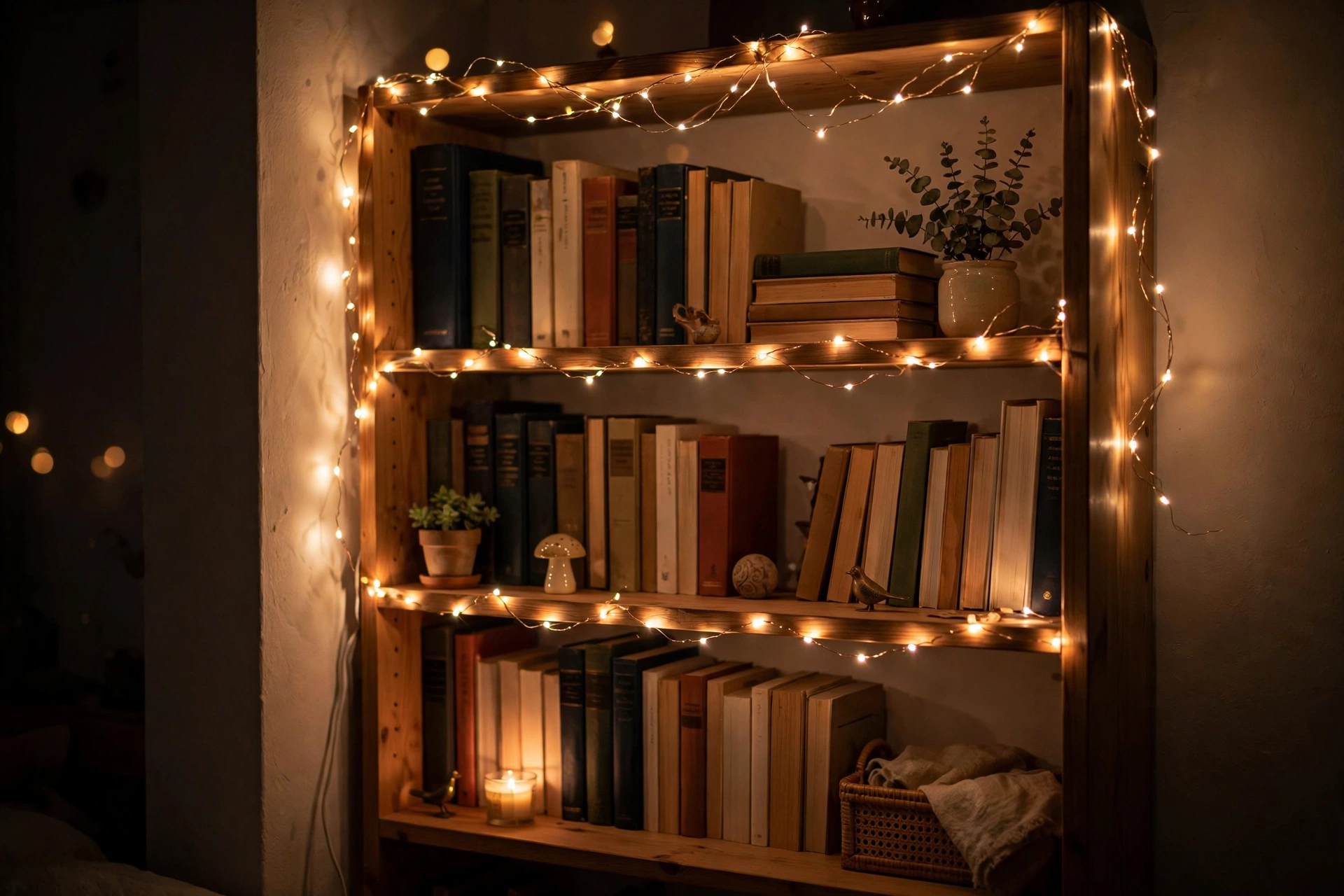
Keep every light the same color temperature. Mixing warm white (2700K) fairy lights with cool white (5000K) window lights makes the room feel disjointed even if you cannot name why. Warm white flatters wood, fabric, and skin; it is the right choice for 95 percent of apartments. And put everything on timers — battery strands with built-in 6-on/18-off timers, plug-in strands on a $10 outlet timer — so the magic happens automatically at dusk.
One more trick: bounce light. Hang your brightest strand near a mirror or metallic tray, and the reflection doubles the perceived light without a second strand. This is the same principle behind a lot of budget-friendly home decor — placement doing the work that purchases used to do.
Decorating When You Have Almost No Storage
The direct answer: choose decor that packs flat, nests, or earns its keep year-round. If it cannot fit in one under-bed box or a single closet shelf, it does not belong in a small apartment.
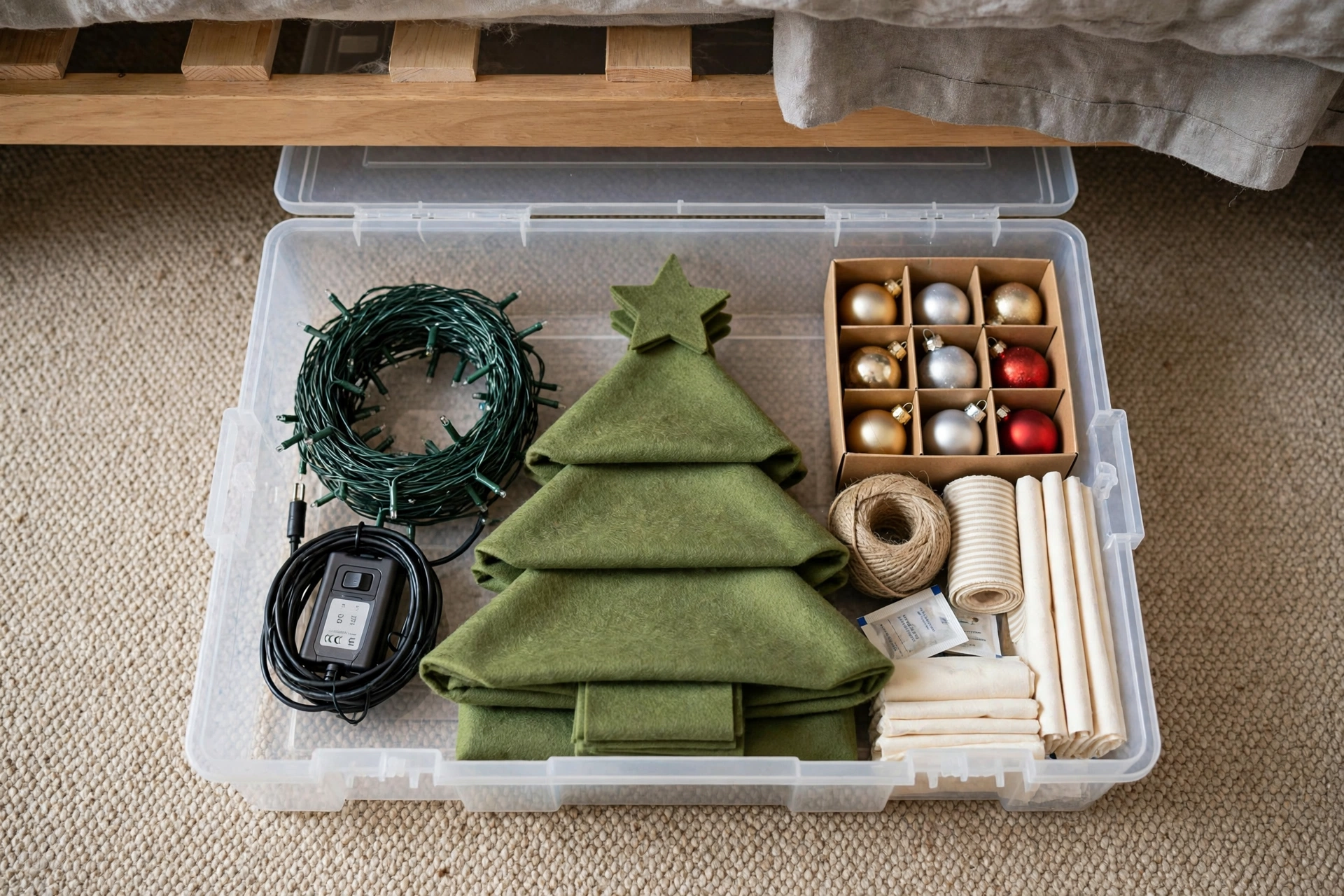
Before buying anything, apply the January test: picture yourself packing it away. Felt wall trees fold flat. Copper-wire fairy lights coil into a sandwich bag. Bottle-brush trees nest inside each other. Garland compresses into a vacuum bag to one-third its volume. A 7-foot artificial tree fails this test spectacularly, which is exactly why it is not in this guide.
- Flat-pack champions: felt trees, window clings, paper honeycomb ornaments, folding paper stars, fabric garlands.
- Nesting pieces: graduated bottle-brush trees, stacking ceramic trees, ornament sets that store inside each other.
- Dual-purpose decor: fairy lights become year-round bedroom lighting, velvet ribbon becomes gift wrap, a nice tray becomes a serving tray, and a potted evergreen becomes a houseplant.
- The one-box rule: one 28-quart under-bed box (about 34 x 17 x 6 inches) holds a complete small-apartment Christmas scheme: two garlands, three light strands, a felt tree, 40 ornaments, stockings, and ribbon.
A Room-by-Room Plan for a Small Apartment
The direct answer: decorate in this order — living area first, then entry, kitchen, and bedroom — and give each room one focal moment rather than spreading decor thin. Four strong moments beat forty scattered ones.
The Living Area (Your Main Stage)
This is where the wall tree goes, plus the lit garland on the main shelf or media console. Add the tabletop tree cluster on the side table and one cozy textile swap: a plaid or velvet throw and two holiday pillow covers (covers, not whole pillows — they store flat). That is the whole living room, and it is complete.
The Entryway (First Impressions in Four Feet)
Most apartment entries are a wall and a door. Dress the door with a wreath on an over-door hanger, add a small garland swag above the coat hooks, and put a festive doormat outside if your building allows it. A battery-operated lantern on the entry table finishes it. Total footprint: zero floor space.
The Kitchen (The Room Everyone Forgets)
You spend December in the kitchen whether you decorate it or not, so give it the shelf-edge garland treatment on open shelving, a rosemary topiary on the counter, and a holiday tea towel on the oven handle. Hang three ornaments from the range hood with ribbon at staggered lengths (12, 16, 20 inches) for a chandelier effect that costs nothing.
The Bedroom (For You, Not Guests)
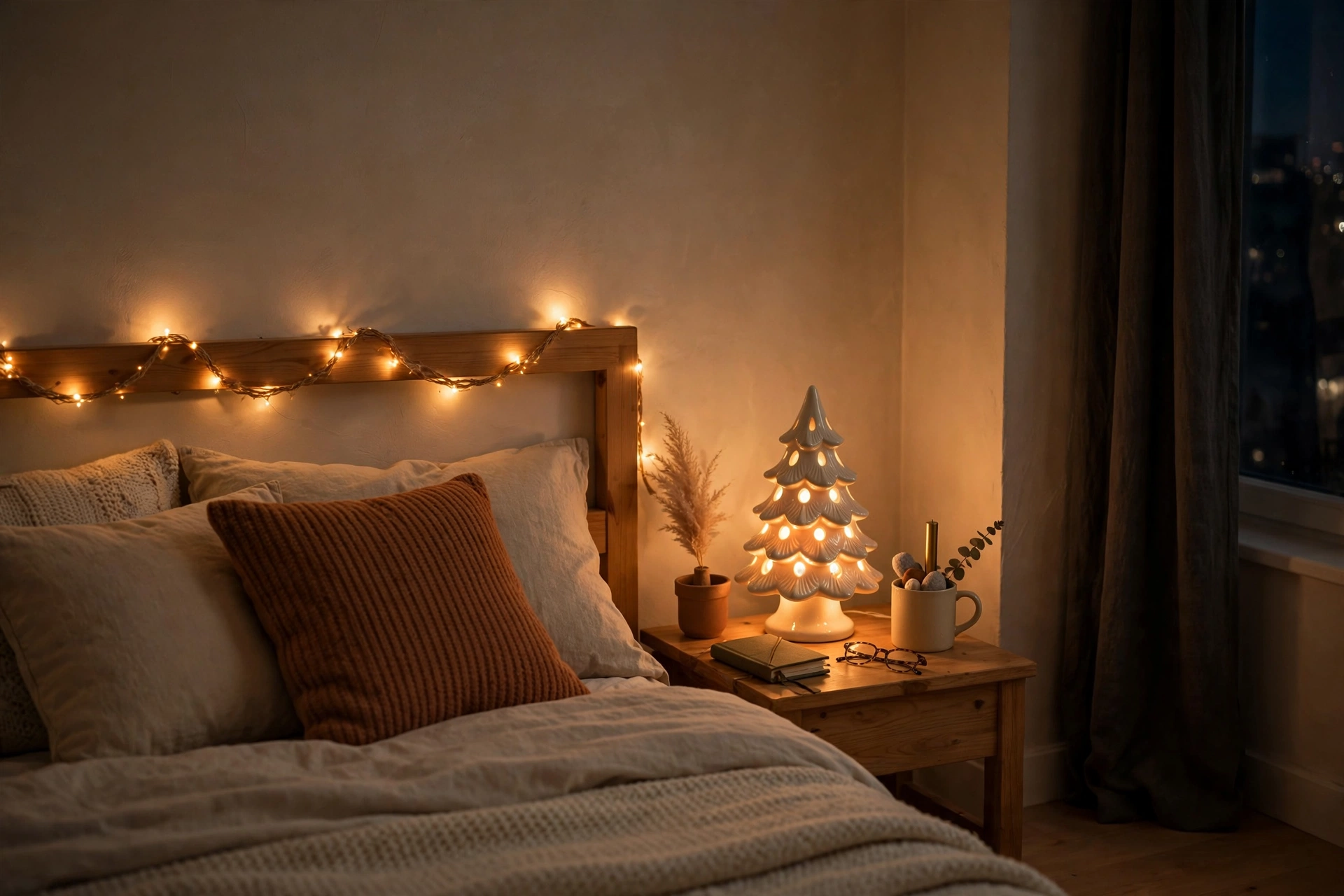
Fairy lights along the headboard or curtain rod, one small ceramic tree on the nightstand, and a holiday pillow cover. That is it. Bedroom Christmas decor is self-care, not staging — keep it to what makes you smile when you wake up on December 25th.
A Weekend Decorating Timeline: From Bare Apartment to Finished in Two Days
The direct answer: split the work across two short sessions — Saturday for structure (hooks, garland, wall tree frame), Sunday for dressing (ornaments, lights, textiles). Rushing it into one evening is how adhesive hooks fail and garlands end up crooked.
Saturday (about 90 minutes): clean and stick all adhesive hooks first, since heavy-duty ones need up to 24 hours to cure. While they cure, hang the wall tree frame and lights, drape the doorway and shelf garlands, and mount the window wreath. Do every task that involves standing back and checking symmetry now, while you still have daylight — garland looks different under evening lamplight, and you want the structure right before the glow hides the flaws.
Sunday (about 60 minutes): hang ornaments on the wall tree, weave the second light strand through the garlands, arrange the tabletop tree cluster, and do the textile swap — pillow covers, throw blanket, tea towel. Finish by setting all your timers so the lights come on at dusk without you touching anything.
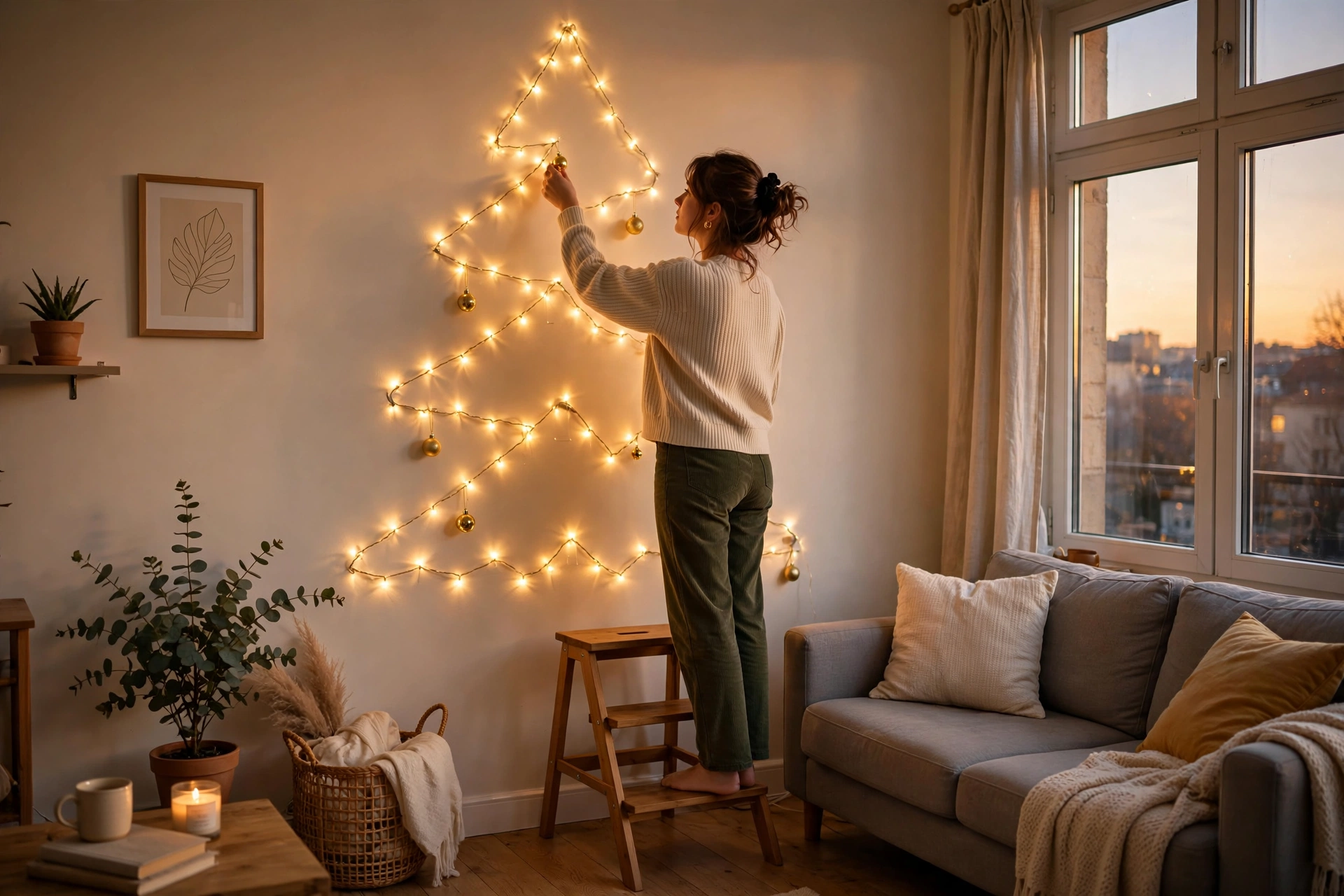
The two-day split has a hidden benefit: Saturday night, with just the lights and garland up, you get a preview of the glow and can adjust Sunday morning. Maybe the wall tree wants to shift six inches left, or the shelf garland needs one more swag. Small apartments forgive nothing — every placement is visible — so that overnight pause is worth more than an extra hour of fussing.
Frequently Asked Questions
1. Can you really decorate for Christmas without a Christmas tree?
Absolutely. A wall tree, a dressed window, vertical garlands, and layered lighting together create a stronger holiday impression than a single sad tree squeezed into a corner. Most guests will not even register the absence — they register the overall feeling, which is what actually matters.
2. What is the best Christmas tree alternative for a studio apartment?
A wall-mounted tree — either a felt tree with Velcro ornaments or a zigzag string-light tree — gives you the tree silhouette, lights, and ornament display with zero floor footprint. For tabletops, a 24-36 inch potted evergreen or a cluster of bottle-brush trees is the next best option.
3. How do I hang Christmas decorations without damaging walls?
Use adhesive hooks rated for at least double your actual load, prep every surface with rubbing alcohol, and wait the full cure time (up to 24 hours for heavy-duty hooks) before hanging. Remove by pulling the tab straight down along the wall. Tension rods and over-door hangers need no adhesive at all.
4. How many lights do I need for a small apartment?
Two to three strands is plenty for 400-600 square feet: one 33-foot fairy light strand for the wall tree or high layer, one 20-foot strand woven through garland, and optionally a light curtain for the window. Keep all strands the same color temperature, ideally warm white at 2700-3000K.
5. Where should I put stockings if I do not have a fireplace or mantel?
Hang them directly on the wall with adhesive hooks in a staggered row above a console table, bench, or sofa. Run a horizontal garland above them at 66-70 inches to create a visual “mantel line.” Stuff the toes with tissue paper so they hold their shape.
6. How much does it cost to decorate a small apartment for Christmas?
A full scheme typically costs $40-80 using budget retailers, thrift stores, and dollar-store finds: roughly $15-30 for a felt or light wall tree, $10-20 for garland, $8-15 for fairy lights, and the rest for ornaments, hooks, and ribbon. Shopping secondhand and reusing year to year drops the annual cost close to zero.
7. How do I store Christmas decor in an apartment with no storage room?
Choose decor that packs flat or nests: felt trees, window clings, copper-wire lights, and vacuum-compressed garland all fit in a single 28-quart under-bed box. Keep dual-purpose pieces (fairy lights, trays, potted evergreens) in everyday use year-round so they never need storing.
8. Will a wall tree look cheap or childish?
Not if it is scaled and styled properly. A 5-6 foot light-strung wall tree with 12-20 real ornaments and a proper topper reads as an intentional design choice, especially photographed at night. The versions that look cheap are too small (under 3 feet) or sparsely decorated — density is what sells it.
9. How early should I start decorating a small apartment?
The weekend after Thanksgiving is the sweet spot for most people, and a small apartment scheme takes just 2-3 hours. Because setup is fast, you can also decorate in stages: lights and garland one evening, ornaments and textiles the next. Take everything down in the first week of January before the clutter starts working against the small space.
10. What is the biggest mistake people make decorating small apartments for Christmas?
Spreading decor too thin — one ornament here, a candle there — so nothing reads as intentional. Pick four focal moments (wall tree, dressed window, garland line, tabletop cluster), concentrate your decor there, and leave the rest of the apartment alone. Restraint in placement plus richness in the focal spots is the whole formula.
Small apartments do not need permission to do Christmas properly — they just need a plan built for the space they actually have. Start with the wall tree this weekend, add the window and garland lines, layer in the light, and by the second week of December your 500 square feet will feel more festive than most full-size living rooms. And when January comes, the whole thing packs into a single box under the bed, which might be the most satisfying part of all.