Gardening by the Moon: Does Moon Phase Gardening Really Work?
Ask a room of experienced gardeners whether they plant by the moon and you’ll get a surprising number of yeses. Some learned it from a grandparent who wouldn’t sow potatoes until the moon was waning. Others follow a printed lunar calendar pinned inside the shed door, with every seed packet matched to a date. Many…
Ask a room of experienced gardeners whether they plant by the moon and you’ll get a surprising number of yeses. Some learned it from a grandparent who wouldn’t sow potatoes until the moon was waning. Others follow a printed lunar calendar pinned inside the shed door, with every seed packet matched to a date. Many swear their germination is faster and their harvests heavier because of it.
Then there’s the other camp, who point out that the moon is a very long way away and that soil temperature, water, and sunlight are what actually make seeds grow.
Both sides have a point worth hearing. Gardening by the moon is one of the oldest and most widespread planting traditions in the world, and it has a clear internal logic. The scientific evidence for it, though, is thin and inconsistent. This guide explains how moon phase gardening works, what the traditional rules say about what to plant and when, how biodynamic calendars differ, what research has actually found, and how to try it yourself without putting your harvest at risk.
What Gardening by the Moon Means
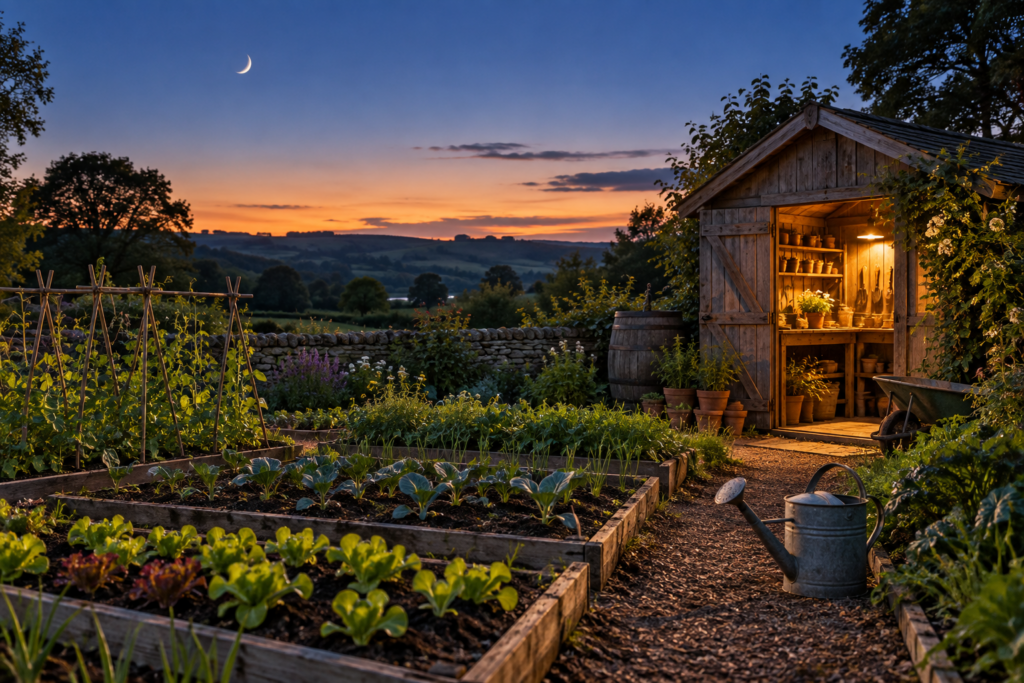
Gardening by the moon, also called lunar gardening or moon phase planting, is the practice of timing garden tasks such as sowing, transplanting, pruning, and harvesting according to the phases of the moon. The central idea is that the moon’s cycle influences plant growth, so certain tasks go better at certain points in that cycle.
The tradition is ancient and shows up across many cultures. Roman writers on agriculture discussed timing farm work by the moon, and farming communities from Europe to Asia to the Americas developed their own lunar planting customs. For centuries, printed almanacs gave farmers moon-based planting dates alongside weather lore and frost predictions. Many of those almanac traditions are still published and followed today.
The Lunar Cycle in Brief
The moon takes about 29.5 days to move through a full cycle of phases, from one new moon to the next. This is called the synodic month. Along the way it passes through eight commonly named phases:
- New moon: the moon sits between Earth and the sun, and its lit side faces away from us, so it’s essentially invisible.
- Waxing crescent: a thin sliver of light appears and grows each night.
- First quarter: half the visible disc is lit.
- Waxing gibbous: more than half is lit and still growing.
- Full moon: the entire visible face is lit.
- Waning gibbous: the lit portion begins to shrink.
- Last (third) quarter: half the disc is lit again, on the opposite side.
- Waning crescent: a shrinking sliver before the next new moon.
In moon gardening, “waxing” means the period when the lit portion is growing, from new moon to full moon. “Waning” is the period when it shrinks, from full moon back to new. Most traditional systems divide the month into four quarters of roughly seven days each.
The Reasoning Behind It
Traditional moon gardening rests on two main ideas. The first is that the moon’s gravitational pull, which drives ocean tides, also draws moisture upward in the soil around the new and full moons, helping seeds absorb water and germinate. The second is that increasing moonlight during the waxing phase encourages leafy growth above ground, while decreasing light during the waning phase directs a plant’s energy downward into its roots.
These ideas are the foundation for the planting rules in the next section. Whether they hold up physically is a separate question, covered later in this guide.
The Four Quarters: What to Plant in Each Moon Phase
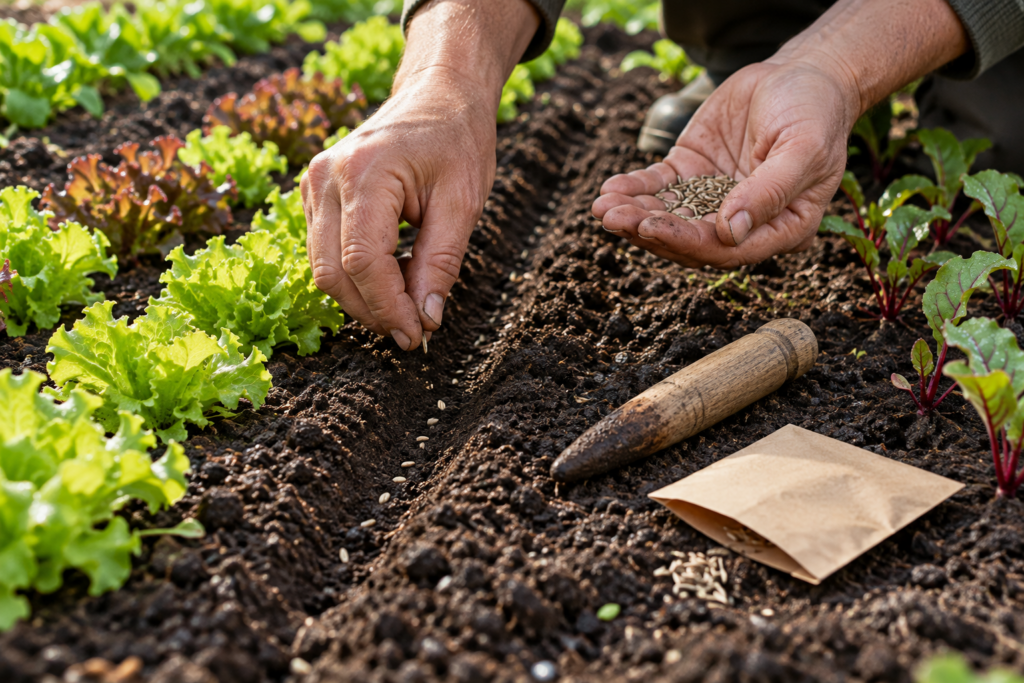
Most traditional moon planting systems follow the same basic pattern. Crops that produce their harvest above ground are sown while the moon is waxing, crops harvested below ground are sown while it’s waning, and the final quarter is kept for rest and maintenance.
When Is the Best Moon Phase to Plant Seeds?
According to moon gardening tradition, the best time to sow most seeds is during the waxing moon, between the new moon and the full moon, when rising soil moisture is thought to aid germination. Leafy crops are sown in the first quarter, fruiting crops in the second. Root crops are sown just after the full moon, as it begins to wane.
First Quarter: New Moon to First Quarter
This is traditionally the time to sow and transplant leafy crops and annuals that produce their seeds outside the fruit. Moonlight is increasing, and moisture near the surface is said to be high.
Typical crops for this quarter include lettuce, spinach, cabbage, kale, chard, celery, broccoli, cauliflower, Brussels sprouts, leafy herbs such as parsley and cilantro, and grains.
Second Quarter: First Quarter to Full Moon
As moonlight reaches its peak, tradition recommends sowing annual crops that produce seeds inside a fruit or pod. The strong light is thought to encourage vigorous leaf and stem growth.
Typical crops for this quarter include tomatoes, peppers, eggplant, beans, peas, squash, zucchini, pumpkins, cucumbers, and melons, along with annual flowers.
Third Quarter: Full Moon to Last Quarter
As moonlight wanes, tradition holds that plant energy moves downward into the roots. This is the time for crops harvested below ground, as well as plants that need to establish strong root systems.
Typical tasks for this quarter include sowing or planting potatoes, carrots, beets, radishes, turnips, parsnips, onions, and garlic, along with bulbs, perennials, biennials, fruit trees, shrubs, and berry bushes. Rhubarb and asparagus crowns are also traditionally planted now.
Fourth Quarter: Last Quarter to New Moon
The final quarter is traditionally a resting period with no planting. Instead, it’s used for maintenance tasks such as weeding, turning compost, cultivating soil, controlling pests, mowing, and pruning. Some traditions also recommend harvesting crops for storage in this quarter, on the belief that they keep better.
Should You Prune or Harvest by the Moon?
Moon gardening tradition recommends pruning during the waning moon, particularly the fourth quarter, on the belief that less sap flows to cut branches, reducing bleeding and slowing regrowth. Harvesting crops for storage is also traditionally done during the waning moon. Crops for immediate eating can be harvested at any time.
These pruning and harvesting customs are among the most widely followed parts of the tradition, especially among orchard growers and timber cutters in some regions. As with sowing, the evidence behind them is limited, and the timing of pruning for disease prevention, flowering, and plant dormancy matters far more than the moon phase.
Biodynamic and Zodiac Moon Calendars
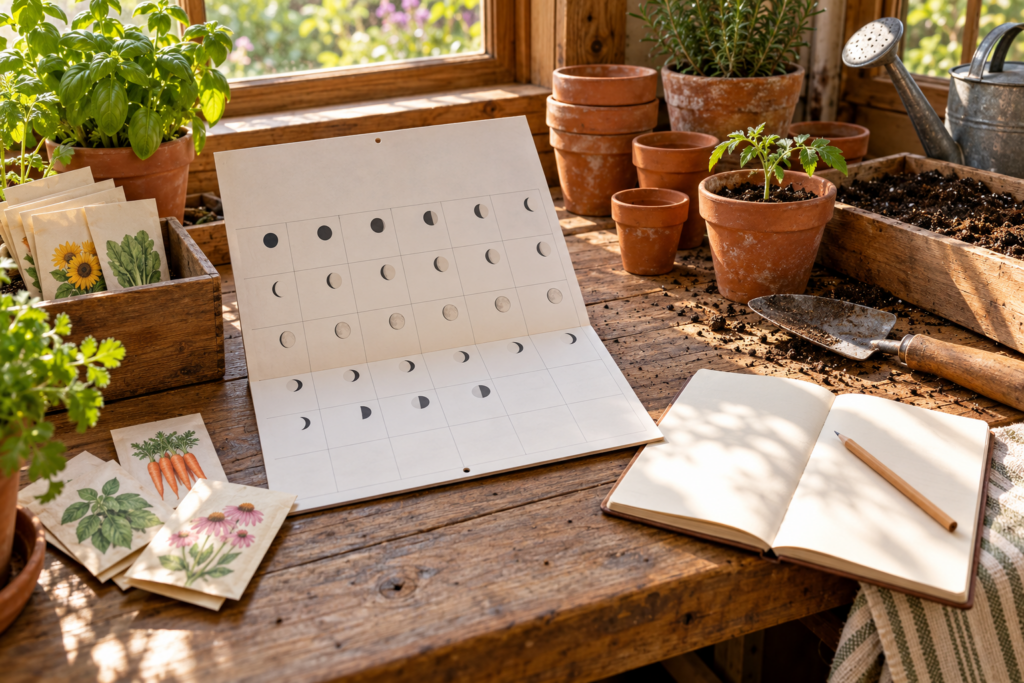
Some gardeners follow a more detailed lunar system linked to biodynamic farming, an approach to agriculture that grew out of a series of lectures given by the Austrian philosopher Rudolf Steiner in the 1920s. Biodynamic calendars go beyond the four phases and track the moon’s position against the constellations of the zodiac.
Sidereal Rather Than Synodic
While phase-based moon gardening follows the roughly 29.5-day cycle from new moon to new moon, biodynamic calendars track the moon’s journey around the sky against the background stars, which takes about 27.3 days. This is known as the sidereal month. During this cycle, the moon passes through each of the twelve zodiac constellations.
Root, Leaf, Flower, and Fruit Days
Biodynamic systems group the zodiac constellations according to the four classical elements, and each element is linked to a part of the plant:
- Earth signs are associated with root days, favored for sowing and tending root crops like carrots, beets, and potatoes.
- Water signs are associated with leaf days, favored for leafy crops like lettuce, spinach, and cabbage.
- Air signs are associated with flower days, favored for flowering plants and crops such as broccoli and cauliflower.
- Fire signs are associated with fruit days, favored for fruiting and seed crops like tomatoes, beans, and squash.
Because the moon moves into a new constellation every two to three days, biodynamic calendars change far more often than phase-based ones.
Ascending and Descending Moon
Biodynamic calendars also track whether the moon is “ascending” or “descending,” meaning whether its daily arc across the sky is rising higher or sinking lower over roughly two weeks. This is different from waxing and waning. An ascending moon is associated with rising sap and good times for harvesting fruits and grafting, while a descending moon is associated with root activity and good times for planting and transplanting.
Many biodynamic calendars also mark days to avoid gardening altogether, such as periods when the moon is closest to Earth (perigee) or crossing the path of the sun (the lunar nodes), as well as around eclipses.
Phase-Based vs Biodynamic Systems
Phase-based moon gardening is simpler and easier to fit into a busy schedule, with roughly one week per quarter. Biodynamic calendars are more detailed and require checking a calendar almost daily. The two systems sometimes give conflicting advice for the same day, which is one reason gardeners tend to choose one approach and stick with it.
Does Moon Phase Gardening Work? What the Evidence Says
This is the question most gardeners really want answered, and it deserves a straight response rather than either enthusiastic endorsement or dismissal.
Is There Scientific Evidence That Moon Gardening Works?
There is little reliable scientific evidence that planting by the moon improves germination, growth, or yield. Some small studies have reported subtle lunar-linked effects, but results have been inconsistent and often not repeated by other researchers. Controlled trials comparing moon-timed and non-timed sowing have generally found no consistent difference in harvests.
The research that does exist has several limitations. Many studies are small, older, or conducted without strong controls. Positive results tend to appear in isolated trials rather than across repeated experiments. Studies of biodynamic farms often find benefits, but these are usually linked to the rich compost, organic practices, and careful management that biodynamic growers use, rather than to planting on specific calendar days.
Researchers have observed some genuine rhythms in nature linked to the moon. Many marine animals time spawning to lunar cycles, and some studies have explored subtle lunar-linked patterns in plant water movement. These effects are small, and in many cases debated, and they haven’t translated into dependable, measurable gains in garden crops.
Can the Moon Affect Soil Moisture?
The moon’s gravitational pull creates ocean tides because it acts across the entire width of the Earth and on enormous bodies of water. In a small volume of soil, that tidal effect is extremely weak. Soil moisture is driven overwhelmingly by rainfall, watering, evaporation, drainage, and the pull of Earth’s own gravity, not by the moon.
The same applies to moonlight. Even a full moon is several hundred thousand times dimmer than direct sunlight. That’s enough to see by at night, but far too little to fuel photosynthesis in any meaningful way. Plants do sense very dim light, and some can detect moonlight, but it plays a minor role compared with the length and intensity of daylight.
Why So Many Gardeners Believe It Works
If the evidence is weak, why do so many experienced gardeners report good results? Several explanations likely play a part.
It adds structure. A lunar calendar breaks sowing into regular windows through the season. Gardeners who follow it tend to sow little and often, which naturally leads to better succession planting and fewer gluts and gaps.
It encourages observation. Moon gardeners usually keep careful records, watch their plants closely, and plan ahead. Attentive gardening produces better results regardless of timing.
Seasonal timing still does the heavy lifting. Most moon gardeners sow within the right seasonal window for each crop. When the season and weather are right, crops tend to do well whatever the moon is doing.
Memory is selective. Successes on “right” days are easy to remember and credit to the moon, while successes on “wrong” days, or failures on “right” ones, fade from memory. This is a natural human tendency, not a criticism of gardeners.
It connects gardeners to the season. Many people value moon gardening for the sense of rhythm and connection it brings, which is a legitimate reason to practice it even without a measurable yield benefit.
How to Try Moon Gardening Without Risking Your Harvest
If you’re curious about moon gardening, there’s no harm in trying it, as long as the moon calendar works within good gardening practice rather than overriding it.
Put the Season First
Always choose the right seasonal window for a crop before looking at the moon. Seeds sown into cold, wet soil or planted out before the last frost will struggle regardless of the lunar phase. Use your area’s average last and first frost dates, the soil temperature each crop needs to germinate, and the recommended sowing times on seed packets to set the outer limits. Within that window, you can use the moon phase to pick the specific days.
Stay Flexible
Weather and life don’t always cooperate with a lunar calendar. If the recommended quarter falls during a cold snap, heavy rain, or a busy week, it’s better to sow at the next good opportunity than to miss a crop’s window entirely. Most moon gardening traditions allow for this, treating the phases as ideal times rather than strict rules.
Test It Yourself
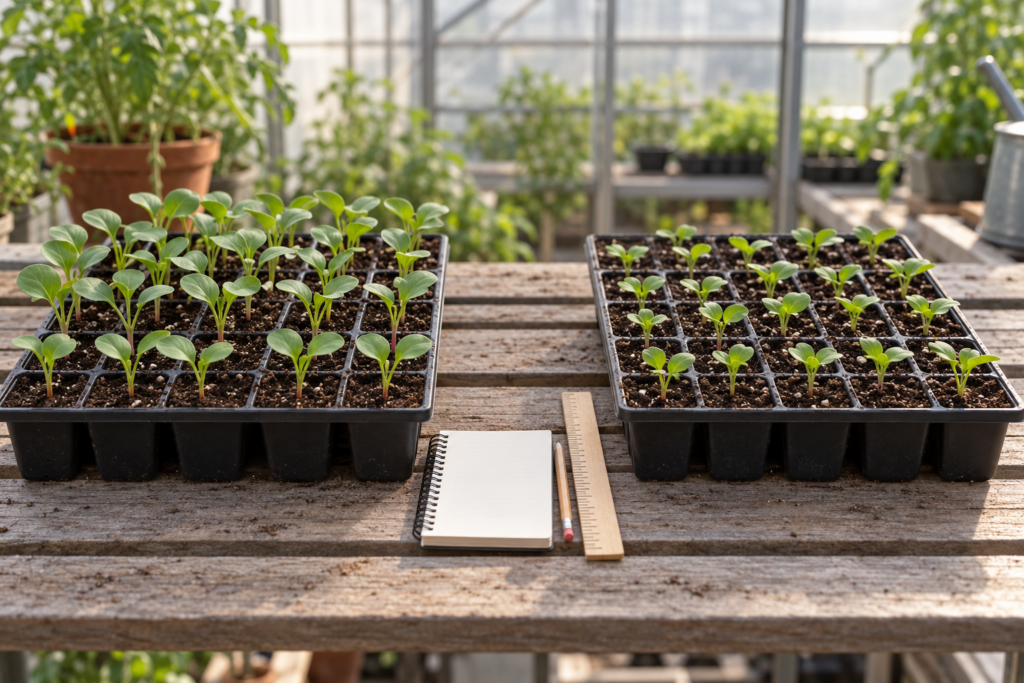
The best way to find out whether moon planting works in your garden is to run a simple side-by-side trial:
- Choose a fast, easy crop such as radishes, lettuce, or bush beans.
- Divide a single bed or a set of seed trays into two halves with the same soil, light, and watering.
- Sow one half on a recommended moon date and the other half about a week later, outside the recommended quarter.
- Record the sowing dates, soil temperature, days to germination, number of seeds that germinate, and final harvest weight for each half.
- Repeat the trial several times through the season, alternating which half gets the “moon” sowing, to reduce the influence of weather.
Keep notes for a full season or two. Your own results will tell you far more about whether moon timing makes a difference in your conditions than any general claim.
Using a Moon Planting Calendar
Moon planting calendars are widely available as printed almanacs, wall calendars, biodynamic sowing guides, and mobile apps. You can also create your own by marking the new moon, first quarter, full moon, and last quarter dates for the year in a garden diary, then noting which quarter suits each crop. Make sure any calendar you use is set to your own time zone, since phase changes can fall on different dates in different parts of the world.
What Really Drives Germination and Growth
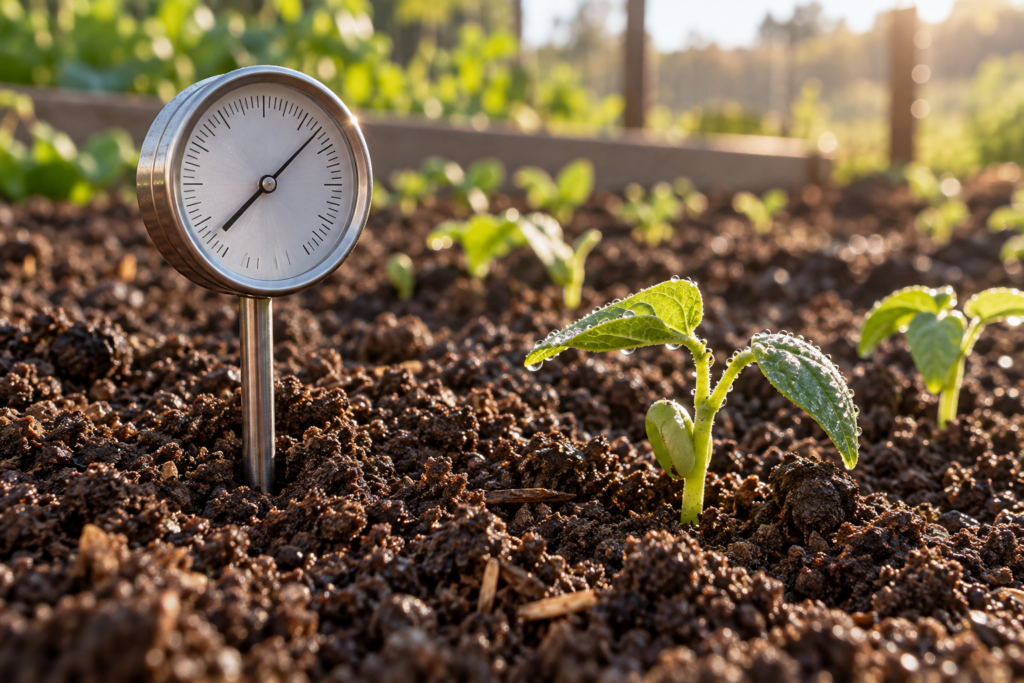
Whatever you decide about the moon, a handful of factors have a far larger and well-documented effect on how seeds germinate and plants grow. Getting these right matters most.
Soil Temperature
Every crop has a range of soil temperatures in which its seeds germinate well. Cool-season crops like lettuce, spinach, and peas germinate in cool soil, while warm-season crops like tomatoes, peppers, beans, squash, and cucumbers need noticeably warmer soil. Seeds sown into soil that’s too cold may sit dormant for weeks or rot before they sprout. A simple soil thermometer, pushed a few inches into the bed in the morning, is one of the most useful tools a gardener can own.
Frost Dates
The average last spring frost and first autumn frost in your area define the safe growing season for tender crops. Planting out tomatoes, peppers, or squash before the last frost can wipe them out in a single cold night, no matter how favorable the moon phase.
Day Length
Here, astronomy genuinely does shape plant growth, just through the sun rather than the moon. Many plants respond to day length, a process called photoperiodism. Onions, for example, form bulbs when days reach a certain length, which is why varieties are sold as short-day, intermediate-day, or long-day types for different latitudes. Spinach and lettuce tend to bolt as days lengthen in early summer. Short-day plants such as chrysanthemums flower as days shorten in autumn.
Moisture
Seeds need consistent moisture to germinate. Letting the soil dry out after sowing, even briefly, can stop germination entirely. Keep seedbeds evenly moist, not waterlogged, until seedlings emerge and establish.
Seed Quality
Fresh, properly stored seed germinates far better than old seed kept in warm, damp conditions. Many types of seed lose viability within a few years. Store seed packets in a cool, dry, dark place, and test older seed by sprouting a few on a damp paper towel before sowing.
Soil Health
Healthy soil rich in organic matter, with good structure and drainage, supports strong root growth and steady nutrient supply. Adding compost regularly, avoiding compaction, and maintaining a balanced pH do more for yields than timing alone.
Moon gardening can sit comfortably alongside all of these. Many gardeners who follow the moon find it’s a pleasant way to organize their sowing and stay in tune with the seasons. As long as it complements, rather than replaces, attention to soil, weather, and timing, there’s little to lose by giving it a try and seeing what your own garden has to say.
Frequently Asked Questions
Should you plant on the day of the full moon?
Traditional moon gardening recommends sowing fruiting crops in the days leading up to the full moon, and root crops in the days just after it. Many moon gardeners avoid planting on the exact day of the full moon itself, treating it as a transition point. Biodynamic calendars may also mark it as a day to avoid.
Does the moon affect when you should harvest?
Moon gardening tradition suggests harvesting crops meant for storage, such as potatoes, onions, and winter squash, during the waning moon, on the belief that they contain less moisture and keep longer. There’s little scientific evidence for this. Proper curing, harvesting at maturity, and good storage conditions have a much larger effect on how long crops last.
Does gardening by the moon work in the Southern Hemisphere?
Yes. The moon’s phases occur at the same time everywhere on Earth, so the same lunar calendar applies in both hemispheres, adjusted only for time zone. The moon looks flipped compared with the Northern Hemisphere, so a waxing moon is lit on the left rather than the right. Seasonal timing, of course, follows the Southern Hemisphere’s own seasons.
What does “dark of the moon” mean in gardening?
“Dark of the moon” is a traditional term for the waning period, especially the days around the new moon when little or no moonlight is visible. In folklore, this period is associated with planting root crops and with tasks like weeding, pruning, and harvesting for storage. “Light of the moon” refers to the waxing period, linked with sowing above-ground crops.
Can you use moon gardening for houseplants?
Some indoor gardeners time repotting, propagation, and sowing by the moon, following the same traditional rules as outdoor gardening. Indoor plants aren’t affected by rainfall or soil tides, so any effect is even less likely. Light, watering, temperature, and repotting when roots outgrow the pot are what matter most for houseplant health.
Should you mow the lawn according to the moon?
Folklore suggests mowing during the waxing moon to encourage thicker regrowth, and during the waning moon to slow growth and reduce how often you need to mow. There’s no strong evidence for either effect. Mowing height, frequency, sharp blades, and watering have a much greater influence on lawn health than lunar timing.
Where can I find a moon planting calendar?
Moon planting calendars are available in many printed almanacs, garden diaries, and biodynamic sowing guides, as well as in numerous gardening and astronomy apps. You can also build your own by noting the dates of each moon phase for the year, adjusted to your time zone, and matching them to the crops you plan to grow.
Keep Learning
For more beginner help, see How to Start a Garden: The Complete Beginner’s Guide, How to Start a Vegetable Garden: Step-by-Step Guide for Beginners, and Cold Frame Gardening: How to Extend Your Growing Season.