Square Foot Gardening: The Complete Method Guide
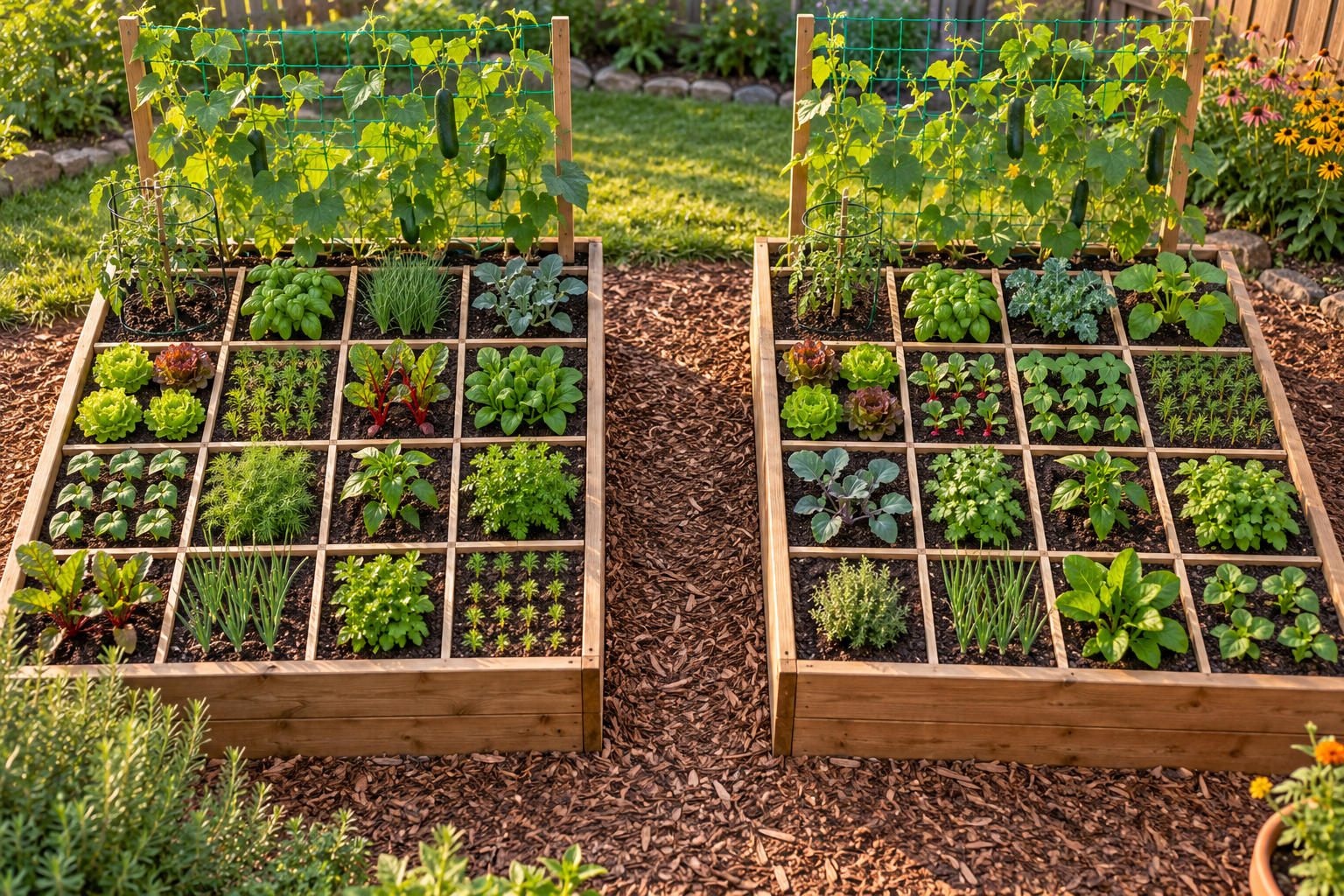
Walk past a square foot garden and the first thing you notice is how orderly it looks. A small wooden box, divided into a checkerboard of equal squares, with one tomato plant in one square, four lettuces in the next, nine beans beside them, and sixteen feathery carrot tops in the corner. It looks almost…
Walk past a square foot garden and the first thing you notice is how orderly it looks. A small wooden box, divided into a checkerboard of equal squares, with one tomato plant in one square, four lettuces in the next, nine beans beside them, and sixteen feathery carrot tops in the corner. It looks almost too tidy to be productive. Then you see how much food comes out of it.
Square foot gardening is a method, not just a layout. It combines a specific bed size, a light and rich growing mix, a permanent grid, and a simple spacing system to replace long rows with small, intensively planted squares. The result is a garden that fits into tight spaces, needs far less weeding and watering than a traditional plot, and is easy for beginners to plan because every decision comes down to one square at a time.
This guide covers the full method: where it came from and why it works, how to build the boxes and grid, the growing mix, exactly how many plants go in each square, how to plant and replant through the season, and how to keep a square foot garden healthy and productive year after year.
What Square Foot Gardening Is and Why It Works
Square foot gardening was developed by Mel Bartholomew, a retired engineer who grew frustrated with the waste he saw in traditional row gardening: long rows sown thickly, then thinned, then weeded, with wide paths between them that took up most of the space. He popularized the method in a book published in the early 1980s, and later released a revised version that refined the system into the form most gardeners follow today.
The method rests on a handful of core principles:
- Small beds you never step on. Beds are typically 4 x 4 feet (120 x 120 cm), so every square can be reached from the sides without walking on the soil.
- A shallow box of loose, rich mix. Instead of digging and amending native soil, the revised method builds boxes about 6 inches (15 cm) deep and fills them with a blend of compost, peat moss, and vermiculite.
- A permanent visible grid. The bed is divided into sixteen 12 x 12 inch (30 x 30 cm) squares with strips of wood or another material laid on top.
- Plants spaced by the square. Each square holds 1, 4, 9, or 16 plants, depending on how large that crop grows.
- A different crop in each square. Mixing crops across the bed spreads risk, confuses pests, and builds rotation into the garden naturally.
- Replant as soon as you harvest. When a square is finished, you add a little compost and plant something new straight away.
- Grow vining crops upward. Tomatoes, cucumbers, pole beans, and peas climb a vertical frame at the north side of the bed rather than sprawling across the soil.
The logic behind it is straightforward. Rows waste space and effort because most of the ground is path. A small, dense bed puts nearly all your soil, water, and compost exactly where the plants are. Close spacing means leaves shade the soil, which reduces weeds and moisture loss. And planning in squares makes it far easier to grow small, continuous amounts of many crops instead of a glut of one thing all at once.
Does Square Foot Gardening Really Work?
Yes, for most home gardeners it works very well, especially for salad greens, herbs, root vegetables, peppers, and trellised crops. It produces a high yield from a small space, needs little weeding, and is easy to plan. It works less well for large sprawling crops, such as pumpkins and winter squash, and for crops needed in bulk.
The method does have real criticisms worth knowing about. The traditional growing mix is expensive to buy in quantity, and some gardeners prefer to avoid peat moss for environmental reasons. The standard 6-inch (15 cm) depth is shallow for deep-rooted crops such as long carrots and parsnips unless the box sits on decent soil that roots can grow into. And a few spacing recommendations are tight enough that large varieties can crowd each other in rich soil.
In practice, many successful square foot gardeners adapt the method rather than following every rule. They build beds a little deeper, substitute coconut coir for peat, or give large tomato varieties a little extra room. The core ideas of small beds, a loose rich mix, a visible grid, and planting by the square hold up well even when the details are adjusted.
Building Your Square Foot Garden: Boxes, Grids, and Layout
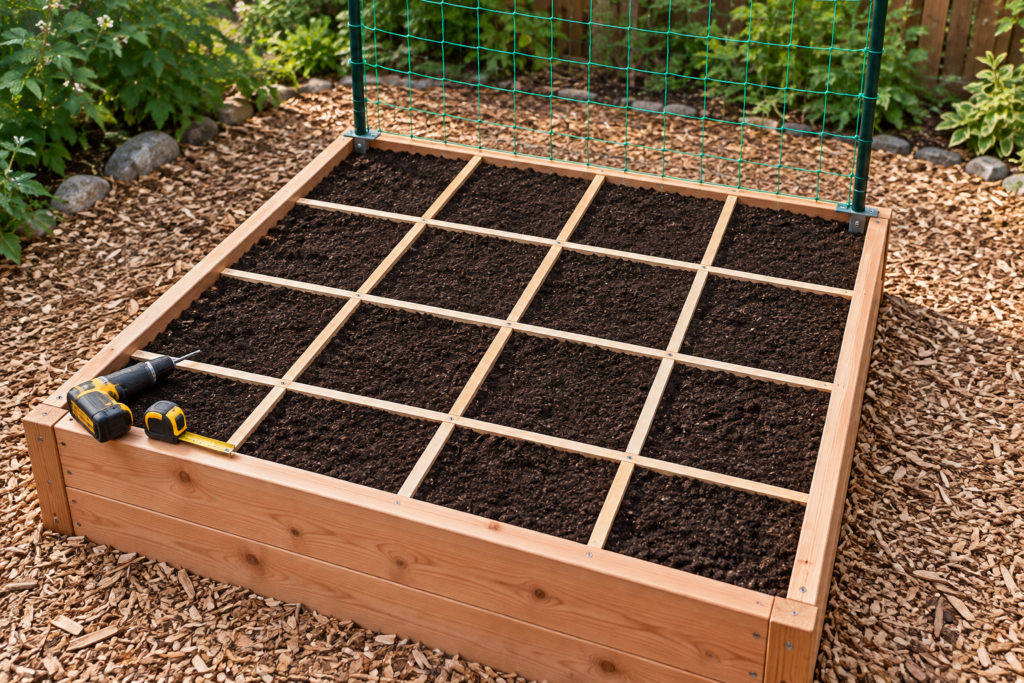
Building a square foot garden takes an afternoon and very few tools. The structure has three parts: the box, the grid, and, if you’re growing climbing crops, a vertical frame.
The Box
The standard box is 4 x 4 feet (120 x 120 cm) and about 6 inches (15 cm) deep. This size keeps every square within reach from the sides. If a box sits against a fence or wall and can only be reached from one side, make it 2 feet (60 cm) deep front to back instead, such as 2 x 4 or 2 x 8 feet.
Rot-resistant wood such as cedar is the most common material, using boards about 6 inches wide. Screw the corners together with exterior screws or use metal corner brackets. Composite boards, recycled plastic lumber, and metal raised-bed kits work just as well, as long as the internal dimensions allow for full 12-inch squares.
Many square foot gardeners also build a few deeper sections. A smaller bottomless box, about 12 inches (30 cm) deep and one or two squares in size, set on top of a standard box and filled with extra mix, gives carrots, parsnips, and potatoes the depth they need without deepening the whole bed.
The traditional method places a weed barrier fabric under the box. Many gardeners now prefer plain cardboard when a box sits on soil or lawn, since cardboard smothers grass and weeds for a season and then breaks down, letting earthworms and deeper roots move freely between the box and the ground. If the box sits on a hard surface such as a patio, a porous fabric base keeps the mix in place while letting water out.
The Grid
The grid is what makes the method work. Without it, beds drift back toward crowded, unplanned rows. Use thin wooden strips (lath), vinyl strips, metal flat bar, or even taut cord, laid across the top of the box and fixed at the edges so they divide the surface into sixteen equal squares. The grid stays in place all season and makes planting, harvesting, and replanting instantly clear.
Wood strips are easiest to cut and fix; screw them to the box edges and drill small holes where they cross so they can be tied together. Avoid grids that sit deep in the soil, since they make it harder to replant squares.
Paths and Layout
Leave paths about 2–3 feet (60–90 cm) wide between boxes so you can kneel, walk, and move a wheelbarrow comfortably. Wood chips, gravel, or pavers all work. Place boxes where they receive at least six to eight hours of direct sun if you plan to grow fruiting crops, and close to a water source.
The Vertical Frame
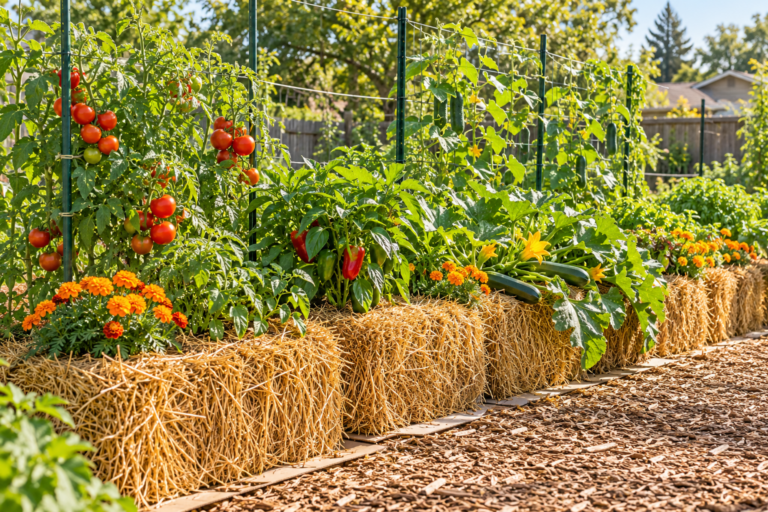
Climbing crops belong on a vertical frame fixed to the north side of the box (in the Northern Hemisphere), where they won’t shade the rest of the bed. A common design uses two lengths of metal electrical conduit or strong wooden posts, one at each corner, connected by a horizontal bar at the top and strung with nylon trellis netting. Frames 5–6 feet (150–180 cm) tall suit tomatoes, cucumbers, pole beans, and peas.
How Big Should a Square Foot Garden Be?
A single 4 x 4 ft box (16 squares) is a good starting size, and it supplies roughly enough salad greens, herbs, and small vegetables for one person through the main season. A commonly suggested guide is one box per person for salad crops, plus additional boxes for main crops like tomatoes, peppers, and beans.
A family of four that wants a steady supply of fresh vegetables for summer meals might start with three or four boxes, then add more once they know how much time they have. It’s easier to add boxes later than to neglect ones you built too early.
Can You Do Square Foot Gardening Without a Raised Bed?
Yes. The spacing system and grid work anywhere. You can mark a 4 x 4 ft area in an existing garden bed, improve the soil with plenty of compost, and lay a grid of string or lath on top. You lose some benefits of a box, such as defined edges and easy, uncompacted soil, but still gain the space efficiency, easy planning, and reduced weeding of planting by the square.
The method also adapts to tabletop planters and large containers. A shallow wooden box with a slatted or drilled plywood base, set on legs at waist height, makes square foot gardening accessible for wheelchair users and people who can’t kneel.
The Growing Mix: Mel’s Mix and Alternatives
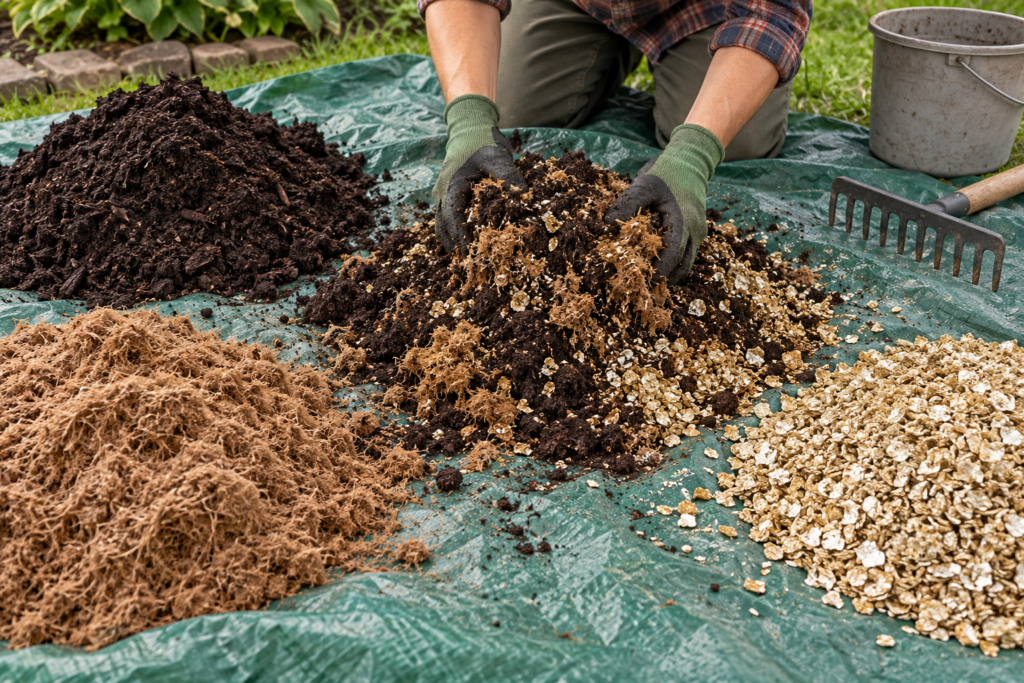
The revised method replaces native soil with a specific soilless blend, often called Mel’s Mix. The recipe is simple: equal parts by volume of compost, peat moss, and coarse vermiculite.
Each part plays a role:
- Compost provides nutrients and beneficial soil life. The method recommends blending compost from several different sources, such as mushroom compost, composted manure, leaf mold, worm castings, and homemade compost. Each type contains a different mix of nutrients, so blending several gives a broader, more balanced supply than any single source.
- Peat moss holds moisture and keeps the mix light and fluffy.
- Coarse vermiculite holds water and air in its layered structure, preventing the mix from compacting. The coarse grade works better than fine for this purpose.
Mix the three components thoroughly, ideally on a large tarp by folding and turning them together, and dampen the mix slightly as you go so the peat absorbs water evenly. Dry peat can be hard to wet once it’s in the box.
Working Out How Much You Need
A 4 x 4 ft box filled 6 inches deep holds 8 cubic feet of mix (4 x 4 x 0.5). With equal parts, that means about 2.7 cubic feet of each component. In metric terms, a 120 x 120 cm box filled 15 cm deep holds about 216 liters, or roughly 72 liters of each ingredient.
Adapting the Mix
Because the full mix can be expensive, especially for several boxes, many gardeners adjust it:
- Coconut coir replaces peat moss well, and many gardeners prefer it as a renewable alternative. It behaves similarly, though it may need a little more attention to nutrients.
- Perlite can replace some or all of the vermiculite. It improves drainage and aeration but holds less water.
- A quality topsoil and compost blend, such as the mixes sold for raised beds, is often cheaper in bulk and works well in slightly deeper boxes.
Whichever mix you use, the key qualities are the same: loose, rich in organic matter, able to hold moisture, and free-draining.
Feeding the Garden
The method relies on compost rather than bagged fertilizer. Each time you harvest a square, add a trowel or two of compost before replanting, and top up the whole box each spring. This keeps nutrient levels steady and replaces mix lost to settling and harvesting. Heavy feeders such as tomatoes, peppers, and squash can still benefit from an occasional liquid feed once they begin fruiting, especially later in a long season.
How Many Plants Per Square: The Spacing System
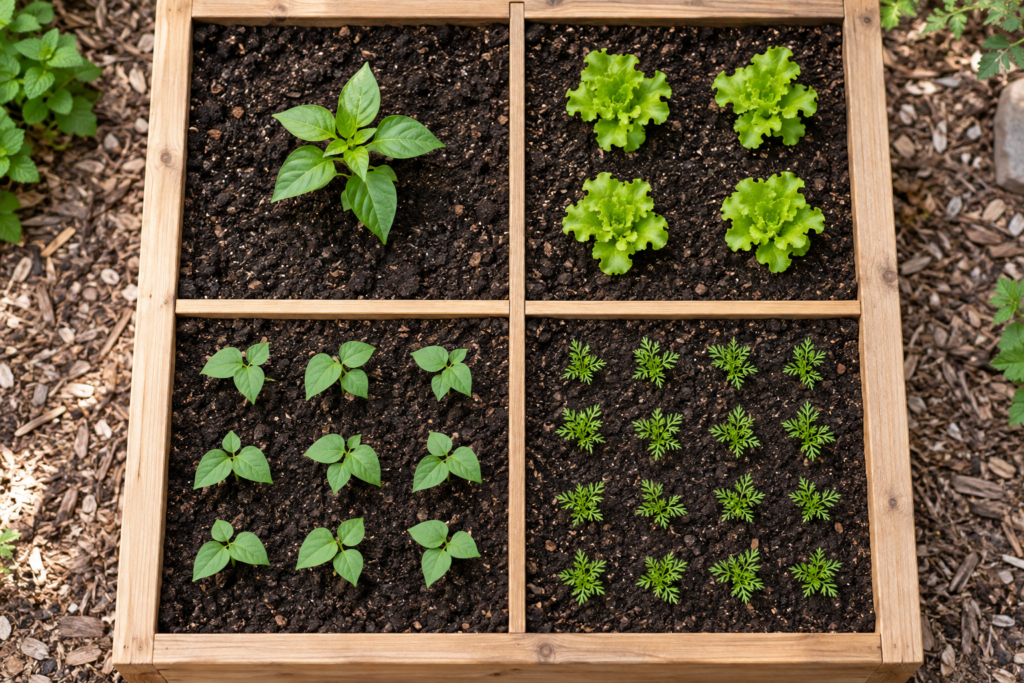
The spacing system is the heart of square foot gardening, and it’s simpler than it first appears. Each square holds 1, 4, 9, or 16 plants, based on how much space that crop needs at maturity.
How Many Plants Can You Grow per Square Foot?
Use the recommended spacing on a seed packet (the final “thin to” distance, not the row spacing) to find the number. Plants spaced 12 inches (30 cm) apart go 1 per square. At 6 inches (15 cm), plant 4. At 4 inches (10 cm), plant 9. At 3 inches (7.5 cm), plant 16. This works for almost any crop.
To place plants evenly, divide each square mentally or with your fingers:
- 1 per square: plant in the center.
- 4 per square: divide the square into four and plant in the center of each quarter.
- 9 per square: divide into a three-by-three pattern, like a tic-tac-toe board.
- 16 per square: divide into a four-by-four pattern.
Common Crops by Plants per Square
These are the typical groupings most square foot gardeners use:
- 1 per square: tomatoes (staked or trellised), peppers, eggplant, broccoli, cabbage, cauliflower, collards, head lettuce varieties that grow large
- 2 per square: cucumbers grown on a trellis
- 4 per square: leaf lettuce, Swiss chard, parsley, basil, celery, kohlrabi, marigolds, strawberries
- 8 per square: peas and pole beans planted along a trellis
- 9 per square: bush beans, beets, spinach, turnips, garlic, onions
- 16 per square: carrots, radishes, green onions (scallions)
Crops That Take More Than One Square
Some plants are too large for one square. Zucchini and summer squash usually need four to nine squares, depending on variety. Winter squash, pumpkins, and melons are better grown on a strong trellis at the back of the box, where they can take a single square at ground level and climb upward, or grown outside the box entirely. Large bush varieties of tomatoes may also need two squares instead of one.
The system works best when you choose compact varieties and train vining plants vertically. A single cherry tomato plant, pruned to one or two main stems and tied to the trellis, fits one square and produces heavily.
Planting, Harvesting, and Replanting Through the Season
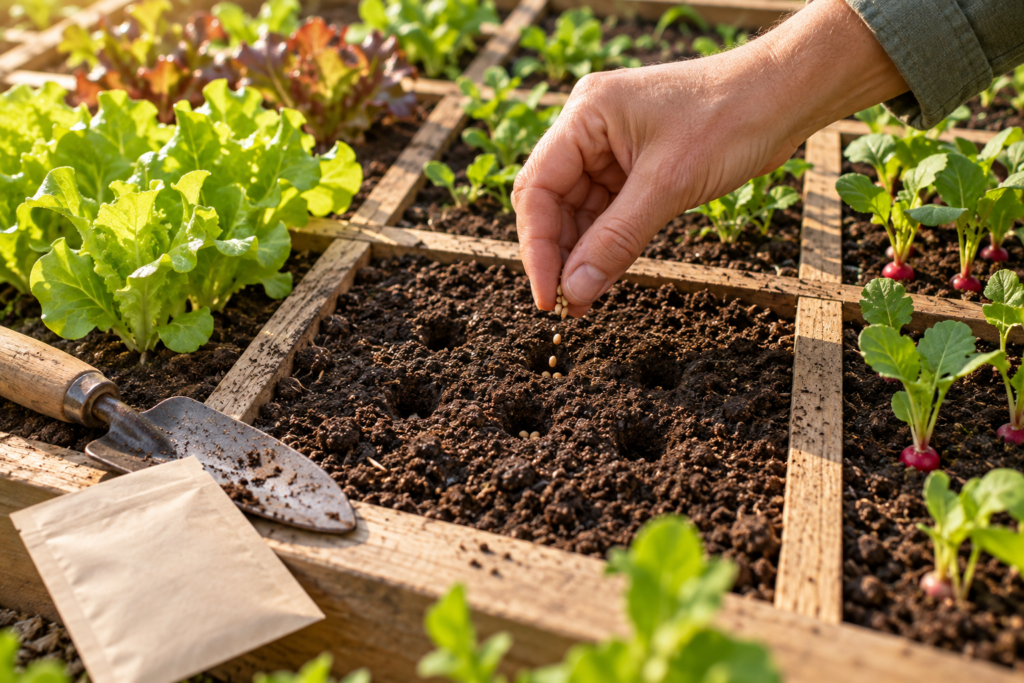
Once the box is built and filled, the rest of the method is a cycle: plan the squares, plant, harvest, and replant.
Planning Your Squares
Sketch the box on paper as a four-by-four grid and write a crop in each square before you plant. A few layout rules help:
- Tall and climbing crops go on the north side, along the trellis, so they don’t shade the shorter plants.
- Mix crops across the box. Avoid placing all squares of one crop together. Spreading crops out reduces the chance of a pest or disease moving quickly from plant to plant.
- Plant small amounts, often. One or two squares of lettuce sown every couple of weeks gives a steady supply rather than sixteen heads ready on the same day.
- Consider neighbors. Put sprawling crops like squash at a corner, where they can spill over the edge, and keep them away from small, low-growing crops that would be smothered.
How to Plant a Square
For direct-sown crops, use your finger or a pencil to make shallow holes at the right spacing for that square, following the depth on the seed packet. Drop two or three seeds into each hole, a pinch rather than a sprinkle, then cover lightly and water gently.
Once seedlings emerge, thin to one per hole by snipping the extras at soil level with scissors rather than pulling them, which can disturb the roots of the seedling you’re keeping. The method’s approach of sowing a small pinch per spot uses far fewer seeds than row sowing and nearly eliminates the tedious thinning of traditional gardens.
For transplants such as tomatoes, peppers, and broccoli, make a small hollow in the center of the square, set the plant in at the right depth, firm the mix around it, and water well. A shallow saucer-shaped depression around each transplant helps water collect near the stem.
Label each square, either with small plant markers or by keeping your paper plan updated.
Harvesting and Replanting
Harvest regularly and use cut-and-come-again techniques wherever possible. Pick the outer leaves of lettuce, chard, and kale, leaving the center to keep growing. Pull radishes and baby carrots as they size up, and pick beans and cucumbers often to keep plants producing.
When a square is completely finished, remove the old plant, loosen the mix with a trowel, add a trowel or two of compost, and replant immediately with a different crop. Changing the crop in each square every time you replant is the method’s built-in version of crop rotation, and it keeps nutrient use balanced across the box.
A Sample Year in One Box
A single 4 x 4 box can move through three plantings in one season in many climates:
- Early spring: peas on the trellis, spinach, leaf lettuce, radishes, green onions, and carrots.
- Summer: as spring crops finish, one or two tomato plants and cucumbers take over the trellis, with peppers, basil, bush beans, beets, and chard in the open squares.
- Late summer and autumn: as summer crops fade, squares are replanted with kale, fall lettuce, spinach, turnips, and radishes, with garlic planted in autumn for harvest the following summer.
Because every square turns over independently, the box rarely sits empty.
Watering, Maintenance, and Solving Common Problems
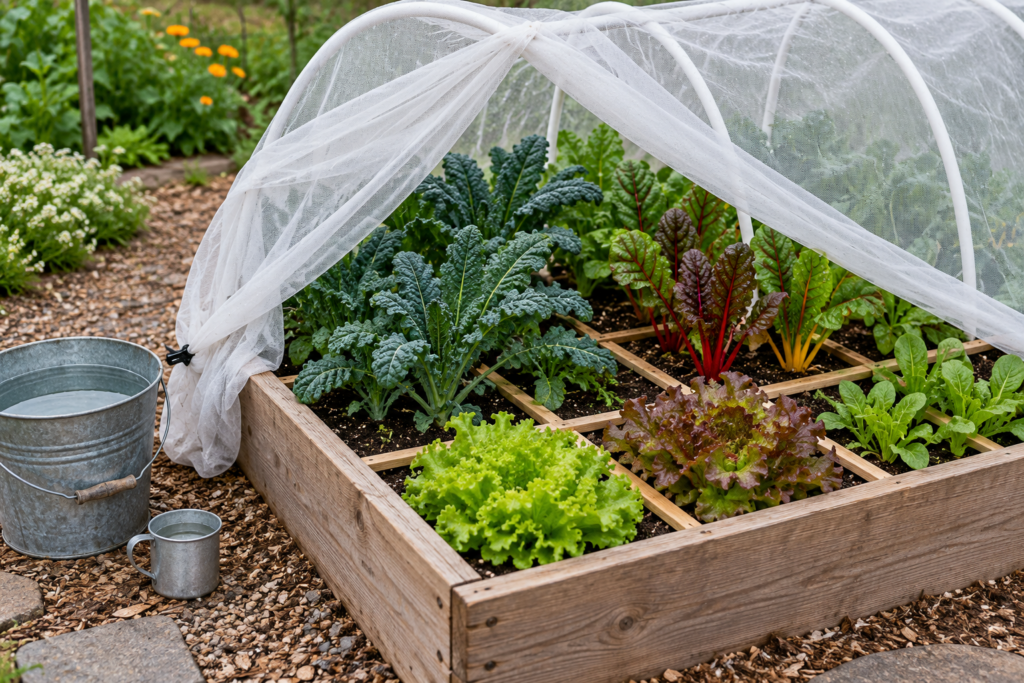
A well-built square foot garden is low-maintenance, but a few habits keep it productive and healthy.
Watering
The light, compost-rich mix holds moisture well, but a shallow 6-inch box can dry out quickly in hot weather. Check the mix daily in summer by pushing a finger an inch or two into it; if it’s dry at that depth, water.
The traditional method recommends watering by hand, using a bucket of water left in the sun to warm up, and ladling a cup or so at the base of each plant. This avoids chilling roots with cold water and keeps foliage dry, which reduces disease. Many gardeners today use a drip line or soaker hose laid along each row of squares, connected to a timer, which gives the same targeted watering with far less effort.
Morning watering is best, as it lets the surface and foliage dry before evening.
Weeds
Weeding in a square foot garden takes minutes rather than hours. The mix starts nearly weed-free, and dense planting shades out most seedlings. Pull any weeds while they’re tiny, when they lift out of the loose mix with almost no effort.
Protecting Crops
Square foot boxes are easy to cover because they’re small and uniform. A few simple structures handle most problems:
- Hoops and row cover. Bend flexible PVC pipe or wire into arches across the box and drape frost cloth or insect netting over them. This extends the season in spring and autumn and keeps pests like cabbage worms and flea beetles off crops.
- Wire mesh cages. A lightweight frame covered in chicken wire or hardware cloth, sized to sit on the box, keeps birds, rabbits, and pets out.
- Shade cloth. Stretched over the same hoops in midsummer, it keeps lettuce and spinach from bolting in the heat.
A clear plastic cover over the hoops or a cold frame lid sized to the box turns it into a mini greenhouse, letting you plant weeks earlier in spring and harvest later into autumn.
Common Square Foot Gardening Mistakes
Letting large plants overgrow their squares. A tomato left unpruned or a zucchini that isn’t a compact variety will spread across neighboring squares and smother them. Prune, train vertically, and choose compact varieties.
Removing the grid. Once the grid comes off, beds slide back into crowded, unplanned planting. Keep it on all season.
Planting too much of one crop at once. Sixteen squares of lettuce all ready in the same week defeat the purpose. Plant a little, often.
Forgetting the compost when replanting. Squares that are replanted without fresh compost gradually lose fertility, especially in a shallow box.
Skipping the trellis. Climbing crops left to sprawl take over far more than their share of the box. The vertical frame is a core part of the method, not an optional extra.
Letting the mix dry out. Peat and coir-based mixes are hard to rewet once they dry completely. Consistent watering keeps them easy to manage.
Once the box, grid, and trellis are in place, the garden becomes almost a puzzle you solve square by square through the year, and that sense of small, manageable decisions is exactly why so many people who struggled with row gardening stick with this method.
Frequently Asked Questions
What should I plant in my first square foot garden?
Start with easy, fast crops that suit the spacing system well: leaf lettuce, radishes, spinach, bush beans, green onions, basil, and one cherry tomato on the trellis. Add a pepper plant, a square of carrots, and a square of marigolds to attract pollinators. Keeping the first box simple makes it easy to learn the rhythm of planting, harvesting, and replanting.
Can you grow tomatoes in a square foot garden?
Yes. Plant one tomato per square along the trellis on the north side of the box, and train it upward by tying the main stem to the netting as it grows. Pinch out side shoots on vining varieties so the plant stays within its square. Compact bush and cherry varieties are easiest; large beefsteak types may need two squares.
Is square foot gardening good for children?
It’s one of the best gardening methods for children. Each child can take charge of a few squares, the grid makes planting instructions easy to follow, and fast crops like radishes and lettuce give quick results. A smaller 3 x 3 ft box (nine squares) is easier for young children to reach across, and tabletop boxes work well at school or in small yards.
How do you keep track of what’s planted in each square?
The simplest approach is a paper or digital plan of the box drawn as a grid, updated every time you plant or replant a square with the crop and date. Small plant labels in each square help too. Over time, these records show what grew well, when each crop was ready, and which squares need a different crop next time.
When should you start a square foot garden?
You can build and fill boxes any time the ground isn’t frozen, though late winter or early spring gives you time to be ready for the first plantings. Cool-season crops such as peas, spinach, lettuce, and radishes can usually be sown several weeks before your area’s last frost date. Warm-season crops like tomatoes and peppers go in after the last frost.
Can I do square foot gardening on a balcony or patio?
Yes. Build a box with a solid but drilled base, or a slatted base lined with landscape fabric, so the mix stays in while water drains away. Place it on blocks or legs to protect the surface beneath and allow airflow. Check balcony weight limits, since wet growing mix is heavy, and choose a position with at least six hours of sun for fruiting crops.
How long does square foot garden mix last?
A good growing mix lasts for many years and doesn’t need to be replaced. Adding compost each time you replant a square, and topping up the whole box every spring, keeps it fertile and replaces material lost to settling and harvesting. Only replace sections of the mix if they become badly contaminated with a soil-borne disease or pest.
Keep Learning
For more beginner help, see How to Start a Garden: The Complete Beginner’s Guide, How to Start a Vegetable Garden: Step-by-Step Guide for Beginners, and Shade Garden Ideas: Best Plants for Low-Light Areas.